Why do people use double negatives? And what’s the difference between a pidgin vs. a creole?
Here’s what happened this week in language and linguistics.

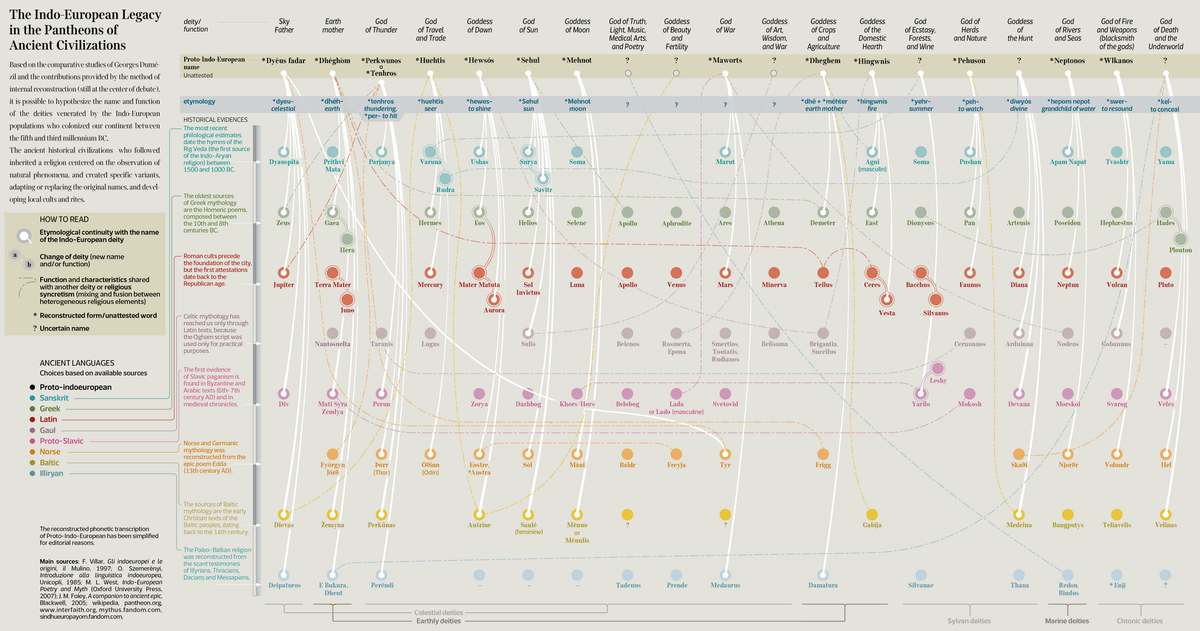
Happy Friday! Marco Giannini of Dataspoiler has made another beautiful infographic available, showing the reconstruction of the Indo-European deities and their names. Pretty incredible!
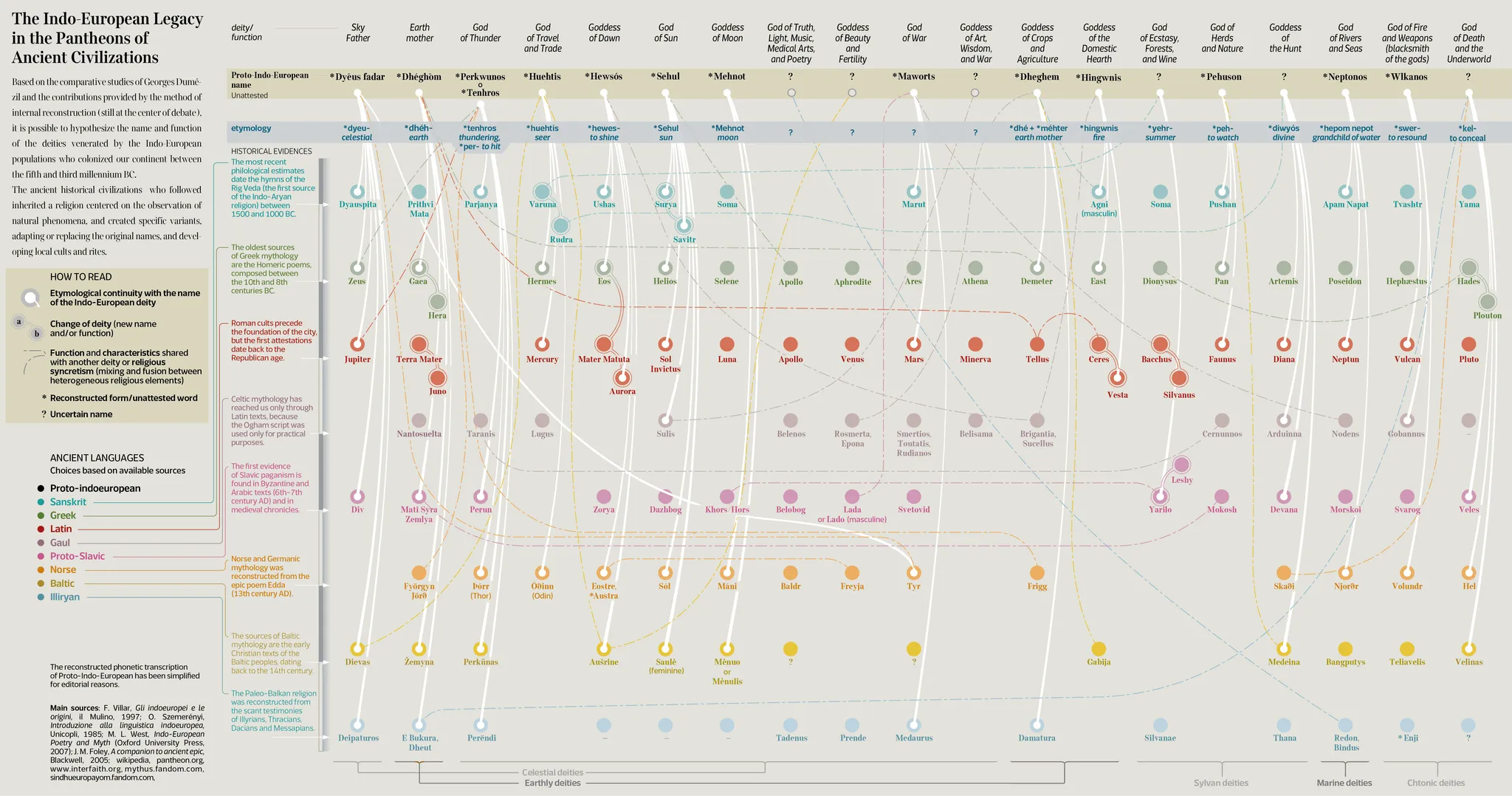
For more details about the graphic, check out the caption and comments on Instagram:
Welcome to this week’s edition of Discovery Dispatch, a weekly roundup of the latest language-related news, research in linguistics, interesting reads from the week, and newest books and other media dealing with language and linguistics.
🆕 New from Linguistic Discovery
This week’s content from Linguistic Discovery.
The etymology of ‘one’ from Proto-Indo-European to Modern English
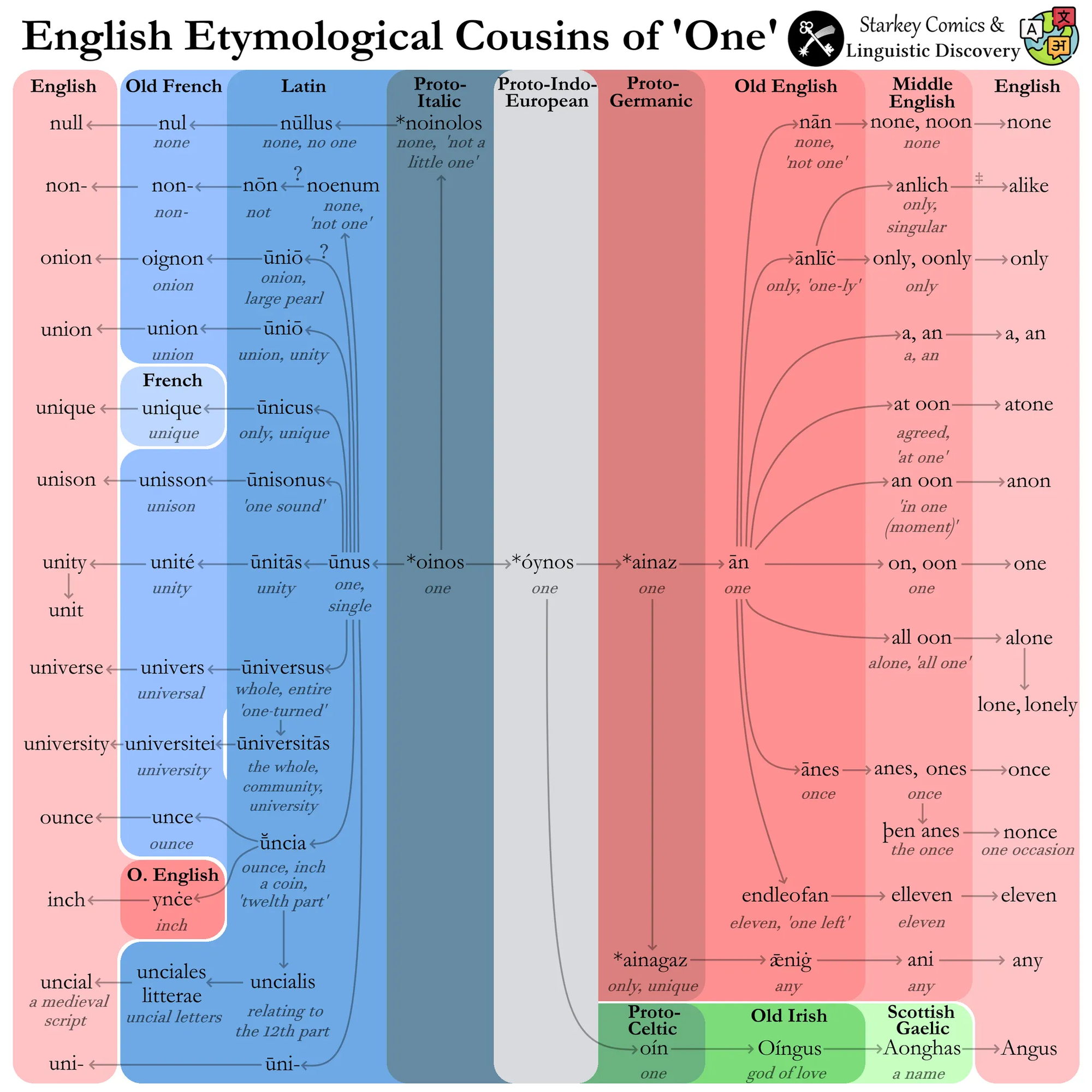
At long last, my thank-you post for 1,000 readers has arrived! I take you on an etymological journey through the manifold histories of the word for ‘one’ (for 1,000!) from Proto-Indo-European 6,000 years ago to all the subtle ways that root is hidden in English today.
And as an extra special treat, I collaborated with Ryan Starkey of Starkey Comics to put together this beautiful etymological infographic! The article walks you through all the steps in the infographic, as well as what we can learn from all this about how language changes.
The article represents over two months of work! I hope you enjoy reading it as much as I did writing it. And if you’d like to show your appreciation—and support my work on the next thank-you issue for the 2,000-subscriber milestone!—you can become a Linguistic Discovery supporter for $5/month (USD). You’ll get early access to chapters of my book, plus the occasional bonus article (such as the upcoming issue, “Do Inuit languages really have more words for snow?”). Your support is tremendously appreciated 🙏
 Daniel W. Hieber, Ph.D.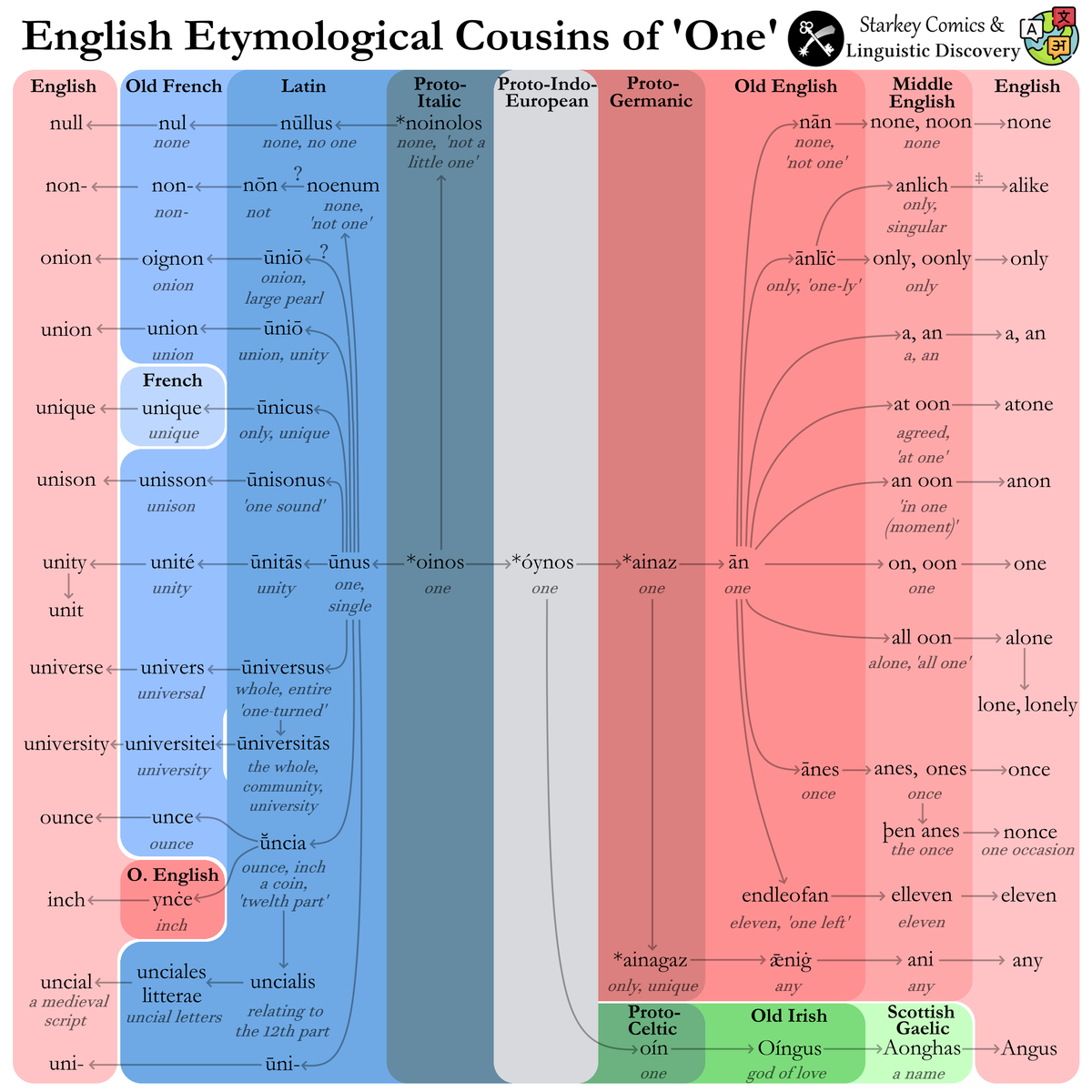
The Negation Cycle


In the article on ‘one’ I talk a bit about The Negation Cycle, and I recently expanded that into a thread for social media as well. Here’s the text of that thread:
Words lose their novelty with repeated use.
The more frequently a word is used, the faster this happens.
When a word becomes less novel, speakers have to reinforce its meaning with other, sometimes seemingly repetitive words.
This is why people use double negatives!
The second negative isn’t negating the first; it’s reinforcing the first.
Let’s look at some examples:
In Spanish, double negation is obligatory. Saying the sentence “¡No toques nada!” ‘Don’t touch anything!’ any other way would either change its meaning or make the sentence ungrammatical.

Why is Spanish this way? Because Spanish descends from Latin, and Latin was a double negation language too! Surely if the prestigious Latin language used double negatives, we can tolerate them in English.
Another example comes from French. In French, there are two particles both meaning ‘not’—ne and pas—and up until recently you had to use both to negate a sentence: je ne dis pas ‘I don’t say’.
Recently, however, the older negative ne has become so semantically watered down from repeated use that speakers omit it entirely, saying je dis pas ‘I don’t say’.
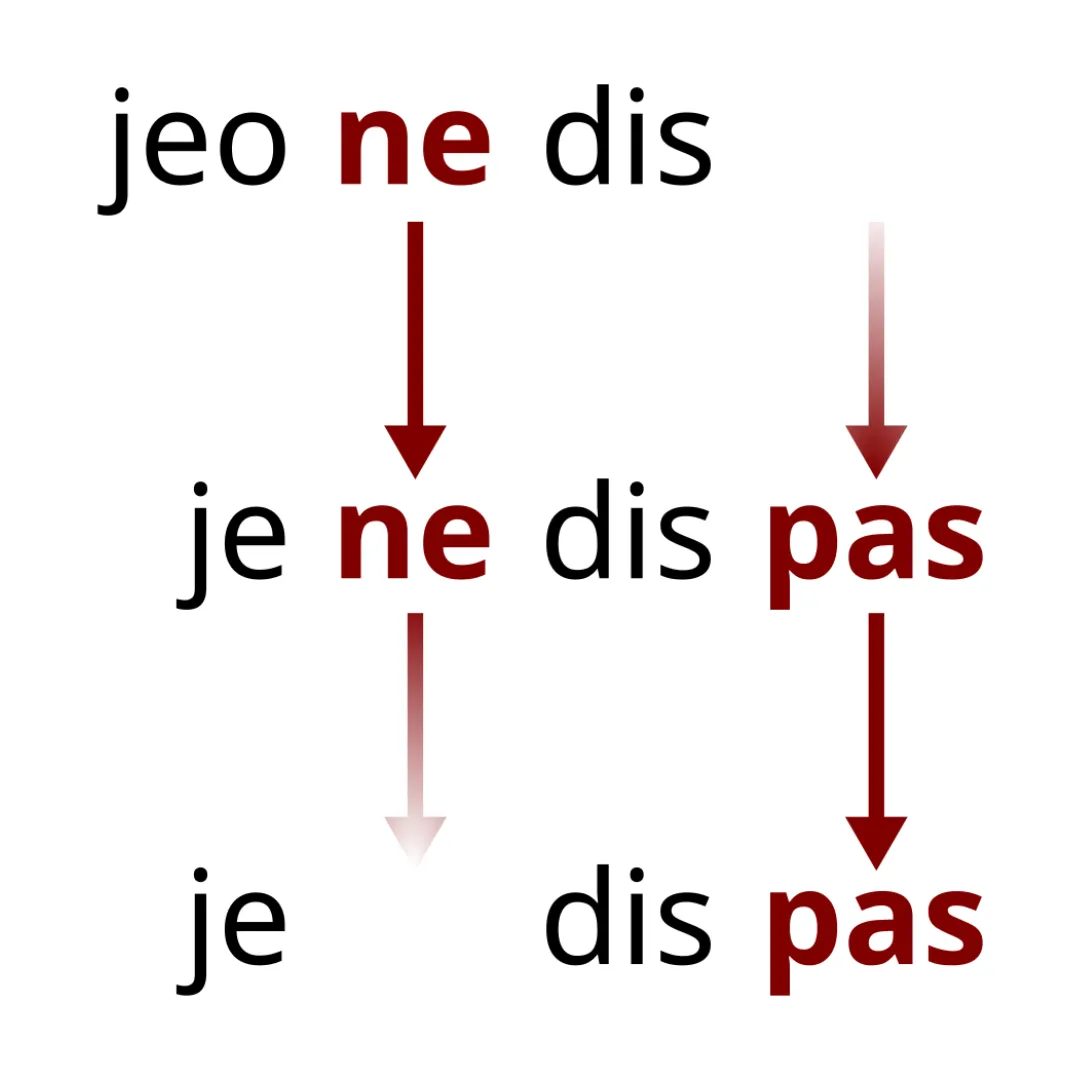
This process of replacing negatives is so common that linguists even have a term for it: The Negation Cycle, or Jespersen’s Cycle (after linguist Otto Jespersen).
I think it’s important to understand what double negation is really about, not only because it gives one a better understanding of how language works, but because it shows that it’s not just some slovenly linguistic behavior signaling a lack of education. Multiple negation is actually quite principled and reasonable.
Why English needs y’all
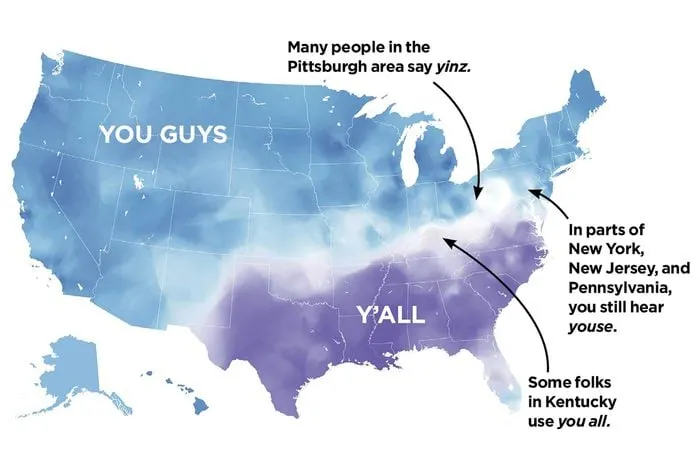
Landon Bryant (@LandonTalks) recently discussed y’all on his channels, so I joined the conversation with a little backstory about why English needed to come up with y’all in the first place. That is, why doesn’t English have a standard plural for you like most other languages? My can read my quick little article about it here:
 Daniel W. Hieber, Ph.D.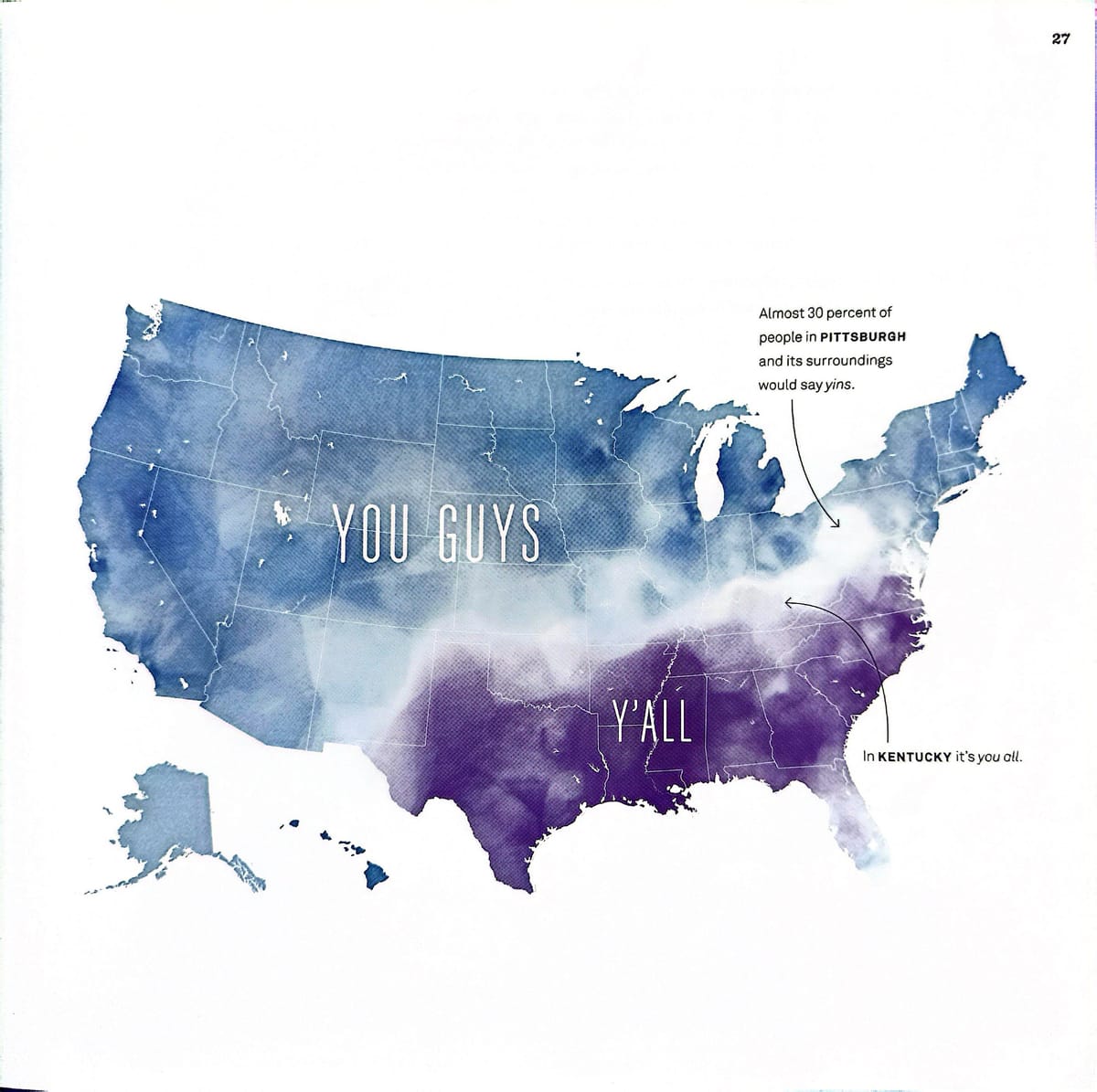
Or watch the video version here:
📰 In the News
Language and linguistics in the news.
Twins Paula and Bridgette Powers recently went viral for speaking in unison on television, captivating global audiences:
But why do some twins talk in unison like this? Researchers Jeffrey Craig and Nancy Segal explain this fascinating phenomenon in an article for The Conversation:
 Jeffrey Craig
On the topic of twins with incredible linguistic abilities, International Business Times also has an article about twins Matthew and Michael Youlden, who speak 26 languages (each), as well as their own private language, Umeri—a conlang of sorts. The Youlden twins are exceptional even among twins, but creating a private language like this is actually fairly common for twins; between 30–50% of twins create their own languages.
 Priya Walia
🗞️ Current Linguistics
Recently published research in linguistics.

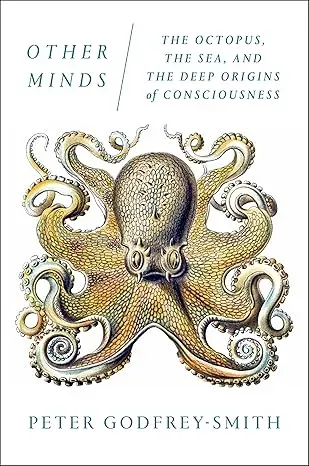
Researchers who were studying two species of cuttlefish recently noticed that the cuttlefish seemed to be making gestures at one another. They tested this by playing video recordings of those gestures to the other cuttlefish, and found that the cuttlefish watching the video responded with another gesture, and not necessarily the same one, indicating that they were not simply mimicking what they saw. The researchers have no idea what these gestures mean, but the cuttlefish behaviors do seem to suggest that the gestures are in some way information-bearing.
 Chris Simms
 Find this author on Google Scholar
Fun Fact: The name of the color sepia comes from the Greek sēpia ‘cuttlefish’, because they made an ink using cuttlefish secretions, and that ink was sepia-colored. That’s also the source of Spanish xibia and French seiche.
📃 This Week’s Reads
Interesting articles I’ve come across this week.
pidgins vs. creoles
What’s the difference between a pidgin and a creole? The Babbel blog explains:
 Steph Koyfman
I’ll offer one small constructive criticism of that article: It defines creoles as follows:
Creole: A stable, fully developed language that arises from a pidgin when it becomes the first language of a community.
However, not all creoles develop from pidgins! For starters, for a number of creoles there’s no historical documentation suggesting they began as pidgins. But more importantly, an increasing number of linguists have come to view creolization as a process of language change that involves a significant degree of adult language learning—which can happen both with pidgins and in situations of intense contact between two language communities (McWhorter 2019). Because adults are inferior to infants when it comes to language learning, the result is a simplification of the languages that are in contact.
Moreover, because creolization is a process, there can be degrees of creolization. Some linguists even argue that English underwent a moderate degree of creolization during the period after the Norman Conquest in 1066. In this period, called Middle English, English lost much of its morphological complexity and took on a myriad amount of vocabulary from French—so much that French might be considered a lexifier language (the language that provides the majority of the vocabulary in a situation of language contact, usually the sociopolitically dominant one).
That one criticism aside, the Babbel article is great and worth a read.
I also have a shortform video on the difference between pidgins, creoles, and mixed languages if you’d like to see how I presented the difference:
Other Reads
The Duolingo blog answers a great question from a reader: “Are any languages ‘unique’?”. I thought author Olivia Thayer did a nice job pointing out some fun and rare features of different languages in the article:
 Olivia Thayer
Xenolinguistics has become a hot topic in the last couple years! This week we’ve got an Aeon article from philosopher of language Nikhil Mahant (Uppsala University) about what xenolinguistics might teach us about human language and how we can prepare for first contact:


🗃️ Resources
Maps, databases, lists, etc. on language and linguistics.
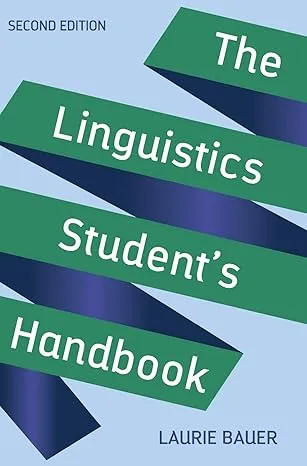
If you’re studying or want to study linguistics, here’s a small list of books specifically for students of linguistics:

That’s all for this week! Lots of interesting things about primate communication coming next week! Hope y’all have a great weekend!
~ Danny
📑 References
- McWhorter, John. 2019. Creoles. In Anthony P. Grant (ed.), The Oxford handbook of language contact (Oxford Handbooks in Linguistics), 282–302. Oxford University Press. https://doi.org/10.1093/oxfordhb/9780199945092.013.13.
If you'd like to support Linguistic Discovery, purchasing through these links is a great way to do so! I greatly appreciate your support!
Check out my entire Amazon storefront here.