China lays claim to Austronesian languages
Also this week: The Linguistics of a Showgirl: How Taylor Swift’s accent has changed over time + We will soon be able to talk with other species—but which one will be first?

Welcome to this week’s edition of Discovery Dispatch, a weekly roundup of the latest language-related news, research in linguistics, interesting reads from the week, and newest books and other media dealing with language and linguistics!
🆕 New from Linguistic Discovery
This week’s content from Linguistic Discovery.
Useless etymology: Offbeat word origins for curious minds
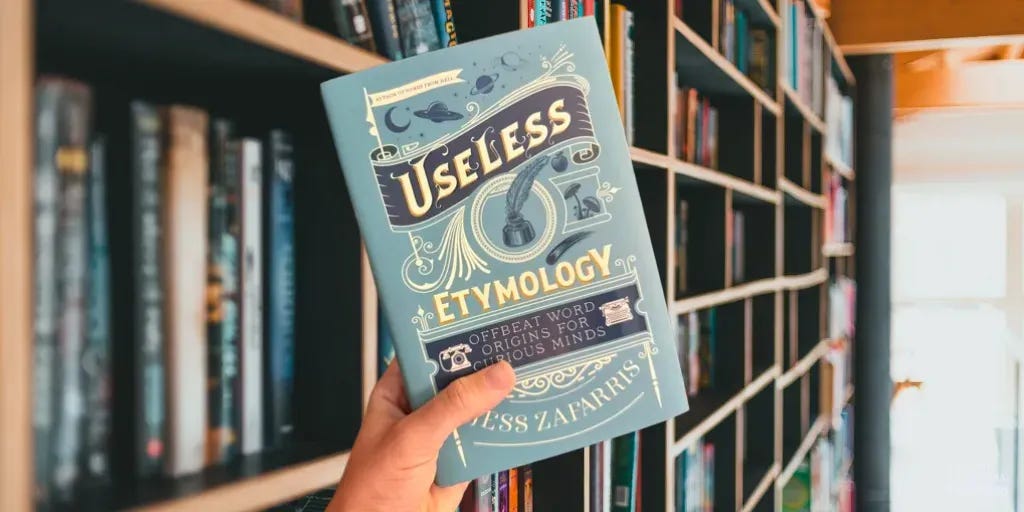
Jess Zafarris’ new book, Useless etymology: Offbeat word origins for curious minds, was released on Tuesday, and Jess kindly agreed to share an excerpt of the book with Linguistic Discovery readers! Learn all about eponymous etymology here:
 Daniel W. Hieber, Ph.D.
Jess is a fellow content creator (TikTok, Instagram), cohost of the wonderful Words unravelled podcast (YouTube, Spotify, Apple), and author of the books Words from hell: Unearthing the dark secrets of English etymology and Once upon a word: A word-origin dictionary for kids. Her writing is always fun, effervescent, and super accessible.
Jess sent me an early review copy of Useless etymology, and it’s a absolute treat to read. She had been wanting to write this book for years, and the culmination of those years of rooting around in etymology (her pun, not mine) and cogitating about it really shows. The result is a book that is more than just a collection of assorted factoids (or factlets if you’re feeling pedantic); instead, it’s a fascinating look at the themes and lessons we can take from etymology.
I highly recommend procuring yourself a copy of the book at one of the links below:
Metaphors for linguistics
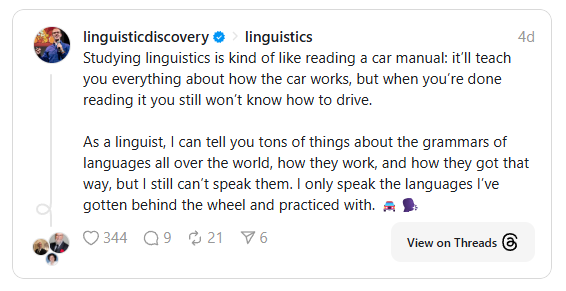
I was talking to an acquaintance this week and came up with what I think is a great analogy to explain what linguistics is about:
Studying linguistics is kind of like reading a car manual: it’ll teach you everything about how the car works, but when you’re done reading it you still won’t know how to drive.As a linguist, I can tell you tons of things about the grammars of languages all over the world, how they work, and how they got that way, but I still can’t speak them. I only speak the languages I’ve gotten behind the wheel and practiced with. 🚘🗣️

Head on Fire
Here’s the last of my podcast interviews from recent years, this time with Don Martin, author of several books, most recently the young adult novel Verity Vox and the curse of Foxfire, and the nonfiction book Where did everybody go? Why we’re lonely but not alone. He also hosts the Head on Fire podcast, where we chatted about language documentation, language endangerment, the surprising differences between languages, and prescriptive vs. descriptive approaches to language—among other topics! Have a listen at the links:
📰 In the News
Language and linguistics in the news.
Race Across the World

A word which baffled the producers of the latest series of Race Across the World is among 10 Welsh words to be added to the Oxford English Dictionary in its latest update. Fin Gough and Sioned Cray confused Race Across the World producers with the word poody earlier this year.


China lays claim to Austronesian languages

I’m going to quote from this article extensively because it covers the topic well and provides good background for understanding it:
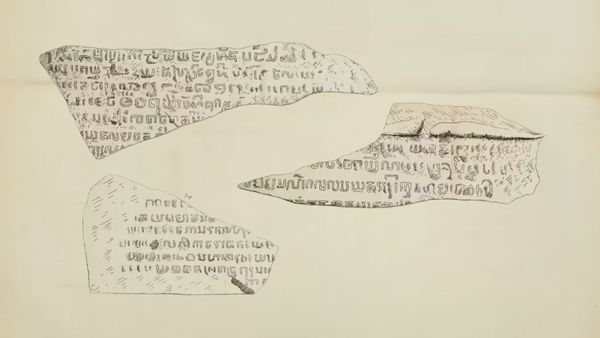
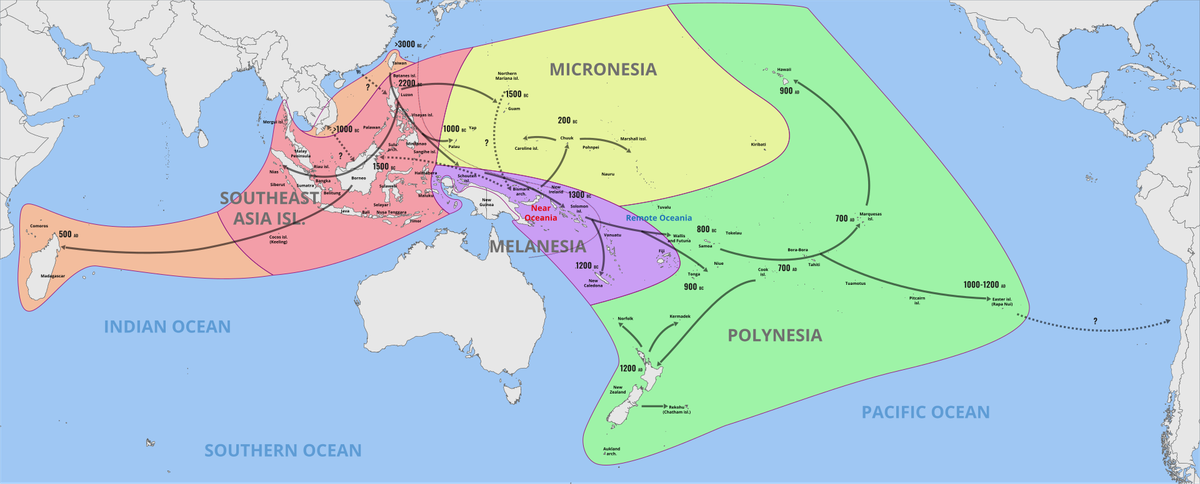
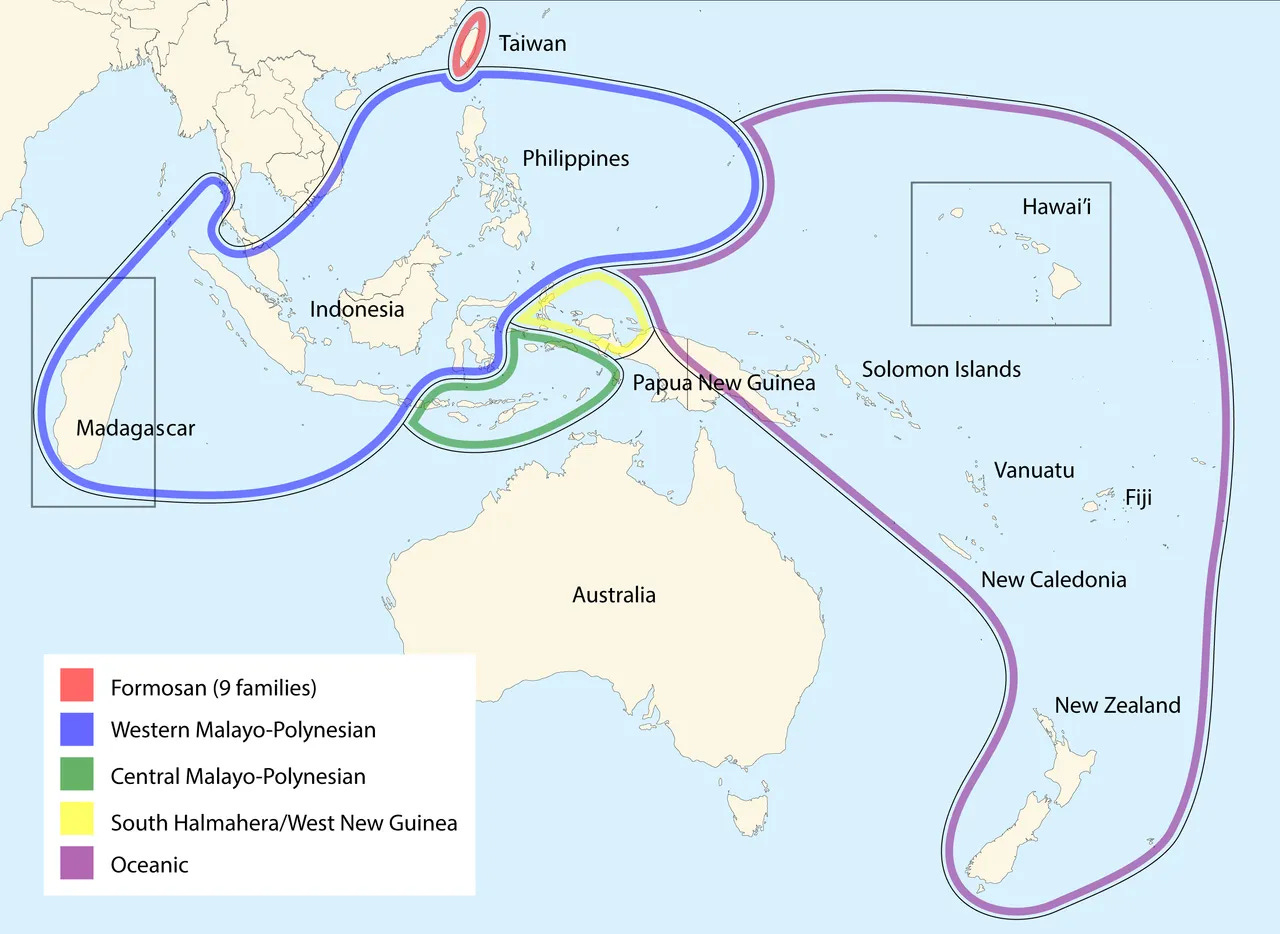
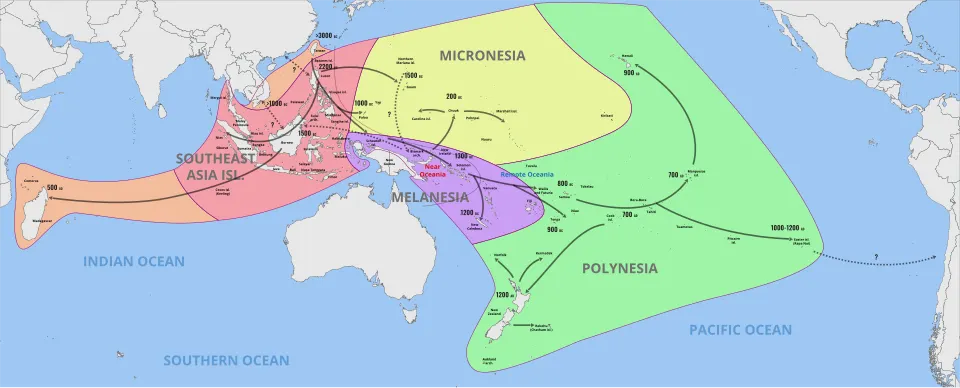
A newly opened museum in China appears to be devoted to the origins of the Austronesian-speaking peoples, who some 5,000 years ago spread from East Asia across the Pacific, seeding it with a distinctive culture and some 1,200 languages.
Since the 1980s, most archaeologists and historical linguists have thought Austronesian languages and culture first developed in Taiwan some 5000 years ago, then spread southward through the Philippines into the Pacific. But Chinese researchers working in Fujian are challenging the “out-of-Taiwan” hypothesis, arguing that the language family and associated culture developed in mainland China, on Pingtan and the nearby coast. In recent papers and in museum exhibits, they claim that artifacts and remains excavated there resemble those of early Austronesian speakers found in Taiwan.
That picture, largely dismissed by archaeologists elsewhere, reinforces claims that Taiwan was part of China from the beginning. “Language is regularly used to legitimize a shared cultural history,” says Marian Klamer, a linguist specializing in Austronesian and Papuan linguistics at Leiden University. “I think that plays a role here as well.”
Linguistic evidence, too, overwhelmingly points to Taiwan as the cradle of Austronesian languages and their related culture, says Malcolm Ross, a linguist at the Australian National University. The language family is divided into several primary branches: All Austronesian languages outside Taiwan belong to a single subgroup, Malayo-Polynesian, whereas Taiwan alone contains multiple distinct subgroups. The island is uniquely diverse, says historical linguist Hsiu-Chuan Liao of National Tsing Hua University. “For example, mata is the word for ‘eye’ in most Austronesian languages, but in Taiwan you also find matsa, maca, and mtsoo.” Such variation can only be explained if the language family began diverging on the island.
- China bolsters controversial claim to Pacific languages with new museum (Science)
 Contributors to Wikimedia projects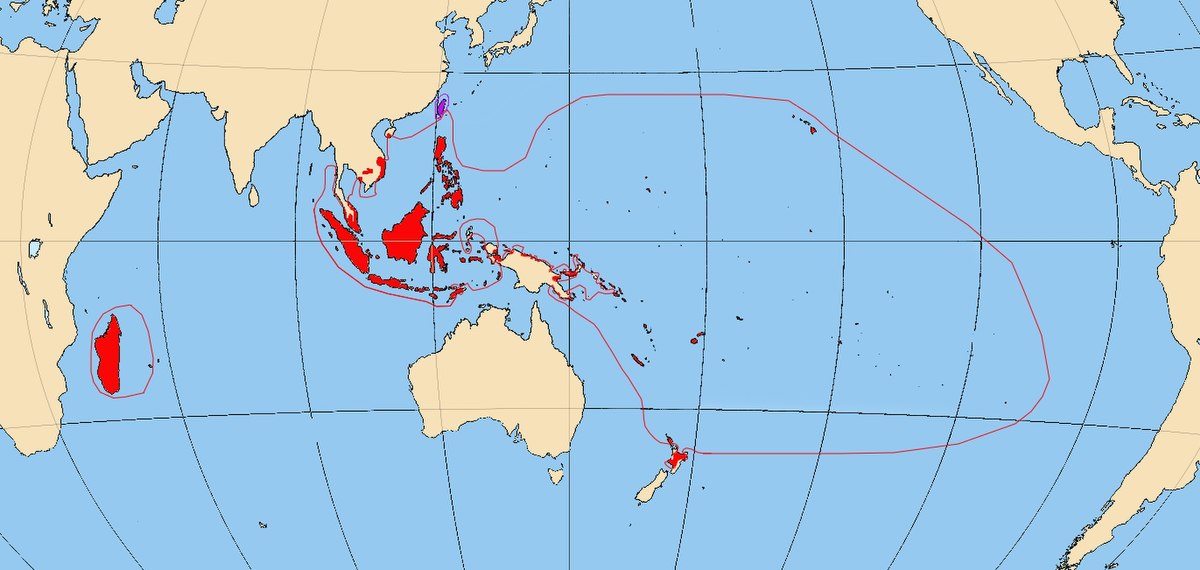
🗞️ Current Linguistics
Recently published research in linguistics.
The Linguistics of a Showgirl

An analysis of Taylor Swift’s interviews from three different eras of her career (and I don’t just mean the Eras Tour) show that her accent has shifted over time, from a notably Southern accent to now one that reflects the Pennsylvania dialect where she grew up. This confirms what people have long noted—“that Swift had a fairly marked shift in her pronunciation once she moved to Tennessee and then back to Pennsylvania again.”
This study is an excellent example of how the way we speak can change even as adults, when we tend to think of our language as fairly stable. And if you want to learn more about the kinds of changes in language that happen over the course of individual lifespans, I’ve got an entire article that teaches you about exactly that:
 Daniel W. Hieber, Ph.D.
Reporting:
 Mohana Basu
 Sinead Butler
Research Article:
Mohamed & Winn. 2025. Acoustic analysis of Taylor Swift’s dialect changes across different eras of her career. Journal of the Acoustical Society of America 15: 2278–2289. DOI: https://doi.org/10.1121/10.0039052.
Genetics reflects how languages mixed in the past
Here’s some additional reporting from Scientific American of the study I covered a few weeks back, on how genetic intermixing of populations mirrors their linguistic intermixing, in the form of borrowed vocabulary and grammatical structures.
 Cody Cottier
- Research Article: Graff et al. 2025. Patterns of genetic admixture reveal similar rates of borrowing across diverse scenarios of language contact. Science Advances 11(35). DOI: https://doi.org/10.1126/sciadv.adv7521.
📃 This Week’s Reads
Interesting articles I’ve come across this week.
 #author.fullName}
- Dr. Erica Brozovsky explains what folk etymologies are and how they work.
 Tim Seyrek
 Rachel Feltman, Allison Parshall, Jeffery DelViscio
- This is some additional reporting on Adam Aleksic’s (@EtymologyNerd) new book Algospeak: How social media is transforming the future of language (Amazon | Bookshop.org)
- Deborah Tannen on how her love for language began (The Washingtonian)
- Deborah Tannen is the author of the widely acclaimed books You just don’t understand: Women and men in conversation, as well as Talking from 9 to 5: Women and men at work, and several others.
- Māori language: A renaissance at risk? (Babel: The Language Magazine, No. 52)
📚 Books & Media
New (and old) books and media touching on language and linguistics.
The search for the perfect language
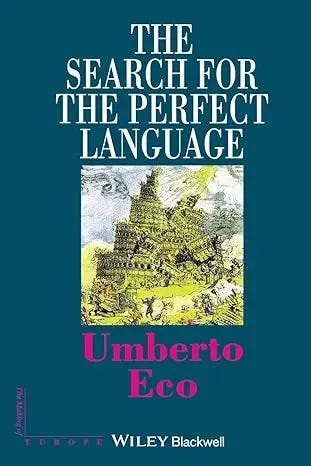
Here’s an older but fun book by Umberto Eco all about the philosophy, motivation, and mindset behind conlanging (inventing languages).
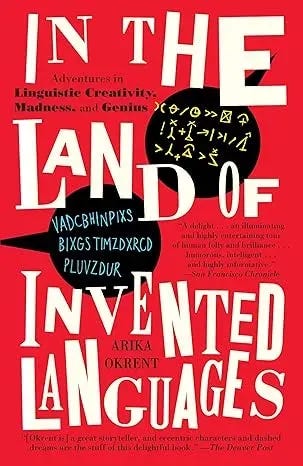
Another excellent, more recent book on the same topic is In the land of invented languages by Arika Okrent:
A language I love is…

I discovered a newer podcast recently and wanted to recommend it to y’all. A language I love is… hosts a different language expert each week and focuses on a different language, asking three key questions:
- What is your story and connection to this language?
- What do you love about this language?
- What is something you want the audience to know about this language?
It’s got rave reviews on all the podcast platforms so far too.
It’s hosted by Danny Bate, author of the new book Why Q needs U: A history of our letters and how we use them, which you can read an excerpt of in this issue of the Linguistic Discovery newsletter:
 Danny Bate
🗃️ Resources
Maps, databases, lists, etc. on language and linguistics.
Linguistics League
Linguistics League is a worldwide organization of volunteers creating programming and resources for teens interested in linguistics. They have a quarterly newsletter and provide resources on how to start your own linguistics club in your school.

👋🏼 Til next week!
If you’d like to support Linguistic Discovery, purchasing through these links is a great way to do so! I greatly appreciate your support!
Check out my entire Amazon storefront here.