Do all cultures use baby talk?
Or is baby talk just something that white middle class Americans do?

If baby talk helps children learn language better or faster, as we saw in the previous post in this series, it stands to reason that parents would instinctively use it. But if not all parents and cultures use it, how important could it really be?
In this issue of my series on the science of talking to tiny humans, we’ll look at claims that some languages don’t use baby talk and see whether they hold up to scrutiny. Check out the rest of the series at the links below, and sign up to get notified when subsequent issues are published!
ℹ️ Articles in this Series
- Part 1: Why you should be talking to your infant
- Part 2: What’s the point of baby talk?
- Part 3: Is baby talk good for your child?
- Part 4: Do all cultures use baby talk? [this post]
- Part 5: Baby talk in the languages of the world [forthcoming]
- Part 6: How much should you talk to your child?
- Part 7: What really matters when talking to your child
Is baby talk just a weird American habit?
There’s plenty of opportunity for motivated reasoning all around when it comes to opinions on the universality of baby talk.
Many people—some linguists included—think that baby talk is a uniquely Western phenomenon, or that it’s limited to well-educated, white, middle-class parents, or that it’s some weird thing that only Americans do. Here’s an example from a pop linguistics book about child language acquisition from 2006:
If anything, motherese reveals more about parents than children: it is a peculiar cultural phenomenon in modern Western industrialized societies, not part of the universal and biological foundation of language. (Yang 2006: 89)
A Scientific American article from 2017 proclaims that “Parents in a remote Amazon village barely talk to their babies” and that “Ignoring a Western child-rearing practice does not seem to matter for the Tsimané of Bolivia” [emphasis added].
At the outset, we should be suspicious of the idea that only educated white parents participate in an activity that demonstrably improves their children’s language outcomes (as we saw in the last issue in this series). Such a narrative appeals to implicit ethnocentric, racist, or classist biases, so it’s worth approaching these claims with some healthy skepticism. Indeed, the vast majority of research in child language acquisition has been conducted on precisely this predominantly white, Western demographic (Nielsen et al. 2017), so even if baby talk does exist in other communities (and it does), it’s quite likely that Western scholars wouldn’t have been aware of it (and they weren’t for some time).
Of course, the notion that baby talk is unique to Western culture also appeals to cultural relativists, who are (quite reasonably) cautious of imposing Western perspectives and assumptions on the analysis of other cultures. Yet this too can be an ideologically-motivated position, one based less on scientific caution and more on anti-Western or anti-colonial sentiments. The risk that comes from adopting this position, however, is undue exoticization or romanticization of other cultures. So there’s plenty of opportunity for motivated reasoning all around when it comes to opinions on the universality of baby talk.
For example, widely-reported studies with communities like the Tsimane in the remote Amazon of Bolivia (mentioned by the Scientific American article above; Cristià et al. 2017), the Yucatec Maya in Mexico (Shneidman & Goldin‐Meadow 2012), and the Kaluli in Papua New Guinea (Schieffelin 1990) led some to claim that these and presumably other cultures essentially lack baby talk. In each case, however, it turns out that child-directed speech (CDS) is simply less frequent, occurs later in development, or works differently than it does in Western/American communities. As research into child language acquisition has broadened to include cultures across the world in the last several decades, it’s become increasingly clear that CDS is not limited to white, educated, middle-class families.
Baby talk in other languages
While baby talk is important for child language development, the exact timing of when children receive it is relatively less important.
Consider the Kaluli people of Papua New Guinea, for example. The Kaluli are sometimes claimed not to have baby talk because young children among the Kaluli are not viewed as having their own intentions. By tradition, however, when infants first use the words for ‘mother’ and ‘breast’, parents very intentionally begin to “teach the child to talk”. They do this by speaking for the child using a special high-pitched, very nasal voice register. Adults spend a lot of time “talking for” children, holding them up to face the addressee and then saying what the child ought to say in that situation, and frequently using the word ɛlɛma ‘say it like this’ (Ochs 1982; Schieffelin 1990). Here’s an example of what this looks like in practice, where a mother is teaching her son, Wanu, how to interact with another child, Binalia (adapted from Ochs & Schieffelin 2009: 306–307):
| Speaker | Kaluli | English |
|---|---|---|
| Mother (to Wanu) | Abɛnowo? Ɛlɛma. | Whose is it? Say it like that. |
| Wanu (to Binalia) | Abɛnowo? | Whose is it? |
| Mother | Gɛnowo? Ɛlɛma. | Is it yours? Say it like that. |
| Wanu | Gɛnowo? | Is it yours? |
| Mother | Ge oba? Ɛlɛma. | Who are you? Say it like that. |
| Wanu | Ge oba? | Who are you? |
| Mother | Gi suwo? Ɛlɛma. | Did you pick it? Say it like that. |
| Wanu | Gi suwo? | Did you pick it? |
| Mother | Ni nuwɛ sukel! Ɛlɛma. | My grandmother picked it! Say it like that. |
| Wanu | Ni nuwɛ sukel! | My grandmother picked it! |
| Mother | We ni nuwɛ sukel. Ɛlɛma. | This my grandmother picked! Say it like that. |
| Wanu | We ni nuwɛ sukel. | This my grandmother picked. |
This is different from what baby talk looks like in other cultures, but it has the same function of adjusting one’s speech in a way to make it both attention-grabbing and comprehensible to the child.
Another culture sometimes claimed not to use baby talk is that of the Tsimane people of Bolivia. A 2017 study found that Tsimane parents speak to young children for less than one minute every hour (Cristià et al. 2017), which is only about ⅒ the amount of time that U.S. mothers speak to their children of the same age. The graph below shows the average minutes per hour of CDS received by Tsimane children at different age ranges. As you can see, the amount of CDS received stays pretty minimal until about age 4.
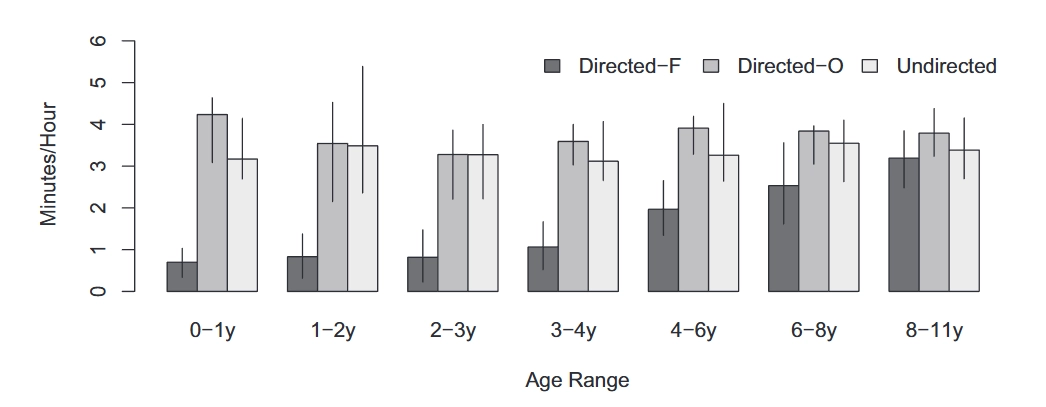
The reason for this, tragically, may be the high infant mortality rate in the community. Fully 13% of infants die in their first year, mainly due to infectious diseases (Smith 2017). As a result, parents may try not to be as emotionally attached to their children. Many children aren’t given names until after their first birthday (Smith 2017).
Whatever the cause, this study led Scientific American to proclaim that, “Parents in a remote Amazon village barely talk to their babies”. The researchers also noted (anecdotally), that this relative dearth of child-directed speech seems to have a dilatory effect on child language development, so that children begin to speak later than their U.S. counterparts (Smith 2017).
But if we burrow into the details of the study a bit further, we find that the Scientific American headline lacks some important context (which they do admittedly provide in the article). Firstly, Tsimane children overhear adult speech for about 7 minutes/hour (Smith 2017), which matters because cultures vary as to how much learning happens through direct instruction and modeling versus observation and mimicry. Secondly, sometimes differences in the amount of child-directed speech that infants receive is partly due to differences in overall talkativeness across cultures. Accounting for these differences greatly reduces discrepancies in how much CDS infants hear across cultures (Cristià et al. 2017: 761).
Lastly, we can’t actually compare the results of this study to any others, because they use widely differing methods for measuring the amount of CDS that children hear. This study focuses explicitly on 1-on-1 speech, whereas it’s unclear whether previous studies included overheard speech or speech directed at a group that the child just happened to be part of. It could actually be that CDS rates in other studies and even U.S. households look similar once the same methods are applied. These methodological differences are so significant that it leads the authors to state:
The evidence on who talks to infants is extremely scarce at present. […] Further work employing homogeneous, cross-culturally appropriate methods is needed to more accurately measure the extent of this variation and to make strict comparisons possible. Therefore, we do not attempt direct comparisons. (Cristià et al. 2017: 767)
Moreover, even though children aren’t receiving much directed speech in their early years, they are hearing a great deal of CDS as they move out of infancy. This pattern was also documented among the Yucatec Maya, who hear significantly less child-directed speech than children of the same age in the U.S. (Shneidman & Goldin‐Meadow 2012)
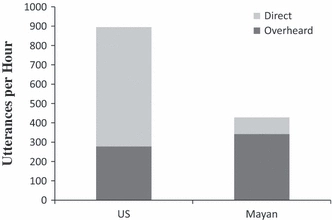
But in their second and third years, Maya children hear an increasingly large amount of CDS, eventually matching that of U.S. children by about 35 months:
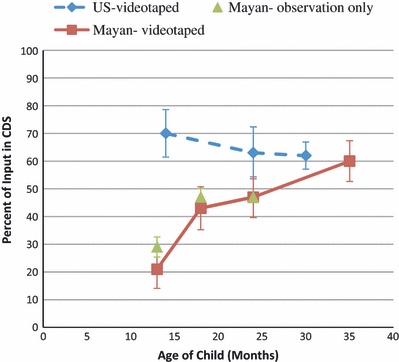
This study demonstrates that directed speech doesn’t have to happen within the first year or so to be effective. The authors found that the number of word types used by Maya adults in their child-directed speech at 24 months predicted the children’s vocabulary size a year later. So while CDS is important for child language development, the exact timing of when children receive it seems relatively less important.
Even in those early years, however, children are receiving child-directed speech—just not from adults! Among the Maya, 90% of child-directed speech at age 3 comes from other children (Shneidman & Goldin‐Meadow 2012: 761). By comparison, for Americans only about 10% of CDS comes from other children. This underscores the importance of understanding cross-cultural differences in child language development: communities vary as to which members of the community are most actively involved in child-rearing, and how, and this has effects on the type and amount of child-directed speech that children receive.
 Daniel W. Hieber, Ph.D.
Is baby talk universal?
Even people who claim they don’t engage in baby talk actually do.
Stepping back and looking more broadly at the body of research on child-directed speech across cultures, the sum of the evidence currently suggests that at least some form of CDS is present in all cultures (Clark 2024: 62–67; Saxton 2017: 112–114). Exaggerated intonation, for instance, has been documented in English, German, Hebrew, Italian, Japanese, Russian, Spanish, Swedish, Luo (a Nilotic language of East Africa), Severn Ojibwe (a Native American language of Ontario and Manitoba also known as Oji-Cree; Upper 1993: 121), and Nuuchahnulth (a Native American language of British Columbia; Kess & Kess 1986: 203) (Burnham, Kitamura & Vollmer-Conna 2002: 1435; Soderstrom 2007). This feature abounds especially during the child’s first year, and so might be considered special to infant-directed speech (IDS) specifically rather than child-directed speech (CDS) more broadly. One experiment also showed that people from 187 countries could recognize IDS even when it wasn’t in a language they knew (Hilton et al. 2022).
Repetitions and recasts—saying words back to the child as a model of correct pronunciation—also appear to be universal features of CDS, and are documented for Danish, English, French, Hebrew, Japanese, K’iche’ Maya (Guatemala), Korean, Mandarin Chinese, Manus (New Guinea), Persian (Iran, Afghanistan, Tajikistan), Samoan (Samoan Islands), and Warlpiri (Australia) (Saxton 2017: 113). And just like English caregivers enunciate individual sounds (as discussed in a previous issue of this series), Hidatsa caregivers have also been documented slowing and emphasizing their speech, exaggerating certain sounds, and fully pronouncing consonant clusters that would ordinarily be reduced or simplified in adult speech (Voegelin & Robinett 1954).
Even people who claim they don’t engage in baby talk actually do. A study of the African American community of Trackton, South Carolina (Heath 1983) found that adults consider the idea of modifying their speech to talk to infants irrational, yet they engage in the same kinds of structured repetitions and recasts as documented in other communities (Saxton 2017: 113). Another study found that 18 out of the 82 Kuwaiti parents who were interviewed insisted they made no modifications to their speech when speaking to their children. Yet every one of those 18 were observed to use typical features of CDS with their children (Haggan 2002). A similar study conducted in the city of Babol, Iran, found that parents generally deny correcting their children’s speech errors even though most parents actually did so (Birjandi & Nasrolahi 2012).
Even if parents don’t engage in CDS with their children, parents are not the only caregivers who children receive linguistic input from. Older siblings and other family members play a large role in child language development in many communities. Even children as young as 4 years old will modify their speech when talking to toddlers! (Shatz & Gelman 1973; Weppelman et al. 2003)
All this leads prominent child language researcher Eve Clark to conclude that “adult speech with young children appears to play a critical role in early acquisition, even in communities where adults may talk rather less with their children than in many middle-class Western societies.” (Clark 2024: 66). At present, then, there is little reason to suspect that CDS is not a universal feature of the world’s cultures. It may not be strictly necessary, but all communities seem to use it regardless.
What’s equally clear, however, is that CDS can look very different across languages! In the next issue we’ll look at some of the neat ways that baby talk varies in the languages of the world. Sign up below to be notified when the next installment in this series is published!
ℹ️ Articles in this Series
- Part 1: Why you should be talking to your infant
- Part 2: What’s the point of baby talk?
- Part 3: Is baby talk good for your child?
- Part 4: Do all cultures use baby talk? [this post]
- Part 5: Baby talk in the languages of the world [forthcoming]
- Part 6: How much should you talk to your child?
- Part 7: What really matters when talking to your child
📚 Recommended Reading
 Daniel W. Hieber, Ph.D.
First language acquisition
Understanding child language acquisition
📑 References
- Birjandi, Parviz & Atefeh Nasrolahi. 2012. Negative evidence in iranian children: How do Iranian parents correct their children’s errors? Journal of Language Teaching and Research 3(4). 700–706. https://doi.org/10.4304/jltr.3.4.700-706.
- Burnham, Denis, Christine Kitamura & Uté Vollmer-Conna. 2002. What’s new, pussycat? On talking to babies and animals. Science 296(5572). 1435–1435. https://doi.org/10.1126/science.1069587.
- Clark, Eve V. 2024. First language acquisition. 4th edn. Cambridge University Press. https://doi.org/10.1017/9781009294485.
- Cristià, Alejandrina, Emmanuel Dupoux, Michael Gurven & Jonathan Stieglitz. 2017. Child‐directed speech is infrequent in a forager‐farmer population: A time allocation study. Child Development 90(3). 759–773. https://doi.org/10.1111/cdev.12974.
- Haggan, Madeline. 2002. Self-reports and self-delusion regarding the use of Motherese: Implications from Kuwaiti adults. Language Sciences 24(1). 17–28. https://doi.org/10.1016/S0388-0001(00)00044-9.
- Heath, Shirley Brice. 1983. Ways with words: Language, life, and work in communities and classrooms. Cambridge University Press.
- Hilton, Courtney B., Cody J. Moser, Mila Bertolo, Harry Lee-Rubin, Dorsa Amir, Constance M. Bainbridge, Jan Simson, et al. 2022. Acoustic regularities in infant-directed speech and song across cultures. Nature Human Behaviour 6(11). 1545–1556. https://doi.org/10.1038/s41562-022-01410-x.
- Kess, Joseph Francis & Anita Copeland Kess. 1986. On Nootka baby talk. International Journal of American Linguistics 52(3). 201–211. https://doi.org/10.1086/466018.
- Nielsen, Mark, Daniel Haun, Joscha Kärtner & Cristine H. Legare. 2017. The persistent sampling bias in developmental psychology: A call to action. Journal of Experimental Child Psychology 162. 31–38. https://doi.org/10.1016/j.jecp.2017.04.017.
- Ochs, Elinor. 1982. Talking to children in Western Samoa. Language in Society 11(1). 77–104. https://doi.org/10.1017/S0047404500009040.
- Ochs, Elinor & Bambi B. Schieffelin. 2009. Language acquisition and socialization: Three developmental stories and their implications. In Alessandro Duranti (ed.), Linguistic anthropology: A reader (Blackwell Anthologies in Social & Cultural Anthropology 1), 296–328. 2nd edn. Malden, MA: Wiley-Blackwell.
- Saxton, Matthew. 2017. Child language: Acquisition and development. 2nd edn. SAGE.
- Schieffelin, Bambi B. 1990. The give and take of everyday life: Language socialization of Kaluli children (Studies in the Social and Cultural Foundations of Language 9). Cambridge University Press.
- Shatz, Marilyn & Rochel Gelman. 1973. The development of communication skills: Modifications in the speech of young children as a function of listener. Monographs of the Society for Research in Child Development. Oxford University Press 38(5). https://doi.org/10.2307/1165783.
- Shneidman, Laura A. & Susan Goldin‐Meadow. 2012. Language input and acquisition in a Mayan village: How important is directed speech? Developmental Science 15(5). 659–673. https://doi.org/10.1111/j.1467-7687.2012.01168.x.
- Upper, Mary. 1993. Lessons from language acquisition: Reports on a study of Oji-Cree first language learning in the home. In Jo-Ann Archibald & Sheena Selkirk (eds.), Selected papers from the 1988 and 1990 Mokakit conferences: Establishing pathways to excellence in First Nations Education. Vancouver, BC: Mokaki Indian Education Research Association.
- Voegelin, C. F. & Florence M. Robinett. 1954. “Mother Language” in Hidatsa. International Journal of American Linguistics 20(1). 65–70. https://doi.org/10.1086/464252.
- Weppelman, Tammy L, Angela Bostow, Ryan Schiffer, Evelyn Elbert-Perez & Rochelle S Newman. 2003. Children’s use of the prosodic characteristics of infant-directed speech. Language & Communication 23(1). 63–80. https://doi.org/10.1016/S0271-5309(01)00023-4.
- Yang, Charles D. 2006. The infinite gift: How children learn and unlearn the languages of the world. Scribner.
If you’d like to support Linguistic Discovery, purchasing through these links is a great way to do so! I greatly appreciate your support!
Check out my Amazon storefront here.
Check out my Bookshop storefront here.