Were the Ancient Greeks colorblind?
Why Homer uses colors so strangely in the Iliad and the Odyssey

“There is only one thing that no one would ever learn from those ancient songs who did not already know it, and that is that the sky is blue.” ~ Lazarus Geiger
There’s something decidedly weird about the way Homer talks about colors in the Iliad and the Odyssey. Take one of his most famous—and odd—epithets: the “wine-dark sea”. Homer uses this phrase five times in the Iliad and twelve times in the Odyssey. The phrase is so ubiquitous that it is frequently used or alluded to in pop culture even today. But how does wine in any way accurately describe the color of the sea? Surely a comparison with something blue or green or even gray would have made for a better descriptor. Homer was writing in Ancient Greek (Indo-European > Hellenic), and in actuality, the phrase “wine-dark” is already a poetic reinterpretation of the word Homer actually used: οἶνοψ oînops, a compound of οἶνος oînos ‘wine’ + ὄψ óps ‘eye; face’, which would have more literally meant ‘wine-looking’. What about the sea is so wine-like that Homer uses the phrase not one but seventeen times to describe it?
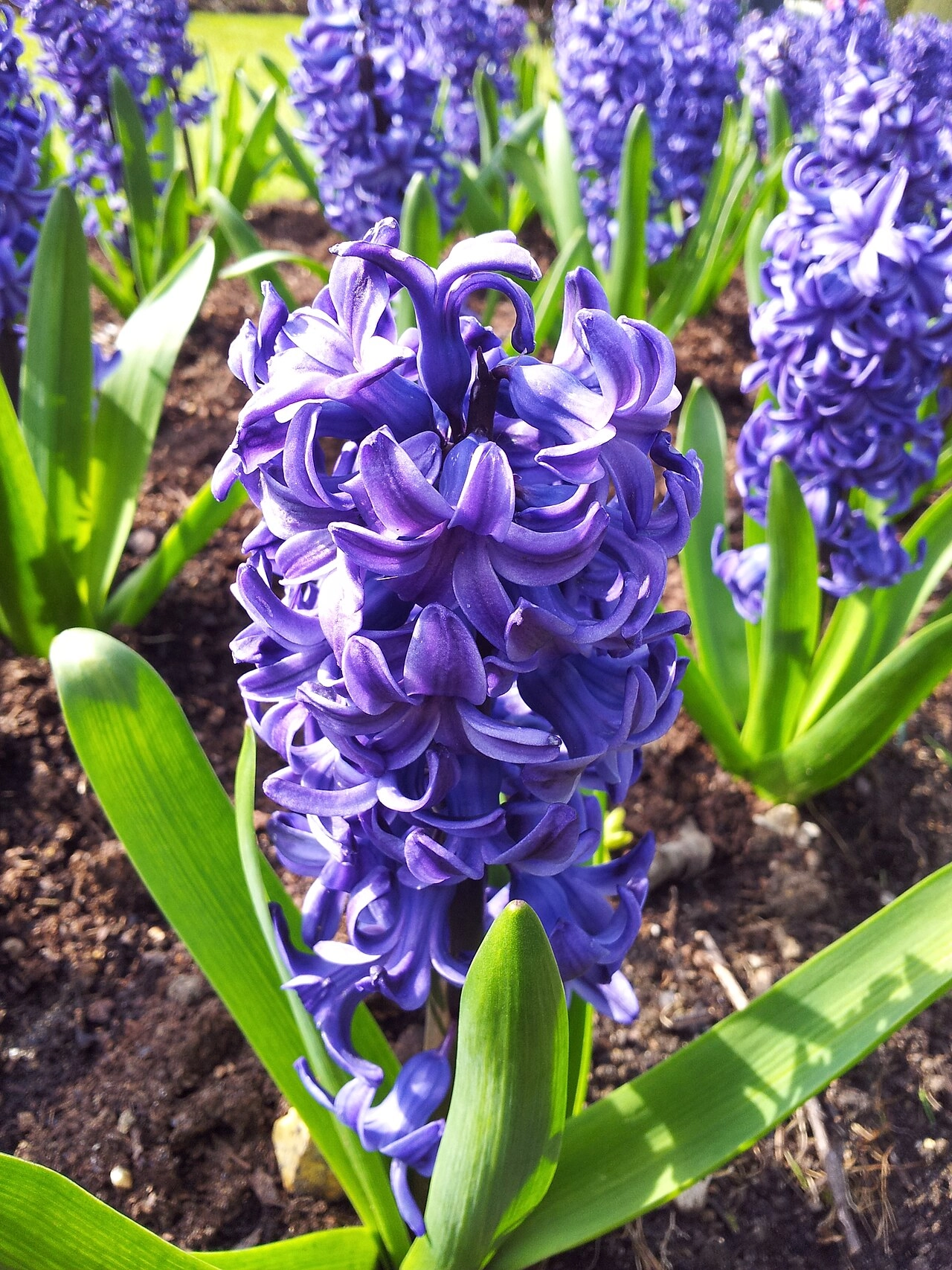
It gets weirder: The only other thing Homer describes using the word oînops is… oxen. (Oxen are, for the record, black, brown, or reddish-brown.) Then there’s the term ἰόεις ióeis ‘violet’, which Homer uses to describe sheep (presumably black sheep), iron, and… the sea. So the sea is wine-looking and violet-like. Got it. Homer also compares the color of Odysseus’ dark hair to the color of a hyacinth, which, in case you didn’t know, looks like this:

This is just the beginning of Homer’s chromatic curiosities—oddities that have puzzled scholars for centuries. In 1858, for instance, British politician William Gladstone compiled a comprehensive list of Homer’s erratic use of colors as part of a massive 1,700-page treatise titled Studies on Homer and the Homeric Age. In a chapter tucked away near the end of the book titled “Homer’s perception and use of color”, Gladstone so thoroughly and rigorously documented Homer’s strange use of color terms that the intellectuals of the time were forced to acknowledge that something more was going on with Homer’s color vocabulary than mere poetic license. Gladstone carefully laid out five types of evidence showing that something was amiss in Homer’s descriptions of colors:
First, as we have already seen, Homer often uses the same word to denote colors that are—to modern observers, at least—completely different. Another example of this is his use of the word χλωρός khlōrós, which later just came to mean ‘green’. But Homer applies khlōrós to faces pale with fear, fresh twigs, the olive wood of the club of Cyclops, and… honey. Or take the word κυάνεος kŭắneos, which later came to mean ‘blue’. Homer employs it to describe the eyebrows of Zeus, the hair of Hector, and a dark cloud—never anything blue.
Second, Homer sometimes characterizes the same objects using contradictory color descriptors. Iron, for instance, is described using terms for violet and gray, as well as the word αἴθων aíthōn ‘a thing which blazes and flashes like burnished metal’. aíthōn is otherwise only used to refer to the color of horses, lions, and… oxen. So oxen are wine-looking and blazing like burnished metal. Cool.
Third, Homer uses color terms only sparingly, and not at all in places where we might confidently expect it. He never discusses the color of horses despite including extensive descriptions of them. He never describes the sky as blue; it is starry, broad, great, iron, or copper, but never blue. Poppies, spring flowers, fields of wheat, hills and forests are never described in terms of their colors. In contrast, the producers of the 1939 film The Wonderful Wizard of Oz specifically elected to use the scene involving a vibrant field of red and pink poppies to flaunt their dazzling new Technicolor technology. They used paper flowers to create the effect of a vast field, making it one of the most expensive and visually iconic sequences in movie history. Yet not once does Homer rely on the color of flowers for his vivid imagery.
Fourth, when colors do feature in the Homeric epics, white and black predominate over all other colors. The table below shows how often Homer uses each color term in the Odyssey and the Iliad combined:
| Ancient Greek | Transliteration | English | Count | Notes |
|---|---|---|---|---|
| μέλᾱς | mélās | black | ~170 | Originally meant ‘dark’ |
| various | — | white | ~100 | |
| ἐρῠθρός | erŭthrós | red | 13 | |
| ξᾰνθός | xănthós | yellow | 10 | |
| ἰόεις | ióeis | violet | 6 | |
| χλωρός | khlōrós | green | — | Mostly used to describe non-green things. |
| κυάνεος | kŭắneos | blue | — | Never used to describe blue things. |
Finally, as illustrated by the above table, the size of Homer’s color vocabulary is surprisingly small. There is a complete absence of any terms used to mean ‘blue’, ‘orange’, or ‘pink’, and khlōrós doesn’t appear to mean ‘green’ at this point.
Taken together, all the evidence points to something unquestionably strange about Homer’s use of color. What could possibly be the cause of his uneven, vague, and inconsistent color descriptions?
Why does Homer use colors so strangely?
“If any man should say that the minstrel was deficient in the organ of colour because he designated the sea by this vague word, I would meet him by saying that the critic is deficient in the organ of poetry.” ~ John Stuart Blackie
Homer is often said to have been blind, and some have used this as an explanation for his odd use of color vocabulary, but his blindness is undoubtedly a myth. He may have been prismatically inept, but his visual descriptions are nonetheless vivid. Also, his contemporaries accepted his poetry unquestioningly! The Ancient Greeks found nothing wrong with his monochromatic portrayals of the world. In fact, we find traces of the same chromatic vagueness in other Ancient Greek writers: Pindar (5th C BCE), for example, also wrote about ‘violet-colored hair’.
Gladstone’s proposed explanation for the “faint and indefinite” color descriptions of the Ancient Greeks was that “the organ of colour and its impressions were but partially developed among the Greeks of the heroic age”. He argued that they saw the world primarily in terms of lightness and darkness rather than hue, save for a splash of red. The word erŭthrós ‘red’ was the only color term other than black and white that Homer used to refer only to reddish things (blood, wine, copper). Gladstone argued that the Greeks had been in effect colorblind—a claim made all the more remarkable by the fact that colorblindness was not yet known to the scholarly community in 1858. The reason for this colorblindness, he claimed, was that the Greeks had at the time only just begun to develop artificial dyes. It is only once people are exposed to artificial colors that they evolved the ability to see colors and subsequently name them.
Put differently, the Greeks had not yet conceived of color as an abstract concept, independent of the objects bearing those colors. This isn’t as strange a claim as it might sound: in a similar fashion, it took ancient Sumerians several centuries to conceive of numbers as abstract concepts. Prior to the standardization of their counting system, the Sumerians had different sets of numbers for different commodities. A separate series of numerals was used to count barley and cereal products, malt, barley groats, land area, and calendar time, among others. From today’s standpoint, this proliferation of counting systems seems like an unnecessarily complex deficiency. But given that the primary function of these numeral systems was to tally commodities, having distinct numerals that told you something about which commodity was being counted would have been incredibly useful. This meant, however, that numbers were always tied to the specific concrete entities being counted. It took centuries for the Sumerians to conceptualize numerals in the abstract, and when they did the result was the incredibly sophisticated mathematical tradition of the Babylonians.
 Daniel W. Hieber, Ph.D.
Gladstone’s thesis also has some explanatory power. Ignoring Gladstone’s proposed evolutionary mechanism for a moment, if we interpret Homer’s depictions in terms of shades of darkness rather than hue, phrases like ‘violet sheep’ and ‘wine-dark sea’ no longer seem so strange. This hypothesis also explains the total absence of blue: it appears that for Homer, kŭắneos simply referred to any dark color, rather than ‘blue’ specifically. And the use of khlōrós to describe non-green things suddenly makes sense when we realize that its original meaning was ‘young herbage’. As such, it could be used to describe anything fresh, verdant, unripe, or pale—including honey and fearful faces.
But from our modern vantage point, Gladstone’s explanation for why the Ancient Greeks focused on lightness vs. darkness rather than hue seems scientifically antiquated. 2,500 years is not enough time for evolutionary forces to exert sufficient selective pressure on a population that they develop the complexities of color vision. To be fair, however, Gladstone’s magnum opus was published just a few months before Charles Darwin and Alfred Russel Wallace jointly announced a theory of evolution by natural selection in 1858. The prevailing explanation for biological change at the time was Jean-Baptiste Lamarck’s model of inheritance of acquired characteristics. In this view, traits that an organism acquires during its lifetime can be passed on to their offspring. Early giraffes strained to reach the high boughs of a tree, and so their offspring developed long necks. A blacksmith might get strong muscles from their work, and their children would then be stronger as a result.
Thus, to the scholars of the time, an explanation of the Ancient Greeks’ color deficiencies in terms of inheritance of acquired characteristics made perfect sense. The Greeks, it was argued, hadn’t yet developed color terms because they simply didn’t have need of them yet. Once they developed artificial paints and dyes, the Greeks became like those giraffes reaching for the highest leaves, and slowly got better at distinguishing the hues of the rainbow.
Nonetheless, Gladstone’s contemporaries were no less harsh in their reception of his ideas. Prominent classicist John Stuart Blackie trenchantly wrote:
If any man should say that the minstrel was deficient in the organ of colour because he designated the sea by this vague word, I would meet him by saying that the critic is deficient in the organ of poetry.
Yet Gladstone’s thesis turned out to be prescient. Although he misunderstood the mechanism, he was ultimately correct that the color vocabulary of the Greek language—and indeed all languages—shifted its focus over time from shades of darkness to hue. Today we know that Gladstone’s findings actually reflect a universal tendency in how the world’s languages develop color terms over time, and that this color term hierarchy, as it is called, arises due to subtle biological influences on language. In the remainder of this article, I’ll explain what the color term hierarchy is, what causes it, and how it’s realized in the world’s languages.
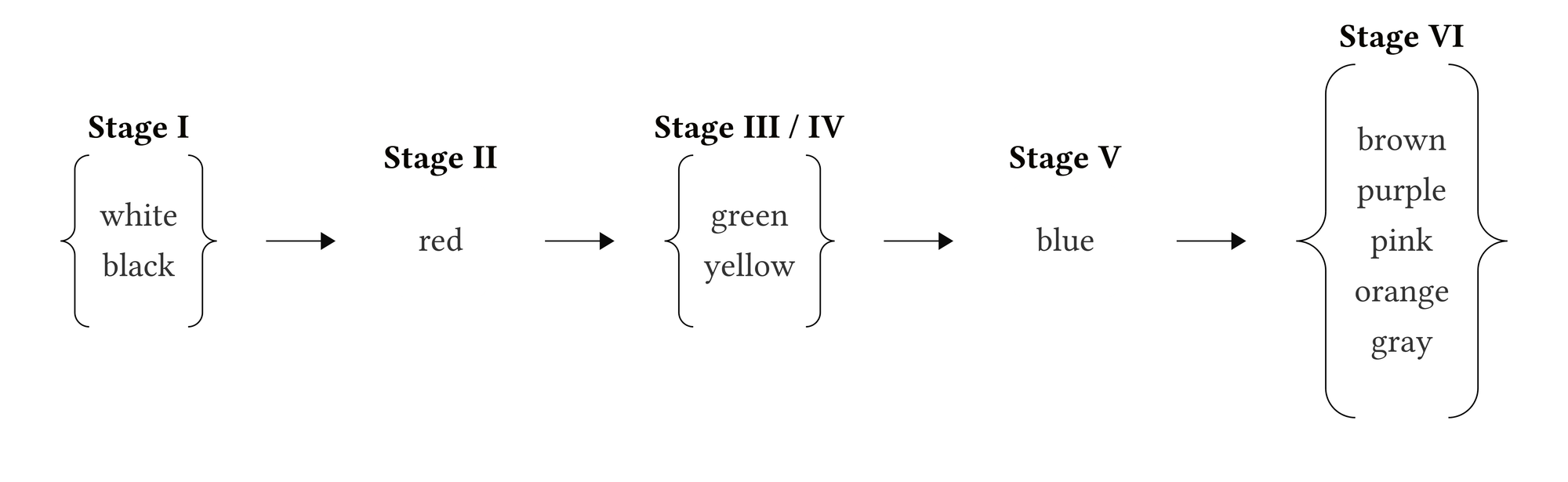
The color term hierarchy
In the century following Gladstone’s seminal work, scholars came to realize that the Ancient Greeks were not the only ones who were chromatically challenged. About a decade after Gladstone’s Studies on Homer, philologist Lazaraus Geiger gave a plenary lecture at the 1867 Assembly of German Naturalists & Physicians titled “On the Color Sense in Primitive Times and its Evolution”, in which he expanded on Gladstone’s work. He realized that it was not just Homer who struggled with colors, but the authors of all the ancient texts—the Indian Vedic poems (Vedic Sanskrit: Indo-European), the Old Testament (Biblical Hebrew: Semitic), the Icelandic sagas (Old Icelandic: Indo-European > Germanic), and even the Quran (Classical Arabic: Semitic). Biblical Hebrew, for instance, lacks a word for ‘blue’, and the Bible is rife with odd color descriptions: a ‘red horse’ and a ‘red heifer without spot’; faces ‘turned green’ with panic; the feathers of a dove covered with ‘green gold’. As for the Vedic hymns, Geiger says:
These hymns, of more than ten thousand lines, are brimming with descriptions of the heavens. Scarcely any subject is evoked more frequently. The sun and reddening dawn’s play of color, day and night, cloud and lightning, the air and the ether, all these are unfolded before us over and over again, in splendor and vivid fullness. But there is only one thing that no one would ever learn from those ancient songs who did not already know it, and that is that the sky is blue.
This article is for paying subscribers. Supporters get bonus articles like this one, and early access to my in-progress book projects! Subscribe to read the rest of this article here: