What kind of language is Eridian, question?
The linguistics of Project Hail Mary

There are few things I enjoy more than a sci-fi story where the characters have to figure out how an alien language works. Why? Because it’s linguistic fieldwork! Xenolinguistics! When writers handle this well, the methods of decipherment adopted by the characters look remarkably like how real-world linguists approach the process of documenting a hitherto undocumented language, and you get fantastic stories like Denis Villeneuve’s movie Arrival, based on Ted Chiang’s short story “Story of Your Life”. And when writers handle this poorly, you get Star Trek’s universal translator—the most boring and implausible linguistic plot device in the history of linguistic plot devices. (Why would you minimize the amount of linguistics in a story? It makes no sense! Even The Hitchhiker’s Guide to the Galaxy takes a paragraph to explain how babelfish work.)
So imagine my delight when I discovered 176 pages into Project Hail Mary that I was about to get another interspecies language documentation project! Jazz hands! 👐 In this article we’ll look at the linguistics of Project Hail Mary and see how it holds up against the real-world science. Since the movie was pretty faithful to the book in terms of linguistics, this should serve as a useful explainer for the movie as well.

How the Eridian language works
You can think of tone as like the melody with which you say a word (because that’s exactly what it is). You could, if you want, transcribe linguistic tones using musical notation, and linguists have even done so in the past.
In the book, scientist Ryland Grace encounters an alien species he names the Eridians, after their home system, 40 Eridani. Grace has to work closely with one member of species, who he names Rocky, to escape various perilous situations and forestall certain death by means of some hardcore sciencing. He soon discovers that the Eridians have language! 🎶 Amaze! Amaze! 🎶
One of the hard parts of first contact with intelligent alien life—in addition to figuring out everyone’s pronouns (p. 172)—is determining the medium of communication. Do the aliens relay information directly via thought waves, like the Trisolarans in Three-Body Problem? Or via complex visual symbols, like the heptapods in Arrival or Species 10-C in Star Trek: Discovery?
 Daniel W. Hieber, Ph.D.
Grace quickly discovers that, like humans, Eridians communicate by propagating sound waves through a medium:
“♩🎝♪♪🎝,” says Rocky.
My jaw drops. Yes, I’m in zero g. It still drops.
There was no pronunciation or inflection of the sounds. Just notes. Like whale song. Except not quite like whale song, because there were several at once. Whale chords, I guess. And he was responding to me. That means he can hear too.
And notably, the sounds were in my range of hearing. Some of the notes were low, some of them high. But definitely audible. That alone is amazing when I think about it. He’s from a different planet, and totally different evolutionary line, but we ended up with compatible sound ranges. (p. 176)
Grace then sets up what documentary linguists would call his first elicitation session, where he uses stimuli or prompts that get the speaker to produce certain target words/phrases. This allows him to both record the words and begin associating them with meanings:
I grab my laptops and launch the waveform-analysis software on one and Excel on the other. I hold up the numeral Ⅰ and point to it. “One,” I say. “One.”
Rocky points to the Ⅰ and says “♪.”
I pause the waveform analyzer and scroll back a few seconds. Rocky’s word for ‘one’ is just two notes played at the same time. There are a bunch of harmonics and resonances in there, too, but the main frequency peaks are just two notes.
I type “one” into the spreadsheet on the other computer and note the relevant frequencies.
I return to the divider and hold up the Ⅴ symbol. “Two,” I say.
“♪,” he says. Another one-syllable word. The oldest words in a language are usually the shortest.
This time, it’s a chord made of four distinct notes. I enter “two” and record the frequencies for that word.
He starts to get excited. I think he knows what I’m up to and it’s got him happy.
I hold up the λ and before I can even speak, he points to it and says, “🎝♪.”
Excellent. Our first two-syllable word. The first syllable has just two notes and the second has five! Rocky can make at least five different notes at the same time. He must have multiple sets of vocal cords or something.
(pp. 199–200, edited for brevity)
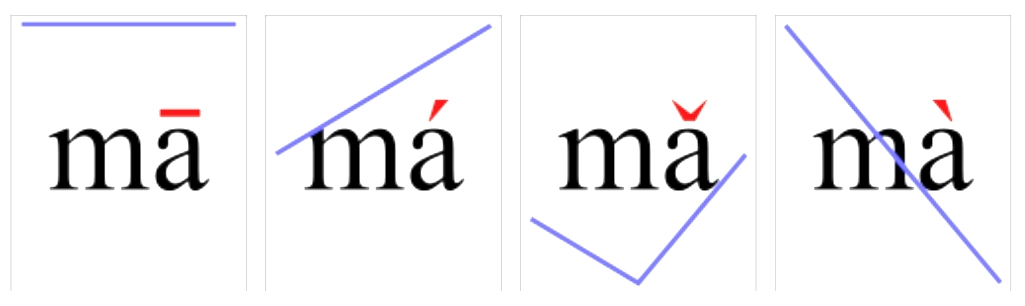
Based on this description, Eridian sounds similar to the tonal languages of Earth! In tone languages, the meaning of a word or affix is determined not just by its vowels and consonants, but also the pitch with which you say the word. The classic example is Mandarin Chinese, where the same syllable ma can mean 5 different things depending on the pitch of the word:
- mā (媽/妈) ‘mother’
- má (麻/麻) ‘hemp’
- mǎ (馬/马) ‘horse’
- mà (罵/骂) ‘scold’
- ma (嗎/吗) (question marker)
You can think of tone as like the melody with which you say a word (because that’s exactly what it is). You could, if you want, transcribe linguistic tones using musical notation, and linguists have even done so in the past, but this usually isn’t necessary because any given language only has a few tones. Mandarin, as we’ve just seen, has 5 tones, and some languages have been analyzed as having up to 14 tones, but most languages (60%) only make a contrast between two tones, usually high tone (H) vs. low tone (L) or no tone (∅) (Gordon 2016: 219–221). In addition, linguistic tone is based on relative pitch rather than absolute pitch, so the same pitch might be used for a High tone in one context but a Low tone in another.
Below are what the 4 primary tones of Mandarin look like when you plot their change in pitch over time (Wikipedia: Tone (linguistics)). (The fifth tone is a neutral tone whose pitch is mostly determined by the tone of the preceding syllable.)
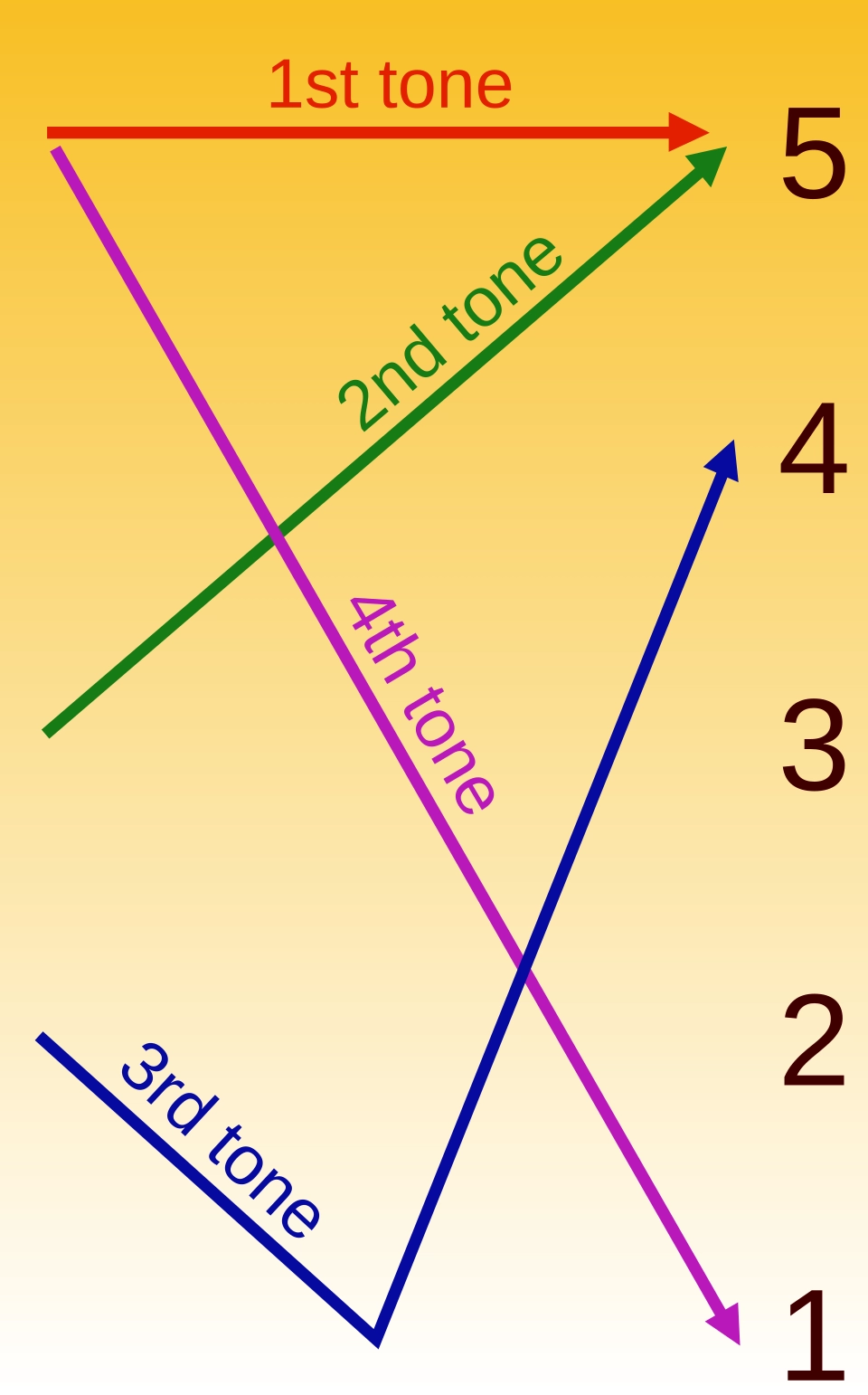
We can also describe tones in terms of their levels. Mandarin’s 2nd tone, for example, is a 35 tone, while its 1st tone is 55, and so on. The maximum number of distinct tone levels a language can have is 5 (Gordon 2016: 223), a fact which is likely due to perceptual and cognitive limitations on Homo sapiens’ ability to discriminate between different pitches in sequence. Coincidentally, the Eridian language appears to allow a maximum of 5 tone levels as well! The second syllable of the Eridian word for ‘three’ consists of 5 distinct notes, as the book mentions.
Many human tone languages only make simple contrasts between a High (H) tone vs. a Low (L) tone, or High (H) vs. Mid (M) vs. Low (L). Each syllable is either H or L (or M). You don’t have to pay attention to whether the pitch is rising or falling, just whether it’s high, low, or mid (relative to other tones in the utterance). For example, the Gusii language of southwestern Kenya only has High tones and Low tones (Nash 2011):
- éndà HL ‘stomach’ vs. éndá HH ‘louse’
These kinds of languages are often called register tone languages, and they contrast with languages like Mandarin where the pitch can change even within a single syllable. Since in this latter type of language you need to pay attention to rises and falls in the pitch within a syllable, they are called contour tone languages. (In reality, register tone languages also typically involve lots of pitch contours, so the distinction between register and contour tone languages is not entirely principled or clearcut.)
Based on how the author, Andy Weir, transcribes Rocky’s dialogue, it seems as though Eridian has both level tones and contour tones (or rather, level chords and contour chords), parallel to human tone languages. Some syllables consist of a single level chord, which Weir transcribes with a single note, ♩ or ♪, while other syllables consist of a sequence of two chords, transcribed as 🎝—the Eridian equivalent of a contour tone. However, Weir never uses ♫, suggesting that Eridian has falling contour tones but never rising contour tones—and there are some human languages like this too! Kiowa and Jemez are two such examples.
Finally, the fact that Weir transcribes some syllables using a quarter note (♩) and others using an eighth note (♪) suggests that the length of the chord makes a meaningful difference in Eridian. This too parallels human languages! Many languages distinguish between long vowels and short vowels, in the literal sense of long vowels being pronounced for a longer duration than short vowels. Here are some examples of words in Gusii that differ only in their vowel length (indicated by a double vowel; Nash 2011: 40):
- émèrì ‘roots’ vs. émèèrì ‘ship’
- βùtìà ‘conclude’ vs. βùùtìà ‘entertain (a guest)’
Some languages also distinguish between long consonants (called geminate consonants) and short consonants, like Berber (Wikipedia: Gemination):
- ini ‘say’ vs. inni ‘those in question’
- akal ‘earth, soil’ vs. akkal ‘loss’
- imi ‘mouth’ vs. immi ‘mother’
- ifis ‘hyena’ vs. ifiss ‘he was quiet’
So Eridian long vs. short chords parallel human long vs. short vowels and consonants.
There are however several fundamental differences between Eridian and human tone languages. First, humans can only produce one pitch at a time—at least usually. Some people have learned to produce multiple pitches at once, a technique known as overtone singing, harmonic singing, or throat singing. The Mongolian, Tuvan, Inuit, and Xhosa cultures are all known for this kind of polyphonic singing. But this doesn’t work for everyday language because it erases a lot of the acoustic information we need to discriminate between different consonants/vowels. So as far as human language goes, tonal languages only get 1 tone per word/syllable/vowel/mora (depending on the language). Eridian, by contrast, can use entire musical chords at once! But we know that these chords are, like human tonal languages, based on relative pitch rather than absolute pitch, because of passages like these:
That whole sentence seemed lower in pitch than anything Rocky has ever said before. I select the whole segment in the software’s recording history and bump it up an octave. The octave is a universal thing, not specific to humans. It means doubling the frequency of every note. The computer immediately translates the result. (p. 212)
The second major difference between Eridian and human tone languages is that human tones work in conjunction with consonants, vowels, and semivowels, whereas Eridian works by tones alone. In this respect, Eridian is similar to whistle speech on Earth, where speakers communicate by merely whistling. However, there are no known systems of whistle speech that constitute an entirely independent language. No language is communicated using whistling alone. All whistle communication systems are merely whistled versions of another language. For example, Silbo Gomero is a whistled form of the Spanish used in the Canary Islands.


A man and woman using Silbo Gomero
For tonal languages, the whistled version of a word typically mimics the tonal pattern of the word. For non-tonal languages, the corresponding whistles are based on the acoustic profile of each sound in the language. Whistlers whistle at specific pitches that correspond to each vowel or consonant in the language. For example, in Silbo Gomero the tongue is placed in a similar shape as when pronouncing each spoken sound, giving the whistle a similar pitch. In whistled Turkish, /o/ is whistled at a lower frequency than /a/, and at a different frequency than other vowels, etc.
What kind of language is Eridian, then? It most closely resembles a mix of human contour tone languages, whistle speech, and throat singing, with a distinction between long vs. short chords thrown in. It is, in sum, surprisingly humanlike! But maybe this is to be expected given that both Eridian and human language use the medium of sound. We might expect all sound-based languages in all the galaxies to exhibit some of these same features. So I, for one, laud Andy Weir for creating a fun and surprisingly realistic conlang for the book.
But for a more critical take on the linguistics of Project Hail Mary, check out this interview that Ars Technica did with linguist Betty Birner, professor emerita at Northern Illinois University:
 Lee Hutchinson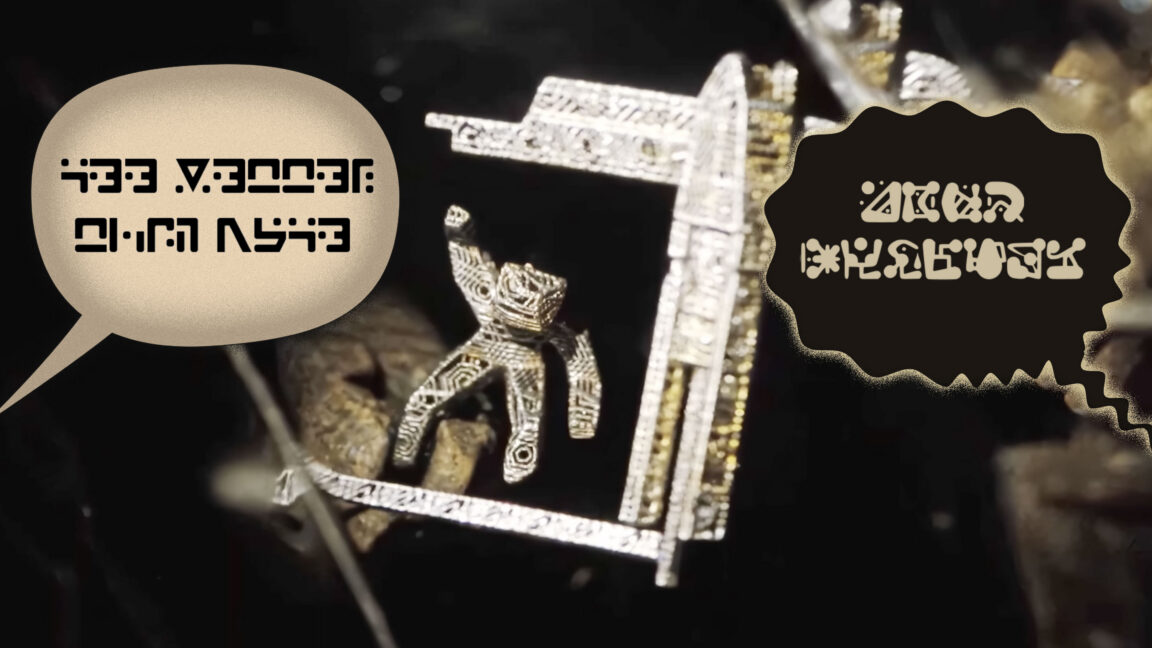
If you want to go deeper into Weir’s treatment of Eridian and how realistic it seems compared to human language, paying subscribers can read my line-by-line commentary of the book after the references below. I made note of any passages that give us insight into how the Eridian language works, along with explanations of the linguistics behind it and how each point compares to human language. Along the way you’ll get to explore some surprising ways that human languages work as well!
📑 References
- Berlin, Brent & Paul Kay. 1969. Basic color terms: Their universality and evolution. University of California Press.
- Cheney, Dorothy L. & Robert M. Seyfarth. 1990. How monkeys see the world: Inside the mind of another species. Chicago: University of Chicago Press.
- Comrie, Bernard. 2013. Numeral bases. In World Atlas of Language Structures Online. Max Planck Institute for Evolutionary Anthropology. http://wals.info/chapter/131.
- Comrie, Bernard. 2021. Typology of numeral systems.
- Gordon, Matthew K. 2016. Phonological typology (Oxford Surveys in Phonology & Phonetics 1). Oxford University Press.
- Harrison, K. David. 2007. When languages die: The extinction of the world’s languages and the erosion of human knowledge. Oxford University Press.
- Hieber, Daniel W. 2016. The cohesive function of prosody in Ékegusií (Kisii) narratives: A functional-typological approach. University of California, Santa Barbara M.A. thesis. http://rgdoi.net/10.13140/RG.2.2.17818.18886. (22 August, 2025).
- Hieber, Daniel W. 2019. The Chitimacha language: A history. In Language in Louisiana: Community and culture (America’s Third Coast Series), 9–27. University Press of Mississippi.
- Mithun, Marianne. 2012. Core argument patterns and deep genetic relations: Hierarchical systems in Northern California. In Pirkko Suihkonen, Bernard Comrie & Valery Solovyev (eds.), Argument structure and grammatical relations: A crosslinguistic typology (Studies in Language Companion Series 126), 257–294. John Benjamins Publishing Company.
- Nash, Carlos M. 2011. Tone in Ekegusii: A description of nominal and verbal tonology. University of California, Santa Barbara Ph.D. thesis.
- Payne, Thomas. 1997. Describing morphosyntax: A guide for field linguists. Cambridge University Press.
- Sterelny, Kim. 2011. From hominins to humans: How sapiens became behaviourally modern. Philosophical Transactions of the Royal Society B: Biological Sciences 366(1566). 809–822. https://doi.org/10.1098/rstb.2010.0301.
- Velupillai, Viveka. 2012. An introduction to linguistic typology. John Benjamins.
If you’d like to support Linguistic Discovery, purchasing through these links is a great way to do so! I greatly appreciate your support!
Check out my Amazon storefront here.
Check out my Bookshop storefront here.
🌟 Bonus Commentary
Below is my commentary on each passage in Project Hail Mary that tells us something interesting about how the Eridian language works.