The Wug Test: How children learn grammar
What can a simple word game teach us about how language works?


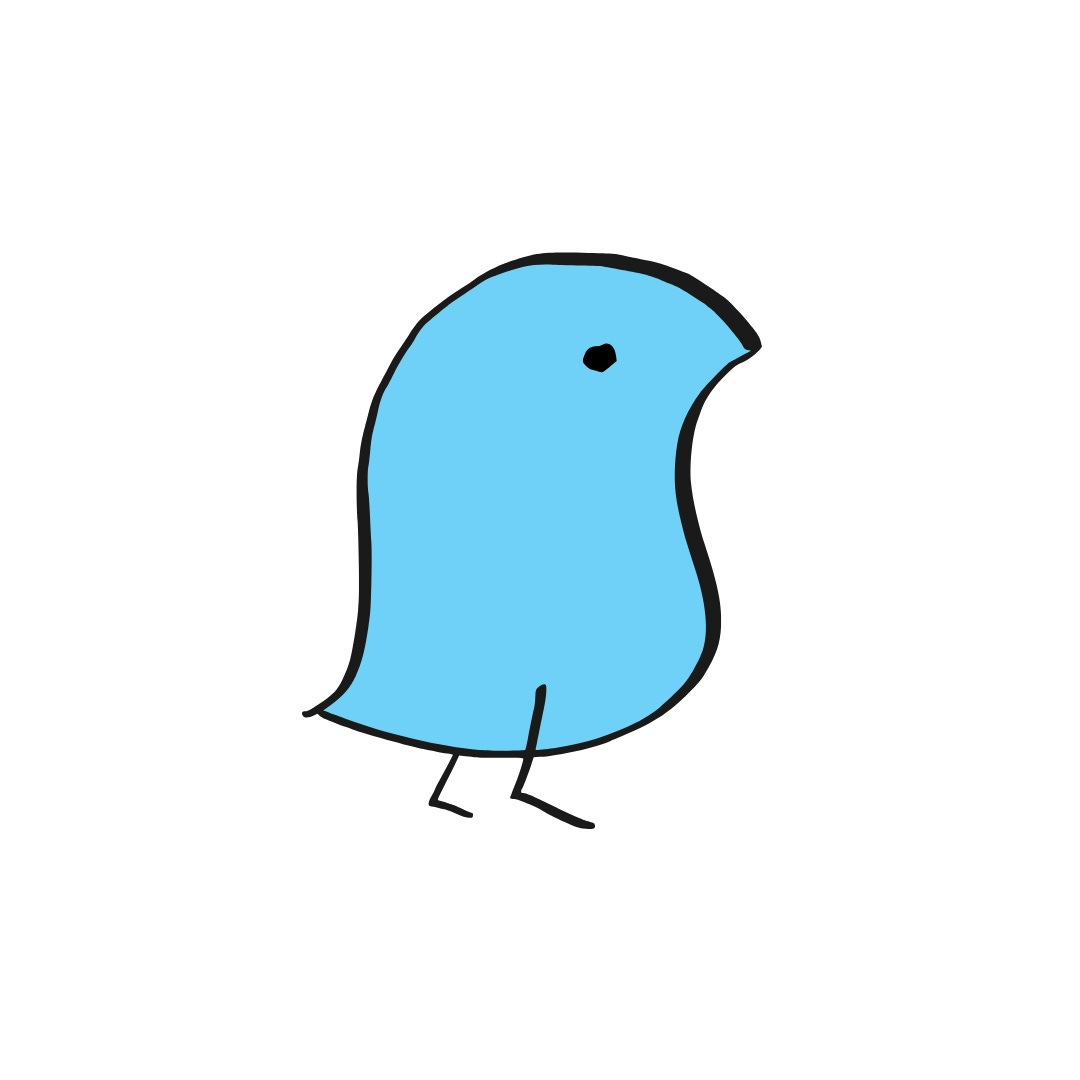
This is a wug. 🐤
Now there is another one. 🐤🐤
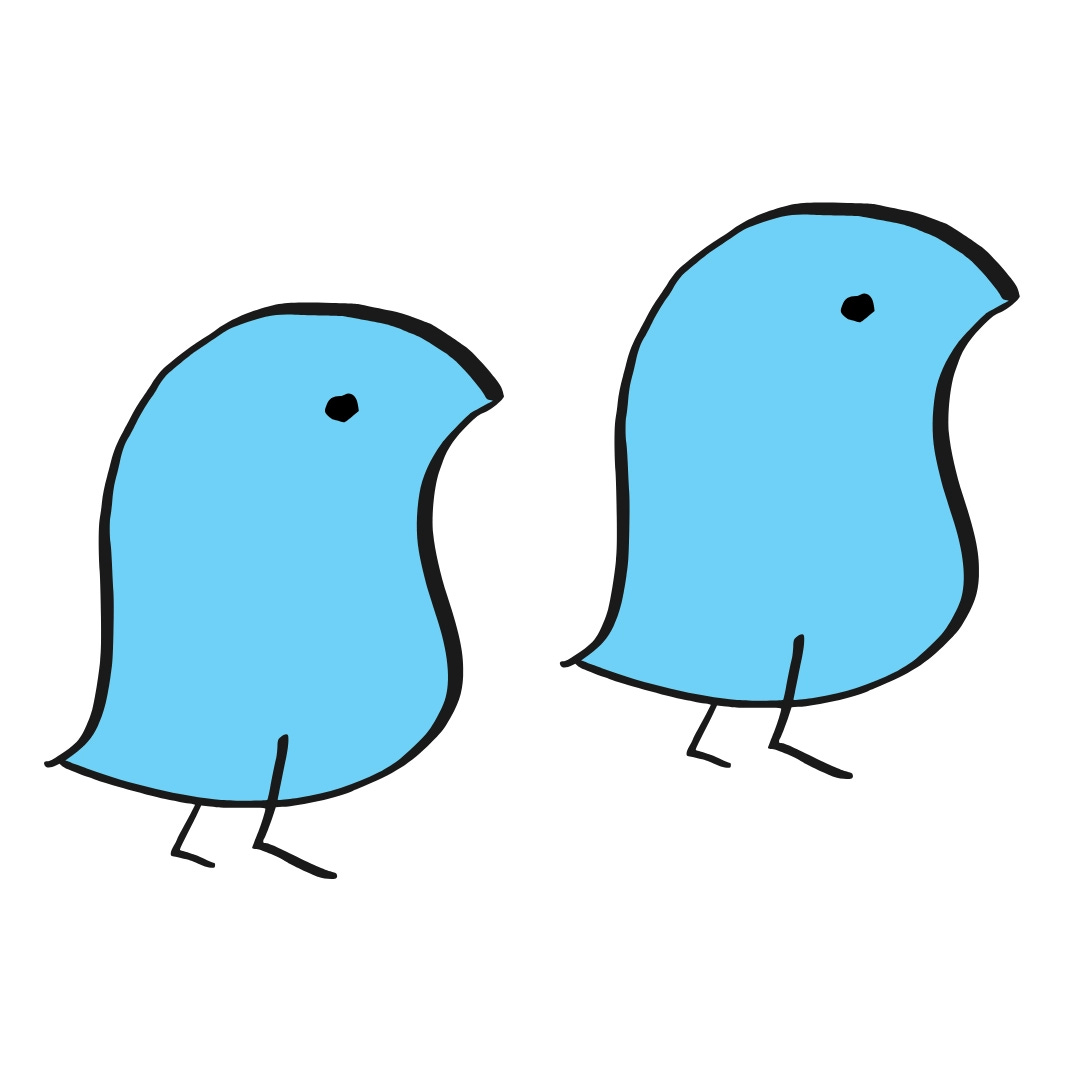
There are two of them. There are two _____.
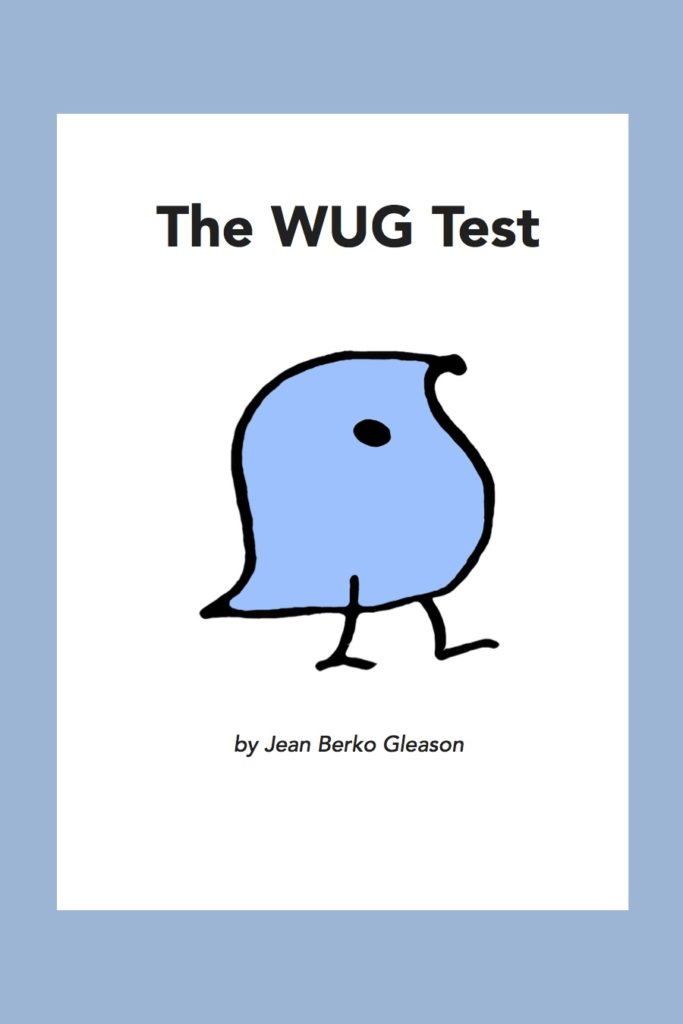
You’ve just participated in one of the most famous linguistics experiments of all time, called The Wug Test. In today’s issue, we’ll see just how much this tiny experiment can teach us about the way children acquire language and how language itself works.
How do children learn grammatical rules?
The task facing children when they learn new inflections is actually much more challenging than simply adding an ‑s or ‑ed to the ends of words.
The creator of the Wug Test, Jean Berko Gleason, wanted to understand how children acquired the rules of English grammar. For example, most English nouns form their plural in the regular way, by adding the ‑s suffix:
- cat → cats
- dog → dogs
- house → houses
But English also has plenty of irregular plurals:
- man → men
- mouse → mice
- sheep → sheep
Regular plurals comport well with the perspective that children learn a rule STEM + ‑s = PLURAL, but irregular plurals make it seem like children have to memorize each plural individually. Gleason wanted to know which strategy children were using when they learned different grammatical affixes like plural ‑s, past tense ‑ed, and progressive ‑ing—what linguists call the different inflections of a word. Do they simply memorize each form on a case-by-case basis, or do they learn a more abstract rule that they can then apply to new words?
Complicating matters, the task facing children when they learn new inflections is actually much more challenging than simply adding an ‑s or ‑ed to the ends of words. In many cases, English uses different pronunciations of an affix depending on the sound around it. In fact, there are actually three different pronunciations of each of the plural ‑s, the possessive ‑s, and the past tense ‑ed, depending on the sound at the end of the word they attach to.
Take plural ‑s to start: If a noun ends in what linguists call a voiceless consonant—a sound where your vocal folds aren’t vibrating, any of the sounds /f, k, p, t, θ/—then the plural is simply pronounced /s/. So cat /kæt/ becomes cats /kæts/, cup /kʌp/ becomes cups /kʌps/, and so on:
- cat /kæt/ → cats /kæts/
- cup /kʌp/ → cups /kʌps/
- month /mʌnθ/ → months /mʌnθs/
However, if the word ends in a voiced sound—where your vocal folds are vibrating—then the plural ‑s is pronounced /z/. Voiced sounds in English include:
- vowels
- semivowels: /w, j/
- voiced consonants: /b, d, ð, g, l, r, m, n, ŋ, v/
So you say dogs /dɑgz/ not */dɑgs/, beds /bɛdz/ not */bɛds/, and cans /kænz/ not */kæns/.
* is used to indicate an incorrect or ungrammatical form.- dog /dɑg/ → dogs /dɑgz/
- bed /bɛd/ → beds /bɛdz/
- can /kæn/ → cans /kænz/
Notice that these plural forms end in /z/, even though the word is spelled with an ⟨s⟩. English spelling is insensitive to this particular pronunciation rule (because we apply it subconsciously). If you’re having trouble convincing yourself there’s actually a /z/ there, here are a few contrasting pairs of words (minimal pairs) that show what happens if you pronounce the plural as /s/ instead. You get an entirely different word! These should convince you that the plural is in fact pronounced as /z/, distinct from /s/.
| Plural with /z/ | Pronunciation | Contrasting Word with /s/ | Pronunciation |
|---|---|---|---|
| hens | /hɛnz/ | hence | /hɛns/ |
| pews | /pjuz/ | puce | /pjus/ |
| ells | /ɛlz/ | else | /ɛls/ |
| bays | /beᶦz/ | base | /beᶦs/ |
| dues | /duz/ | deuce | /dus/ |
Finally, if the word ends in one of English’s sibilant sounds—/s, z, ʃ, ʒ, tʃ, dʒ/—then the plural is pronounced /ɪz/. English inserts a separator vowel (called an epenthetic vowel) to keep the two sibilants apart (otherwise they’d be unpronounceable). So house /haᶷs/ becomes /haᶷsɪz/, not /haᶷss/; maze /meᶦz/ becomes /meᶦzɪz/, not /meᶦzs/, etc.
- house /haᶷs/ → houses /haᶷsɪz/
- maze /meᶦz/ → mazes /meᶦzɪz/
- glass /glæs/ → glasses /glæsɪz/
You can think of these three different forms of the plural ‑s as context-conditioned pronunciation variants of the same suffix. The technical term for this type of variant is an allomorph.
Suddenly “add an ‑s to make it plural” doesn’t seem so straightforward after all!
Thankfully, the pronunciation rules for the possessive ‑’s are exactly the same as for plural ‑s:
- cat /kæt/ → cat’s /kæts/
- cup /kʌp/ → cup’s /kʌps/
- month /mʌnθ/ → month’s /mʌnθs/
- dog /dɑg/ → dog’s /dɑgz/
- bed /bɛd/ → bed’s /bɛdz/
- can /kæn/ → can’s /kænz/
- house /haᶷs/ → house’s /haᶷsɪz/
- maze /meᶦz/ → maze’s /meᶦzɪz/
- glass /glæs/ → glass’s /glæsɪz/
These possessives may be spelled differently from their plural forms, but they are pronounced the same.
The rules for the pronunciation of different allomorphs of the past tense ‑ed parallel those of the plural and the possessive. After voiceless consonants, ‑ed is pronounced as /t/:
- look /lʊk/ → looked /lʊkt/
- ask /æsk/ → asked /æskt/
- help /hɛlp/ → helped /hɛlpt/
After voiced sounds, ‑ed is pronounced as /d/:
- use /juz/ → used /juzd/
- call /kɑl/ → called /kɑld/
- try /traᶦ/ → tried /traᶦd/
But after a similar sound—an alveolar stop /t d/—an epenthetic vowel is inserted, so that ‑ed is pronounced /ɪd/:
- want /wɑnt/ → wanted /wɑntɪd/
- need /nid/ → needed /nidɪd/
- start /stɑrt/ → started /stɑrtɪd/
We can generalize the rules for all three of these suffixes in the following way:
- If the word ends in a similar sound as the suffix, insert an epenthetic vowel to separate the two sounds:
- sibilant + ‑s → /ɪz/
- alveolar stop + ‑ed → /ɪd/
- Otherwise, use the form of the suffix that matches the voicing of the preceding consonant:
- voiceless: /s/ or /t/
- voiced: /z/ or /d/
Yet even this “simplification” is a complex, highly abstract rule! English spelling often obscures the intricacies of these pronunciation rules, but all native English speakers are nonetheless aware of these rules at a subconscious level.
But are children? And if so, when do they become aware of them? Do they learn all the allomorphs of an affix at once? Do they memorize individual forms, or do they learn the abstract rules for each of these forms? Obviously children learn the rules eventually, but what happens while they’re learning the language?
When Gleason first conducted the Wug Test in 1958, linguists didn’t yet have answers to these questions. In fact, Gleason’s study can perhaps be considered the first ever scientific experiment in child language research (Saxton 2017: 12). That’s only part of what has given the study its enduring fame, however. In addition to furnishing the field of linguistics with an unofficial mascot in the adorable wug (you can grab your own wug merch here), the experiment’s astute design provided the first method in linguistics for interrogating the internal grammatical knowledge of children, and it was one of the first studies to offer experimental evidence that children regularize irregular forms (Clark 2024: 225). Let’s look at how the experiment worked and what Gleason discovered.

How the Wug Test works
Gleason reasoned that if children learned plurals and other inflections by rote, they shouldn’t make inflectional errors. They would say cats and men because that’s what the adults say. But if children are learning patterns and applying them productively, they should sometimes overgeneralize, producing forms like these:
- Past Tense ‑ed
- fall → *falled (fell)
- go → *goed (went)
- break → *broked (broke)
- sing → *singed (sang)
- Plural ‑s
- man → *mans (men)
- foot → *foots (feet)
- tooth → *teeths (teeth)
- person → *peoples (people)
To find out what children were actually doing, Gleason created a number of nonsense words to describe colorful pictures of fantastical creatures (including the wug) and people performing novel actions. Below are a few of the original elicitation stimuli she used. The first four are designed to test for plural nouns, and the last two are designed to test for past tense verbs.
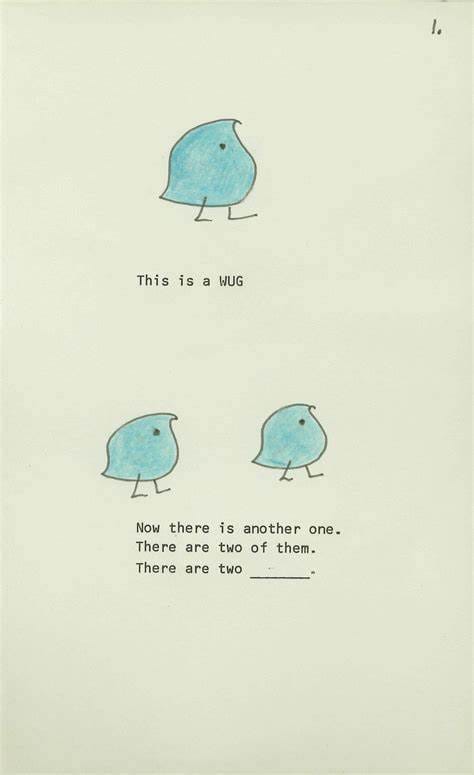
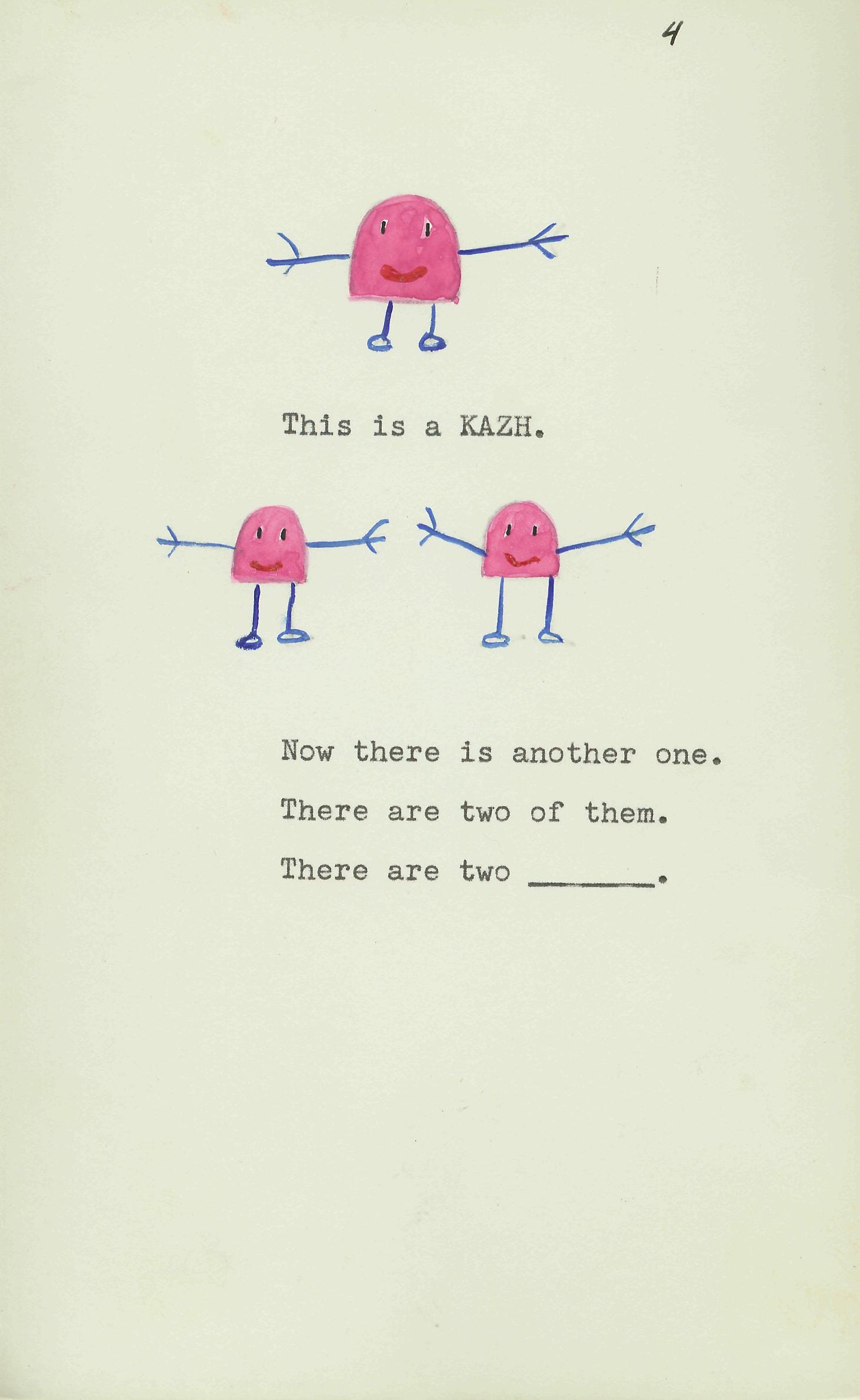
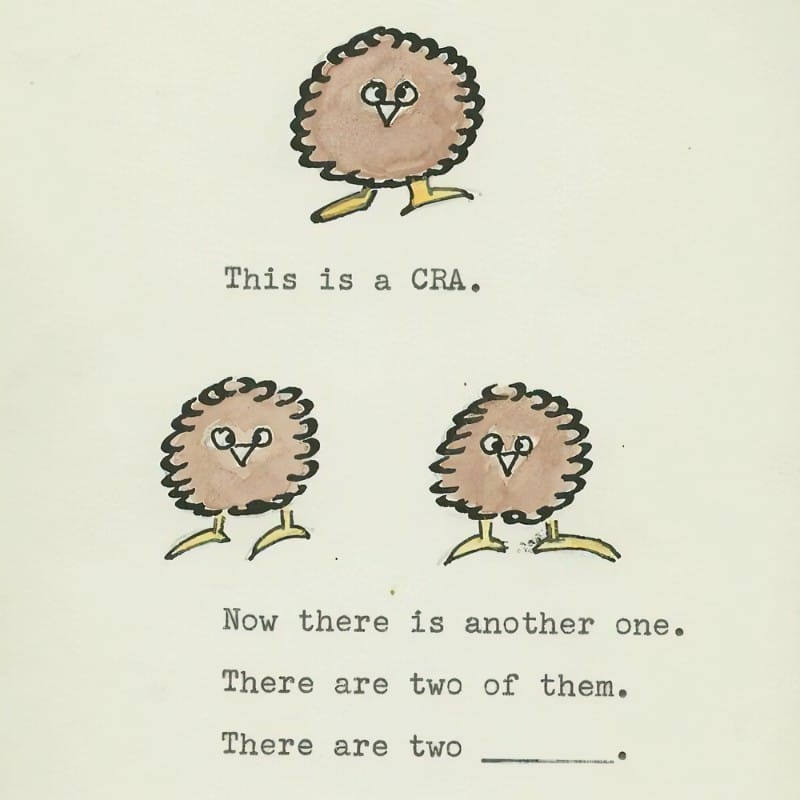
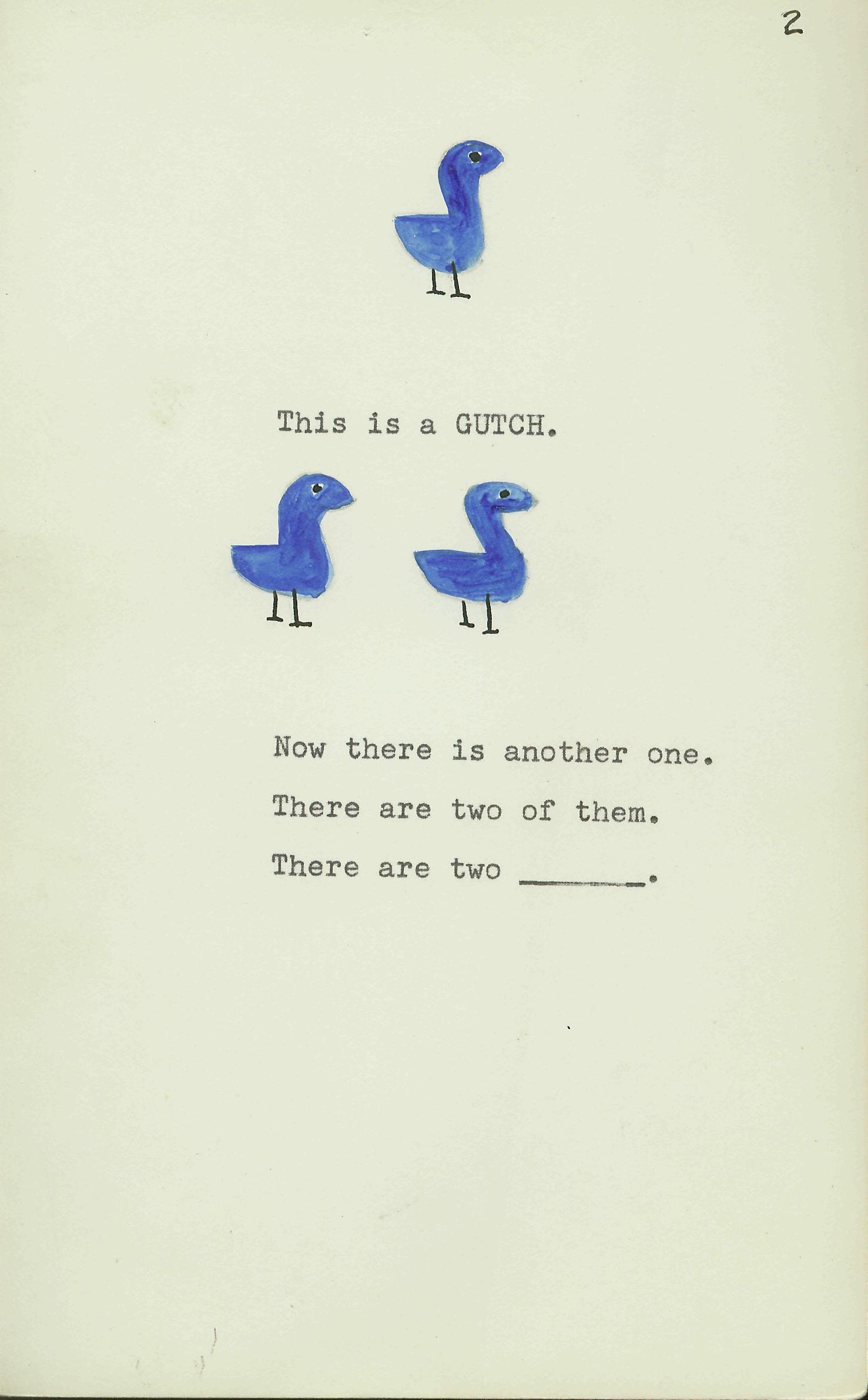
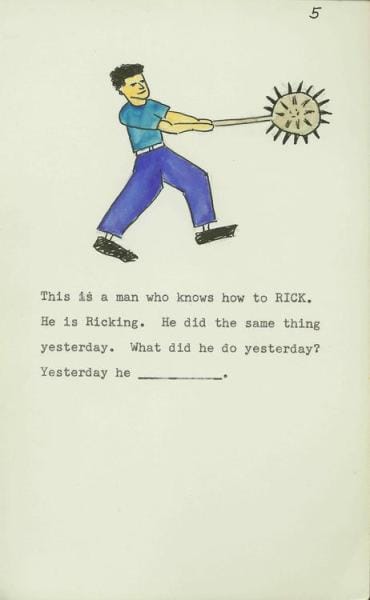
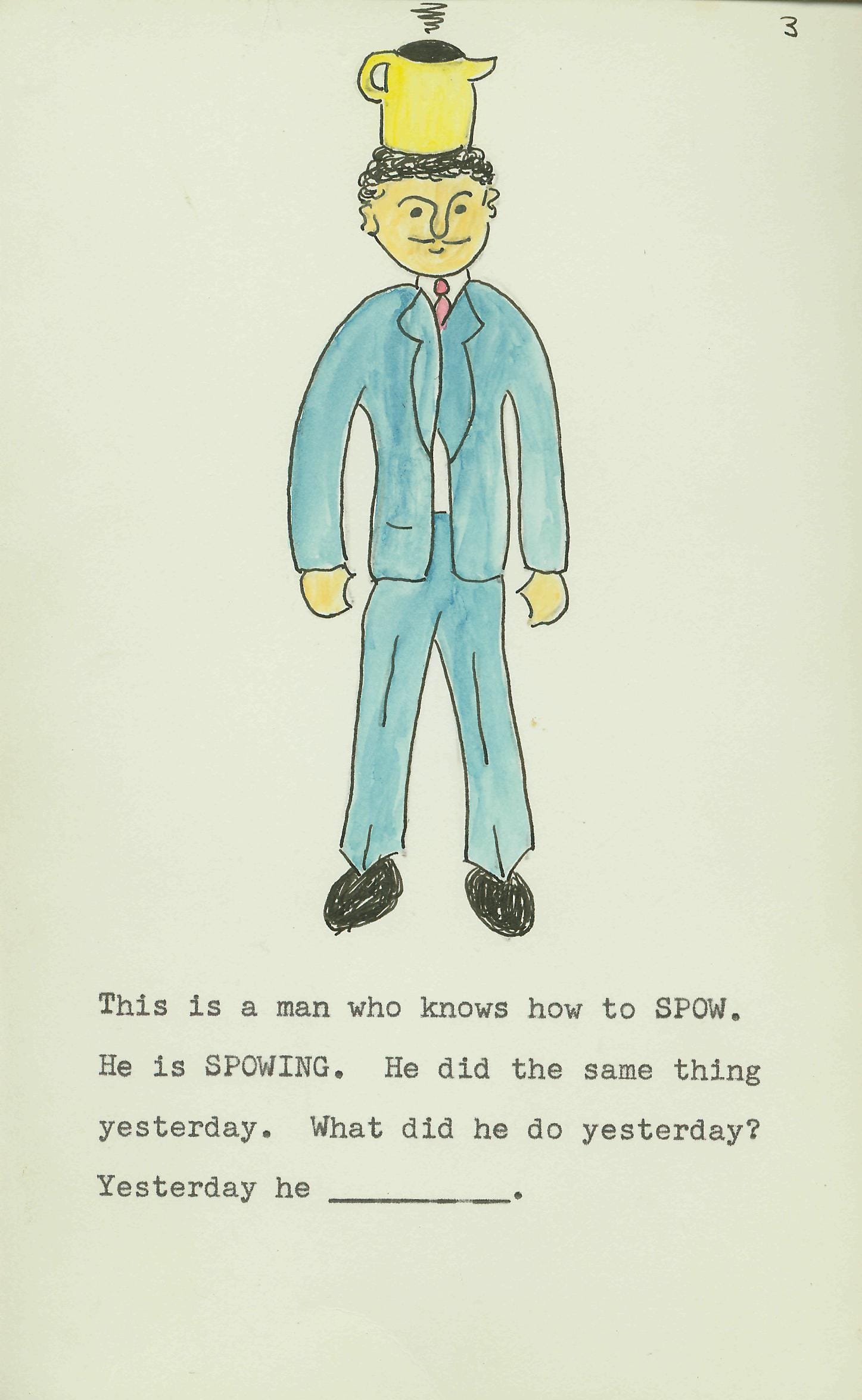
Elicitation stimuli from the original Wug Test (Berko 1958)
Gleason also created cards to test for the progressive ‑ing, the third person singular ‑s, and the possessive ‑’s and plural possessive ‑s’, but most items focused on plural ‑s and past tense ‑ed.
This experimental format worked particularly well with young children because it mirrors picture books, which they all had experience with. The nonsense words were also carefully built to obey English sound patterns. In fact, they were so plausible that Gleason writes:
It was, moreover, evident that a great number of these children thought they were being taught new English words. It was not uncommon for a child to repeat the nonsense word immediately upon hearing it and before being asked any questions. Often, for example, when the experimenter said “This is a gutch”, the child repeated, “Gutch”. Answers were willingly, and often insistently, given. (p. 3–4)
The words were designed to test whether children had internalized the various pronunciation rules explained above. Some ended in voiceless consonants, others in voiced sounds, others in sibilants, and others in alveolar stops. If the child really knew these rules, they should be able to apply them to new words to produce the right allomorph: /wʌgz/ for wugs, /rɪkt/ for ricked, and so on. Gleason also included a few real words to compare children’s performance on familiar words versus made-up ones. These came later in the experiment so that they would not prime the children’s responses for the nonsense words. For example, glass only appeared several turns after tass.
Before running the experiment with children, Gleason tested the materials with twelve adults, and used their answers as the standard of correctness. A child’s response was considered “correct” if it matched any adult response. The experiment was conducted with two groups of children in the U.S.: one group in preschool (where students are between 4 and 5 years old) and one group in first grade (where children are between 5.5 and 7 years old).
Results I: How children learn plural nouns
The Wug Test demonstrates that two individuals can produce the same surface forms but have different underlying grammars.
What did we learn from the Wug Test? Table 2 lays out the raw results, which we’ll break down in a moment. It shows the percentage of correct answers given for each test item in each age group.
| Preschool | First Grade | |
|---|---|---|
| Plurals | ||
| glasses | 75 | 99 |
| wugs | 76 | 97 |
| luns | 68 | 92 |
| tors | 73 | 90 |
| heafs | 79 | 80 |
| cras | 58 | 86 |
| tasses | 28 | 39 |
| gutches | 28 | 38 |
| kazhes | 25 | 36 |
| nizzes | 14 | 33 |
| Progressive | ||
| zibbing | 72 | 97 |
| Past | ||
| binged | 60 | 85 |
| glinged | 63 | 80 |
| ricked | 73 | 73 |
| melted | 72 | 74 |
| spowed | 36 | 59 |
| motted | 32 | 33 |
| bodded | 14 | 31 |
| rang | 0 | 25 |
| Third Singular | ||
| loodges | 57 | 56 |
| nazzes | 47 | 49 |
| Possessive | ||
| wug’s | 68 | 81 |
| bik’s | 68 | 95 |
| niz’s | 58 | 46 |
| wugs’ | 74 | 97 |
| biks’ | 74 | 99 |
| nizzes’ | 53 | 82 |
Let’s start with plural nouns. Table 3 combines the data from the two age groups for plurals.
| Item | Allomorph | % Correct |
|---|---|---|
| glasses | /‑ɪz/ | 91 |
| wugs | /‑z/ | 91 |
| luns | /‑z/ | 86 |
| tors | /‑z/ | 85 |
| heafs / heaves | /‑s/ or /‑z/ | 82 |
| cras | /‑z/ | 79 |
| tasses | /‑ɪz/ | 36 |
| gutches | /‑ɪz/ | 36 |
| kazhes | /‑ɪz/ | 31 |
| nizzes | /‑ɪz/ | 28 |
The word bik was also used in a pretest with the children, and Gleason reports that they used the correct form of bik with the same degree of accuracy as they did for wug.
The first thing to notice is the huge spread in accuracy across items—from 91% for glasses to 28% for nizzes. What explains this disparity? First, children have little trouble with the simpler allomorphs /‑s/ and /‑z/, even for novel words. Any difficulty they do have vanishes by first grade, as Table 2 shows. So at the outset we have strong evidence that children have in fact internalized an abstract rule about the formation of English plurals by age 7—already a very cool and (at the time) groundbreaking result.
Yet even among the /‑s/ and /‑z/ forms, children’s accuracy varies. Why do they perform so well with bik and wug but relatively worse on cra? Gleason posits that this is due to a quirk of the English sound system: Every language has rules about which sounds are allowed to appear next to each other and how they can be arranged within syllables and words. These are called the phonotactics or phonotactic rules for a language. One phonotactic rule of English is certain consonant clusters are disallowed at the ends of syllables. In particular, sibilants must match the voicing of the previous consonant. This means that the sequences */kz/ and */gs/ never occur—which coincidentally rules out forms like */wʌgs/ and */bikz/.
Because of this phonotactic rule, bik and wug are not actually the decisive test cases they seem to be. Correctly using /‑s/ with bik and /‑z/ with wug isn’t technically enough to demonstrate that children know the pronunciation rules for plural nouns. They might just be following a more general pattern about how English sounds can be arranged. The real test case, therefore, is nouns that end in vowels, the semivowels /w j/, or the liquid consonants /l r/. That’s precisely what lun, tor, and cra are designed to test. The fact that children perform well with these nouns shows definitively that they have internalized the pronunciation rules for the /‑s/ and /‑z/ variants of the English plural. And children’s mastery of these forms solidifies between preschool and first grade.
At the same time, however, children did not perform as well on lun, tor, and cra as they did on bik and wug. Why? It may be that children do better when plural form also aligns with English’s natural sound patterns. But for lun, tor, and cra, there is no such general pattern to follow. Children are forced to choose between /‑s/ and /‑z/ based on some other principle. The children who missed these items may have learned the general phonotactic rule about English but not the pronunciation rules for the English plural. What I find especially cool about this is that it demonstrates how two individuals can produce the same surface forms but have different underlying grammars. Linguists call this grammatical isomorphism.
Next, notice how poorly children performed with sibilant-final nouns—tass, gutch, kazh, nizz. The one exception was the word they already knew, glass. They performed better with glass than any of the nonsense words, but they struggled to extend /‑ɪz/ to new words, even by age 7. At first glance, this looks like rote learning: children produce glasses because they’ve memorized it; they haven’t learned the rule for /‑ɪz/ yet. But a closer look suggests something much more advanced (and cooler!) is going on. To understand what, we need to understand the difference between rules and schemas.
Rules vs. Schemas
The rule these children have internalized isn’t, “Add an ‑s to make a noun plural,” it’s “Nouns that end in sibilants are plural.”
What’s striking is not that children got these items wrong, but how confidently they got them wrong:
It must be noted, however, that in these items, the children delivered the wrong form with a great deal of conviction: 62% of them said “one tass, two tass” as if there were no question that the plural of tass should and must be tass. (p. 163)
Contrast this with the children’s behavior when they were uncertain:
Every child interviewed understood what was being asked of [them]. […] In some instances they pronounced the inflexional endings they had added with exaggerated care, so that it was obvious that they understood the problem and wanted no mistake made about their solution. Sometimes, they said “That’s a hard one,” and pondered a while before answering, or answered with one form and then corrected themselves. The answers were not always right so far as English is concerned; but they were consistent and orderly answers, and they demonstrated that there can be no doubt that children in this age range operate with clearly delimited morphological rules.
Elsewhere, Gleason notes that the most common response when children were uncertain was simple silence. So why the enthusiasm with sibilant-final nouns? It seems like children actually have learned a rule—just not the correct one. But what rule?
The rule these children have internalized isn’t, “Add an ‑s to make a noun plural,” it’s “Nouns that end in sibilants are plural.” When they hear gutch or tass, they assume it’s already plural because it ends in a sibilant. The difference between these two formulations is that the former is a rule-based approach with inputs and outputs (STEM + ‑s ⇒ PLURAL), and the latter is a schematic approach that checks whether the word matches a template or pattern. A rule-based approach suggests that children pay attention to the source or input form and then add inflectional endings to it, while a schematic approach suggests that children pay attention to the goal or target form and check whether the word they’re using fits the schema. Subsequent research supports the schematic perspective. Children do in fact rely on schemas rather than rules in their acquisition of inflection (Clark 2024: 239–240).
Children’s performance with heaf is also revealing in this regard: While 42% of adults gave heaves as the plural of heaf, only 3 out of 89 children did. Most children said heafs. This shows that children have not yet acquired the irregular /f/ ~ /v/ alternation, as in leaf ~ leaves. But more relevantly to the point about schemas, 9 children (10%) produced the singular heaf, and 4 used /‑ɪz/ as though /f/ were a sibilant. While /f/ is not actually a sibilant, it is perceptually very similar. Children who said heaf or heafes were treating /f/ as a sibilant, and either correctly applied the /‑ɪz/ suffix like any other sibilant, or matched it to the sibilant schema and treated it as already plural. What incredible pattern-matching and analogical reasoning skills these kids have!
Results II: Past tense and tricksy possessives
Children’s difficulty with the /‑ɪz/ form of the possessive ‑’s mirrored their difficulty with the /‑ɪz/ form of the plural ‑s, as you can see in Table 4:
| Form | Allomorph | % Correct |
|---|---|---|
| bik’s | /‑s/ | 87 |
| wug’s | /‑z/ | 84 |
| niz’s | /‑ɪz/ | 49 |
This is no surprise, since the possessive ‑’s follows the same pronunciation rules as plural ‑s.
For plural possessives ‑s’, however, children didn’t add anything. They simply repeated the singular. While this is traditionally correct for plural possessives (e.g. the possessive of girls is girls’, and both words are pronounced the same: /ɡɝlz/), the children were probably producing the correct form for the wrong reason: they treated any noun ending in a sibilant as already possessive (and plural). Same output, but different underlying grammar.
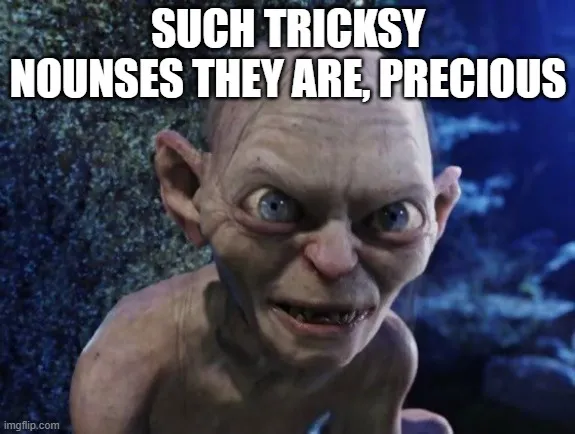
But I get the impression that now, 70 years later, people do in fact say this, at least when they’re trying to enunciate or clarify a plural possessive. And there’s certainly been an increase in the jocular use of this form thanks to Gollum in the Lord of the Rings movies. But even setting aside jocular uses, it seems to me that the use of /‑ɪz/ for plural possessives is actually starting to gain some acceptance. Perhaps in a hundred years we’ll all be saying “the girlses books” instead of “the girls’ books”.
As for the past tense ‑ed, children could easily handle the /‑t/ and /‑d/ variants, but not the /‑ɪd/ variant. Like with /‑ɪz/, they could correctly apply the /‑ɪd/ version to the real word melt → melted, but not the nonsense words mot and bod. And also like /‑ɪz/, their performance with /‑ɪd/ improved with time (14% of younger children correctly produced bodded as compared to 31% of older children), but overall their performance for this variant was dismal. Here again it is likely that children internalize a schema “verbs that end in an alveolar stop /t d/ are past tense” rather than a rule “add ‑ed to the stem”.
Another pattern that emerges from the past tense data is that children do not create irregular past tense forms like bing → bang or gling → glung. Virtually every English verb whose stem ends in ‑ing has an irregular past:
- sing → sang
- ring → rang
- cling → clung
So it’s reasonable to expect that children might pick up on this pattern too, as common as it is. Yet while 50% of adults use an irregular past for the nonsense words bing and gling, only one child did so for bing and one for gling. Remember that children likewise do not form an irregular plural heaves from heaf, even though adults do. Taken together, these results suggest that children at this age have not yet begun to internalize the handful of patterns governing irregular inflections—they’re still working on the regular ones!
What grammatical words/affixes do children learn first?
Overall, children’s performance with past tense verbs parallels their performance with plurals, with one notable difference: they do better with plurals than past tense. And that’s not surprising, because the plural ‑s suffix is generally acquired before the past tense ‑ed suffix! (Brown 1973). Table 5 shows the order of acquisition for 14 grammatical words and affixes in English.
(Spock apparently never made it past stage 12, since he doesn’t use contractions. 🖖🏼)
| Order | Grammatical Construction | Meaning | Example |
|---|---|---|---|
| 1 | progressive: ‑ing | ongoing process | He’s sitting down. |
| 2 | in | containment | It’s in the box. |
| 3 | on | support | It’s on the chair. |
| 4 | plural: ‑s | number | The dogs bark. |
| 5 | irregular past: e.g. went | earlier in time | He went home. |
| 6 | possessive: ‑’s | possession | The girl**’s** dog ran away. |
| 7 | uncontractable copula: was, are (as in questions) | number; earlier in time | Are they boys? |
| 8 | articles: a, the | nonspecific, specific | Jan has a book. |
| 9 | regular past: ‑ed | earlier in time | He jumped the stream. |
| 10 | 3rd person singular regular verb inflection: ‑s | number; earlier in time | She runs fast. |
| 11 | 3rd person irregular verb inflection: has, does | number; earlier in time | Does that dog bark? |
| 12 | uncontractable auxiliary verb: is, were | number; earlier in time; ongoing process | Is he coming? |
| 13 | contractable copula verb: ‑’m, ‑’re, ‑’s | number; earlier in time | That**’s** a spaniel. |
| 14 | contractable auxiliary verb: ‑’m, ‑’re, ‑’s | number; earlier in time; ongoing process | They**’re** running fast. |
The three factors which most strongly influence this order are semantic complexity, formal complexity, and frequency (Clark 2024: 227). Semantic complexity refers to the number of meanings conveyed by a word/affix. The more meanings a word encodes, the longer children take to learn it. Notice how, in Table 5, the further down the list a word is, the more meanings it encodes.
Formal complexity refers to the number of forms that a word/affix has for the same function. The more forms there are, the more “moving parts” children have to learn. In Dutch, for example, there are two totally distinct plurals, ‑s and ‑en (which English has a remnant of in brethren), and the plural ending you use depends on the specific noun:
- Nouns that take the ‑en plural
- boek ‘book’ → boeken ‘books’
- kat ‘cat’ → katten ‘cats’
- Nouns that take the ‑s plural
- tafel ‘table’ → tafels ‘tables’
- dokter ‘doctor’ → dokters ‘doctors’
Even more complex is Swahili, where the plural prefix depends on the noun class, of which there are many. (Think of noun classes like grammatical gender, but situated around other semantic categories than masculine/feminine/neuter. Possible categories include humans, plants, body parts, man-made objects, animals, etc. The semantic basis of noun classes varies by language.) So the plural in Swahili is not one affix, but rather a whole set of affixes:
| Noun Class | Singular | Plural | Semantic Basis |
|---|---|---|---|
| m‑/wa‑ | mtu ‘person’ | watu ‘people’ | humans, animates |
| m‑/mi‑ | mti ‘tree’ | miti ‘trees’ | plants, inanimates |
| ji‑/ma‑ | jicho ‘eye’ | macho ‘eyes’ | various, body parts, fruits, pairs/groups of things |
| ki‑/vi‑ | kitu ‘thing’ | vitu ‘things’ | various, manner/way, languages |
| u‑/n‑ | uso ‘face’ | nyuso ‘faces’ | things with extended outlines/shapes |
| n‑/n‑ | ng’ombe ‘cow’ | ng’ombe ‘cows’ | animals, inanimates |
As you can see, Swahili plural nouns are quite complex, and children generally take longer to master all their nuances than English-speaking children do to master the comparatively simple ‑s suffix and its variants.
Finally, the more frequently a child is exposed to a form, the earlier they typically acquire it. This is one reason child-directed speech (“baby talk”) can have such an outsized effect on language acquisition. I discuss these factors in more detail in this article on baby talk.
 Daniel W. Hieber, Ph.D.
Words or rules?
Children aren’t acquiring rules so much as they are learning to recognize schemas or templates.
So what are children actually learning: productive rules or a big catalog of memorized forms? One popular textbook on child language acquisition frames the problem this way:
In principle, a child could get by in life without any knowledge of [grammatical affixes]. All we would need is a powerful long-term memory storage system, something which humans do, in fact, possess. Using a sufficiently extensive memory, we could learn every word form as it stands, with no reference to or acknowledgement of any internal morphological structure. On this model of learning, the child would treat words like parrots, believing and wanted as indivisible wholes. The child would never need to analyse words into their constituent parts (e.g., parrot + ‑s). (Saxton 2017: 178)
There is in fact good evidence that this is how children start out. They begin as whole-word learners, memorizing specific inflections for specific uses, and only later generalize the pattern to other words (Saxton 2017: 178; Evans 2019: 154; Zukowski & Bernstein Ratner 2022: 155–156; Clark 2024: 228). This means that children may produce adult-like forms long before they learn a productive rule. Children acquiring Hungarian, for instance, produce correctly-inflected words even during the earliest one-word stage of language (MacWhinney 1985). Initially, there are no signs that the inflectional affixes are productive. Children only produce inflected forms that they’ve already heard from their parents (Tomasello & Brooks 1998).
Children also produce inflected forms before they understand them. In one experiment, toddlers were presented with pictures of 1 novel object on one side and 2 novel objects on the other, and were told “Look at the X!”, where X would be a nonsense word either in the singular or plural, e.g. “Look at the jeels!” If children understand plural ‑s, they should look reliably at the correct picture. But children as old as 24 months were insensitive to the plural marker. They’d stare at either picture with equal likelihood. Only around 30 months did they begin to look consistently at the picture that matched the singular or plural form, even though they correctly produce plural markers well before 30 months! (Jolly & Plunkett 2008)
Another strategy children rely on, especially in highly inflected languages with lots of noun cases or verb conjugations, is to pick one form as the default—e.g., the infinitive form of the verb—and use it everywhere. So while the word itself may be well-formed, its use in context is often ungrammatical. But because, as we saw earlier, children tend to acquire the most frequent forms, this strategy may actually mean that children are getting the form right in the majority of cases!
This is another example of children using grammatical assumptions that approximate—but don’t quite match—adult grammar, like the plural and past tense schemas we saw earlier. Since numerous equivalent (isomorphic) grammars could produce the same surface-level output, children are faced with the unenviable task of inferring exactly which grammatical rules will best result in language that matches that of their caregivers. What this means in practice is that children constantly (and subconsciously) massage their grammatical assumptions in order to more and more closely approximate what they hear, until their speech converges on the adult target. Of course, sometimes they land on slightly different rules than their parents did, with the result that language changes with each generation, and now we have things like lonely transitives and costed as a regular past tense instead of cost. That’s language change for ya 🤷🏼
So do children learn abstract grammatical rules? Yes, eventually. They learn the most general rules first (e.g. add an /‑s/ to make a word plural) and only later do they master more specific rules that only apply in certain contexts (e.g. add an /‑ɪz/ only if the word ends in a sibilant). But evidence suggests that children aren’t so much acquiring rules as they are schemas or templates, and this explains their poor performance with the /‑ɪz/ form of the plural and the /‑ɪd/ form of the past. And for the children who do not answer items on the Wug Test correctly but nonetheless do produce correct plurals for real words, it is safe to say that they have not yet learned the abstract schema. They are still memorizing words on an item-by-item basis. It is only after sufficient exposure to the pattern/template that they learn to generalize.
Of course, children eventually do become sensitive to the internal structure of words and master all the grammatical rules of their language, and to this day one of the best demonstrations of that fact is the Wug Test.

📚 Recommended Reading
Gleason’s original 1958 article (published under her maiden name, Berko) is available via open access here:
- Berko, Jean. 1958. The child’s learning of English morphology. Word 14(2–3). 150–177. https://doi.org/10.1080/00437956.1958.11659661.
I have an entire series of articles on the science of baby talk here:
👶 The science of baby talk
- Part 1: Why you should be talking to your infant
- Part 2: What’s the point of baby talk?
- Part 3: Is baby talk good for your child?
- Part 4: Do all cultures use baby talk? [forthcoming]
- Part 5: Baby talk in the languages of the world
- Part 6: How much should you talk to your child?
- Part 7: What really matters when talking to your child
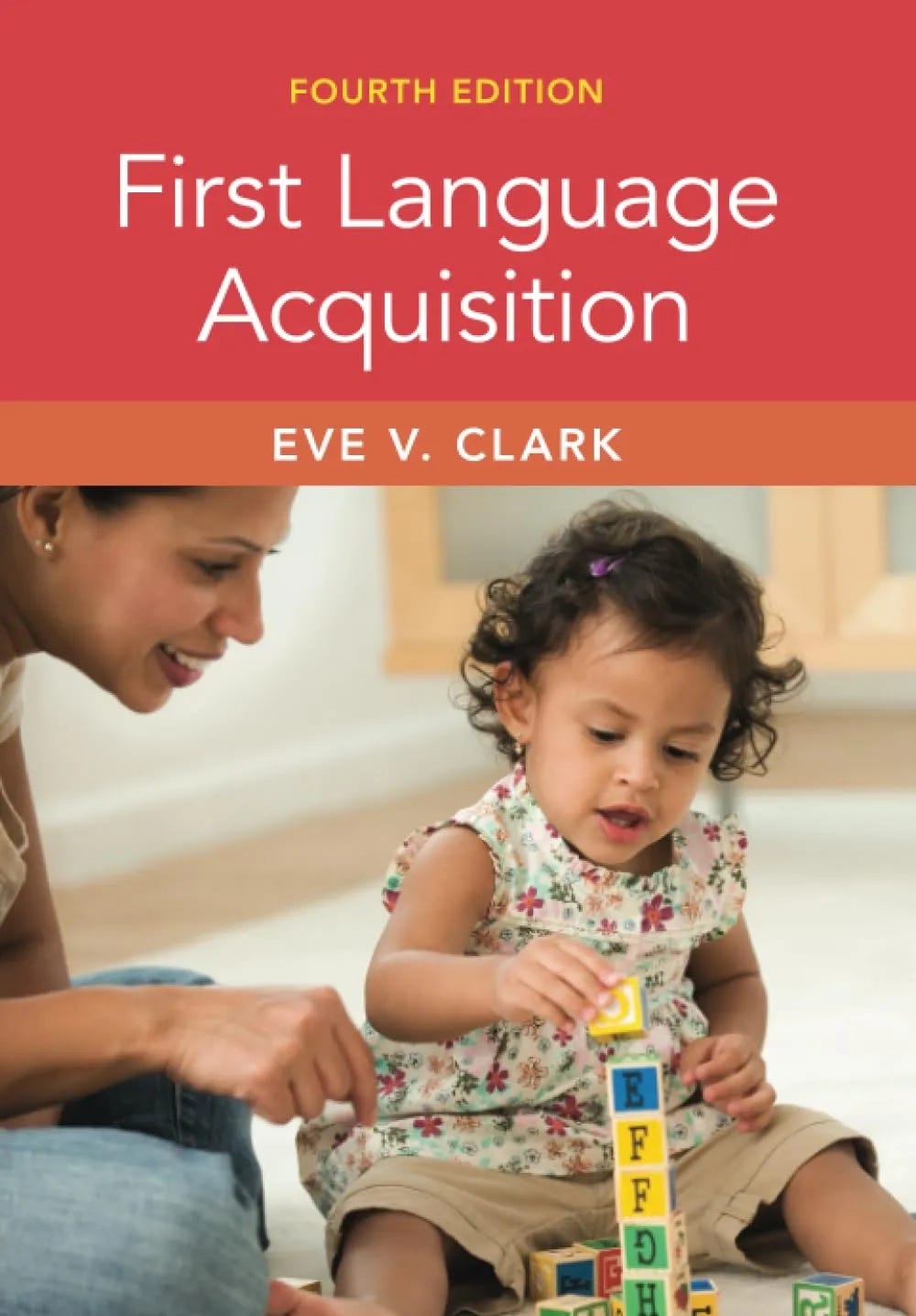
This is (in my opinion) the best introduction to child language acquisition:
Here are two popular YouTube videos about Gleason’s seminal contribution to the field of linguistics:
📑 References
- Berko, Jean. 1958. The child’s learning of English morphology. Word 14(2–3). 150–177. https://doi.org/10.1080/00437956.1958.11659661.
- Brown, Roger. 1973. A first language: The early stages. Harvard University Press.
- Clark, Eve V. 2024. First language acquisition. 4th edn. Cambridge University Press. https://doi.org/10.1017/9781009294485.
- Evans, Vyvyan. 2019. Cognitive linguistics: A complete guide. 2nd edn. Edinburgh University Press.
- Jolly, Helen R. & Kim Plunkett. 2008. Inflectional bootstrapping in 2-year-olds. Language & Speech 51(1–2). 45–59. https://doi.org/10.1177/00238309080510010401.
- MacWhinney, Brian. 1985. Hungarian language acquisition as an exemplification of a general model of grammatical development. In The crosslinguistic study of language acquisition. Psychology Press.
- Saxton, Matthew. 2017. Child language: Acquisition and development. 2nd edn. SAGE.
- Tomasello, Michael & Patricia J. Brooks. 1998. Young children’s earliest transitive and intransitive constructions. Cognitive Linguistics 9(4). 379–396. https://doi.org/10.1515/cogl.1998.9.4.379.
- Zukowski, Andrea & Nan Bernstein Ratner. 2022. Putting words together: Comprehension and production of morphology and syntax in the preschool years. In Jean Berko Gleason & Nan Bernstein Ratner (eds.), The development of language. 10th edn. Plural Publishing.
If you’d like to support Linguistic Discovery, purchasing through these links is a great way to do so! I greatly appreciate your support!
Check out my Amazon storefront here.
Check out my Bookshop storefront here.