The curse of knowledge (and what to do about it)
Inspiring words for linguistics majors


I also included a list of resources on careers in linguistics at the end of this article.
The point of the exercise is to prove to yourself that you’re the type of person who is capable of accomplishing your goals.
I spent my junior year studying abroad in Kenya, researching language shift in Swahili. At one point while I was there one of the other students asked me about some detail of Swahili pronunciation. While I was answering her I realized I had used the word “affricate”, and immediately caught myself, recognizing that that was linguistics jargon she may or may not be familiar with. So I said, “Sorry, do you know what an affricate is?” to which she immediately replied, “Yeah, it’s a sound from Africa, duh.”
All the non-linguists here are confused about why that’s funny. That’s okay; this speech isn’t for you.
That conversation was one of the first times I became aware of the Curse of Knowledge. This is a cognitive bias where you assume that other people have the same kind of specialized knowledge that you do. Once you know something, it’s hard to remember what it felt like not to know it. We forget that we had to learn what a language family is, or even what it means for languages to be related.
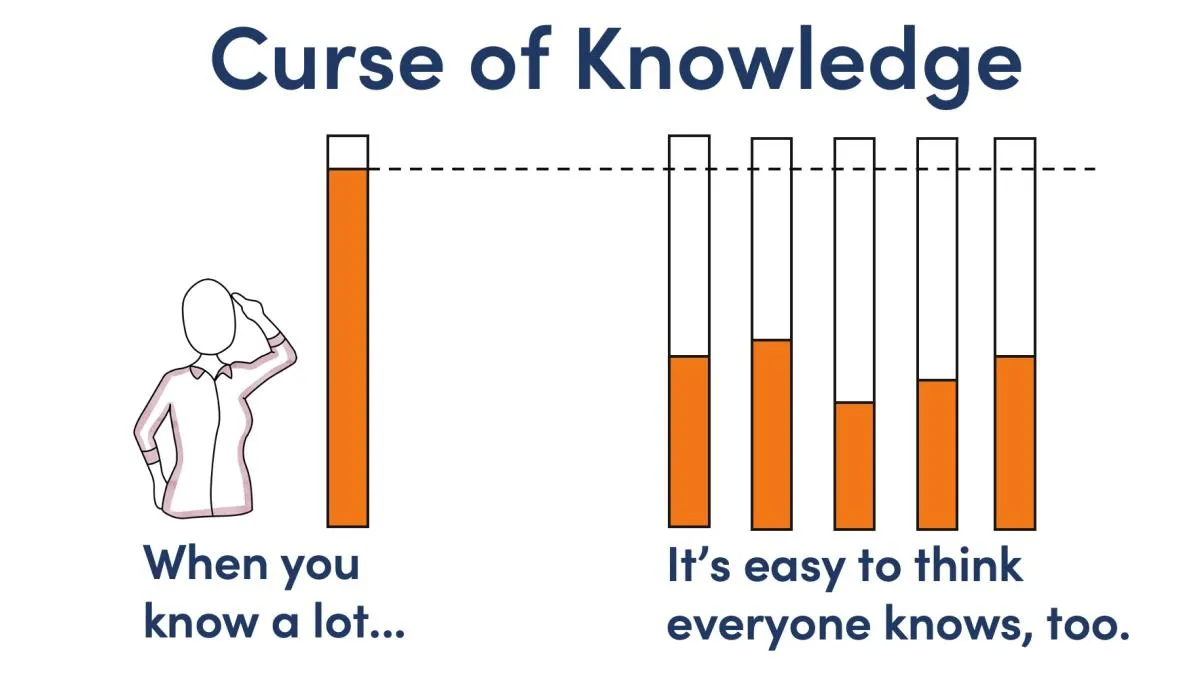
This causes two problems: First, it hinders your ability to communicate ideas to others. Second, it means you’re very likely to overlook or underappreciate just how much you’ve learned, because you’re not aware of it.
I think high performers and overachievers like us are especially bad about this—not because we’re bad communicators, but because we tend to be very forward-thinking. What’s the next project I wanna tackle? What’s the next deadline or fire I need to put out? How can I make an impact in the world? But we’re not very good at taking a moment to pause and reflect on our wins. This is a quiet but pernicious habit that undermines your own confidence, and makes you feel like you’re never enough, you’ve never accomplished enough, you don’t know enough.
The best thing you can do to combat this feeling is to take time on a regular basis—daily, weekly, monthly, and yearly—to appreciate your wins and the lessons you’ve learned. Write them down in a journal. The point of this habit isn’t to just pat yourself on the back to make yourself feel better. The point of the exercise is to prove to yourself that you’re the type of person who is capable of accomplishing your goals. You can’t do that if you never stop to look at the evidence of your accomplishments.
So, in light of that advice, I want to take the rest of this talk to pause and appreciate what you’ve learned doing your linguistics degree.
I think, genuinely, that a linguistics degree is the most useful, versatile, and generally enlightening degree that you can get at university. Allow me to convince you:
For starters, linguistics makes you aware of cognitive bias. You know that linguistic discrimination is one of the last bastions of socially acceptable discrimination only because the majority of people are largely unaware of it. You understand how it affects hiring decisions and dynamics in the workplace. You’re much better prepared for how to think about and address these issues.
Linguistics also makes you a better communicator. You know that language is often less about what is said and more about what is implied or accomplished with speech—Gricean maxims, and the difference between semantics and pragmatics. Every one of you, I’m sure, has had to explain the difference between prescriptivism and descriptivism to someone else when they were being judgey about language. That makes you a science communicator! (which is what I call myself because it’s less cringey than “influencer”). Distilling complex technical ideas in a way that’s accessible to non-specialists is an incredibly useful skill to have.
Linguistics teaches you to think like a scientist. The first thing you learn in LING 101 about how linguists think about language is the difference between prescriptivism vs. descriptivism. Descriptivism is at the heart of what it is to do science: you seek to describe and understand the world before you judge it. Your methods classes taught you about data collection and data management, and to consider ethical questions surrounding how you acquire that data, who has access to it, and how it is used. Over the course of your degree you learned to use evidence-based analysis to structure an argument and present it in an informative way. In industry that’s called data science.
Finally, because it’s such an interdisciplinary field, linguistics exposes you to theoretical paradigms and methodologies from a huge array of different fields.
- Phonetics exposes you to physiology and methods of the hard sciences involving physical measurement.
- Syntax and semantics familiarize you with abstract formal systems.
- Language endangerment and language contact taught you about geopolitics, government policies, and power dynamics.
- You’re more aware of issues in accessibility and inclusivity because you’ve learned about sign languages and minority languages.
- In historical linguistics you might have learned a bit about archaeology and genetics and how they help answer questions about the origins of Indo-European and other language families.
- If you took computational linguistics you might have encountered the basic ideas behind speech recognition and speech synthesis, machine translation and machine learning, AI and Large Language Models.
Across your courses, you’ve engaged with ideas in psychology, cognitive science, neuroscience, evolution, anthropology, sociology, child development, language education, and speech pathology. You’ve been given an intellectual toolkit unlike that of any other students on this campus.
That breadth of knowledge benefits you tremendously because real insight comes from making connections across domains. Multiple studies of Nobel laureates, for example, show that they are significantly more likely to be polymaths across multiple disciplines (Root-Bernstein & Root-Bernstein 2020; Root-Bernstein & Root-Bernstein 2023). Other studies of Nobel-winning research show that integrating knowledge from different disciplines is a core feature of major breakthroughs (Uzzi et al. 2013; Ren, Wang & Li 2023).
You’ve been given a slew of different frameworks for understanding the world. You’ve been taught to think in systems. You know that it’s not enough to find a few similar-sounding words in different languages to call them related, and that you have to look for systematic patterns instead. You’ve come to appreciate the fact that bottom-up, emergent systems like grammar function just fine without top-down, authoritarian oversight. You know that there are often competing pressures at work in any given system. Linguistic relativity (the Sapir-Whorf Hypothesis) tells us that language influences the way we think, but we also know that language is shaped by how it’s used. There are counterbalancing processes at work. And you’ll think about that every time someone makes a bold, absolutist claim in a field you know nothing about. It raises a red flag because you know that the world is more complicated than that.
Acquiring technical skills like advanced statistical modeling or programming is relatively easy. You’ve just finished a degree in linguistics; you’re more than capable of picking up a few books or working through a course and learning what you need to. What’s hard to learn is the soft skills, the analytical frameworks, and the different ways of thinking about a problem—and that is where your degree in linguistics really shines. Indeed, there are reports that employers look for these “soft” skills in graduates over specific technical expertise.
So I hope I’ve convinced you that your linguistics degree is more valuable than you realized, and that you are more knowledgeable than you maybe appreciated. It’s easy to take for granted how much we’ve learned in life and just how far we’ve come. You’re already suffering from the Curse of Knowledge! But I doubt any other group of students on this campus is graduating with the same breadth of knowledge that you are. Right now you have more competence than confidence, and my goal with this talk was to hopefully help shift that balance in the other direction.
This talk is about linguistics, but also not about linguistics. It’s about taking the time to appreciate how far you’ve come and what you’re capable of. It’s about reminding you that what makes you capable of making an impact in the world isn’t your specific skillset or technical expertise, but the fact that you sought out different ways of seeing the world. And I think there’s an important lesson in that.
Thank you for having me today. Congratulations my fellow linguists!
(Also be sure to check out the list of resources on careers in linguistics further below.)
ℹ️ Resources
If you’re still anxious about job prospects post-degree, here is a list of resources on jobs relating to or utilizing your linguistics training:
- Linguistic Society of America’s Careers Page
- Hadas Kotek’s blog has lots of posts about linguistics jobs in industry.
- Linguistics Careercast (Apple | Spotify)
- Linguistics Careercast is the podcast devoted to exploring careers for linguists outside academia. We feature interviews with linguists in industry at all stages of their careers: recently graduated, mid-career, and some with 30+ years of industry experience. These career linguists represent tech, marketing, UX, research, data analysis, translation, speech pathology, content creation, and much more.
- Superlinguo
- Lauren Gawne has a long-running series of job interviews with linguists in various careers.
- Linguamonium
- In the career category there’s a bunch of interviews with linguists.
- Career Linguist
- Career Linguist offers personalized consulting, interactive workshops, and engaging webinars designed to help you apply linguistics to your career journey. Whether you’re refining your story, building communication skills, or exploring new career paths, our services provide practical tools to move you forward.
- Surviving linguistics: A guide for graduate students (Amazon)
- Includes chapters on jobs in industry and jobs in academia.
- Language files: Materials for an introduction to language and linguistics (Amazon | Bookshop)
- The final chapter is about what you can do with a degree in linguistics.
- Why study linguistics (Amazon | Bookshop)
- Chapter 10: “After studying linguistics”
📑 References
- Ren, Jingjing, Fang Wang & Minglu Li. 2023. Dynamics and characteristics of interdisciplinary research in scientific breakthroughs: Case studies of Nobel-winning research in the past 120 years. Scientometrics 128(8). 4383–4419. https://doi.org/10.1007/s11192-023-04762-x.
- Root-Bernstein, Michele & Robert Root-Bernstein. 2023. Polymathy among Nobel laureates as a creative strategy—the qualitative and phenomenological evidence. Creativity Research Journal 35(1). 116–142. https://doi.org/10.1080/10400419.2022.2051294.
- Root-Bernstein, Robert & Michele Root-Bernstein. 2020. A statistical study of intra-domain and trans-domain polymathy among Nobel laureates. Creativity Research Journal 32(2). 93–112. https://doi.org/10.1080/10400419.2020.1751545.
- Uzzi, Brian, Satyam Mukherjee, Michael Stringer & Ben Jones. 2013. Atypical combinations and scientific impact. Science 342(6157). 468–472. https://doi.org/10.1126/science.1240474.
If you’d like to support Linguistic Discovery, purchasing through these links is a great way to do so! I greatly appreciate your support!
Check out my Amazon storefront here.
Check out my Bookshop storefront here.