Is it “Iran” or “Persia”? “Persian” or “Farsi”?
On Persia, Iran, Farsi, and Aryan: The many names for Iran, its peoples, and its languages

The country of Iran, especially in older or Classical sources, is often referred to as Persia, and its official language is likewise called Persian, but also called Farsi. Where do these words come from? Are they related? Are they interchangeable? What’s the difference? Today we’ll look at the many names for Iran and its language throughout history.
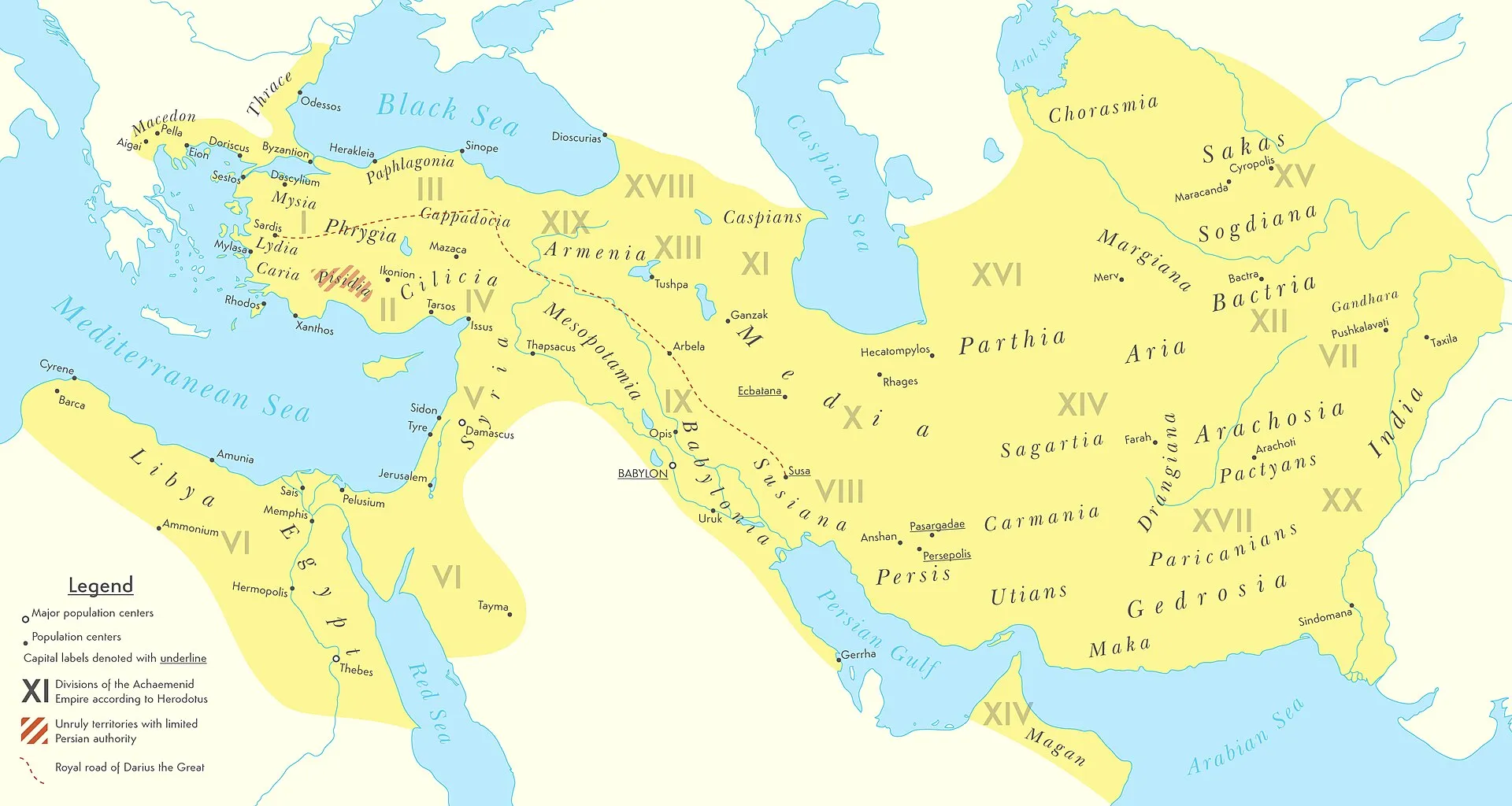
Let’s start with the basics: Persia and Iran refer to the same country. Historical variants of both terms have been in continuous use by different peoples to refer to roughly the same historical region, empire, or country since at least c. 500 BCE. Modern Iran is, to oversimplify, the modern political and cultural descendant of the Persian Empire, now generally referred to by scholars as the Achaemenid Empire (550–330 BCE). Iran is thus home to one of the world’s oldest continuous major civilizations.
Persia
Greek historians even contrived a mythical son of Perseus who was said to be the ancestor of the Persians.
The original Persians were a nomadic people who migrated into the region of southwestern Iran c. 1000 BCE and called themselves the Pārsa, a word whose origin is uncertain. The name might be related to the Sanskrit word पर्शु Parśu, the name of a warrior tribe, or Sanskrit परशु paraśu ‘hatchet, axe’, or derive from Proto-Iranian *párcuš ‘rib’, which in later Sanskrit could also be used to mean ‘the region of the ribs’ or, by metaphorical extension, ‘immediate neighbor’. Regardless, those early Persians bequeathed their name to the area as Persis. That region roughly corresponds to the province of Fars in Iran today, which still bears that name in slightly modified form (the initial /p/ having changed to an /f/—more on this in a bit).
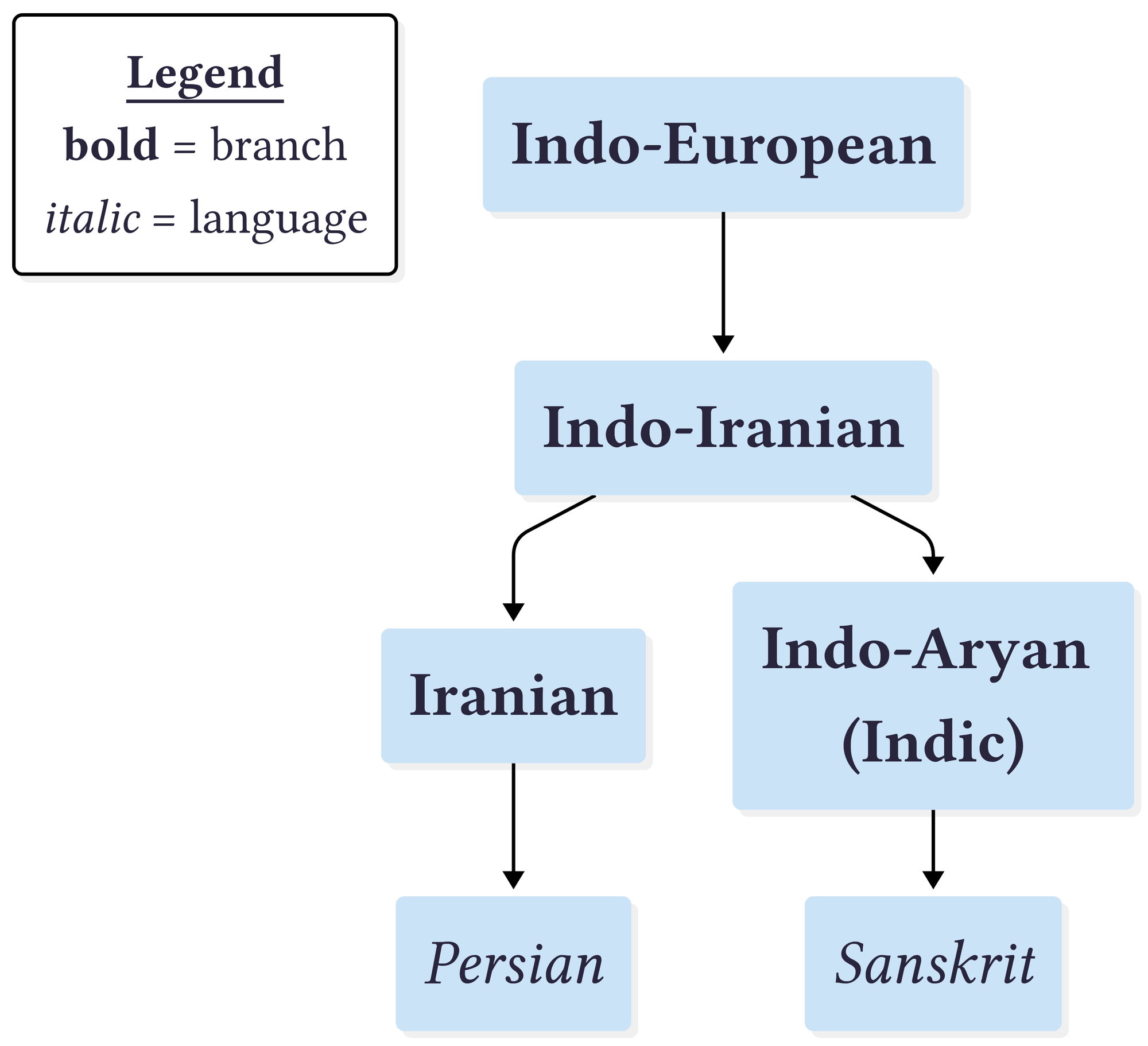
Those ancient Persians were speaking a dialect of a language called Proto-Iranian (spoken c. 1900 – c. 520 BCE), and they had migrated into the region as part of the ongoing expansion of Indo-European peoples into Central Asia and then southward into India and the Iranian Plateau. The group of Indo-Europeans that moved into Central Asia formed the Indo-Iranian branch of the family, which in turn split in two: the Iranian branch moved southwest into the Iranian plateau, while the other sub-branch—called Indo-Aryan—moved into India and produced languages like Sanskrit and Hindi.
One of the southwestern dialects of Proto-Iranian would become Old Persian (spoken c. 600 BCE – c. 300 BCE), which appears in many inscriptions during the Achaemenid (Persian) Empire. The primary administrative language of the Achaemenid Empire was actually Aramaic (a Semitic language related to Arabic and Hebrew, and the language spoken by Jesus), but Old Persian nonetheless played an important local role. In fact, it is one of three languages (along with Elamite [isolate] and Babylonian [Afroasiatic > Semitic]) in the famous Behistun Inscription that was instrumental to the decipherment of cuneiform. This monument is the oldest physical documentation of the Iranian languages (Windfuhr 2009: 5).
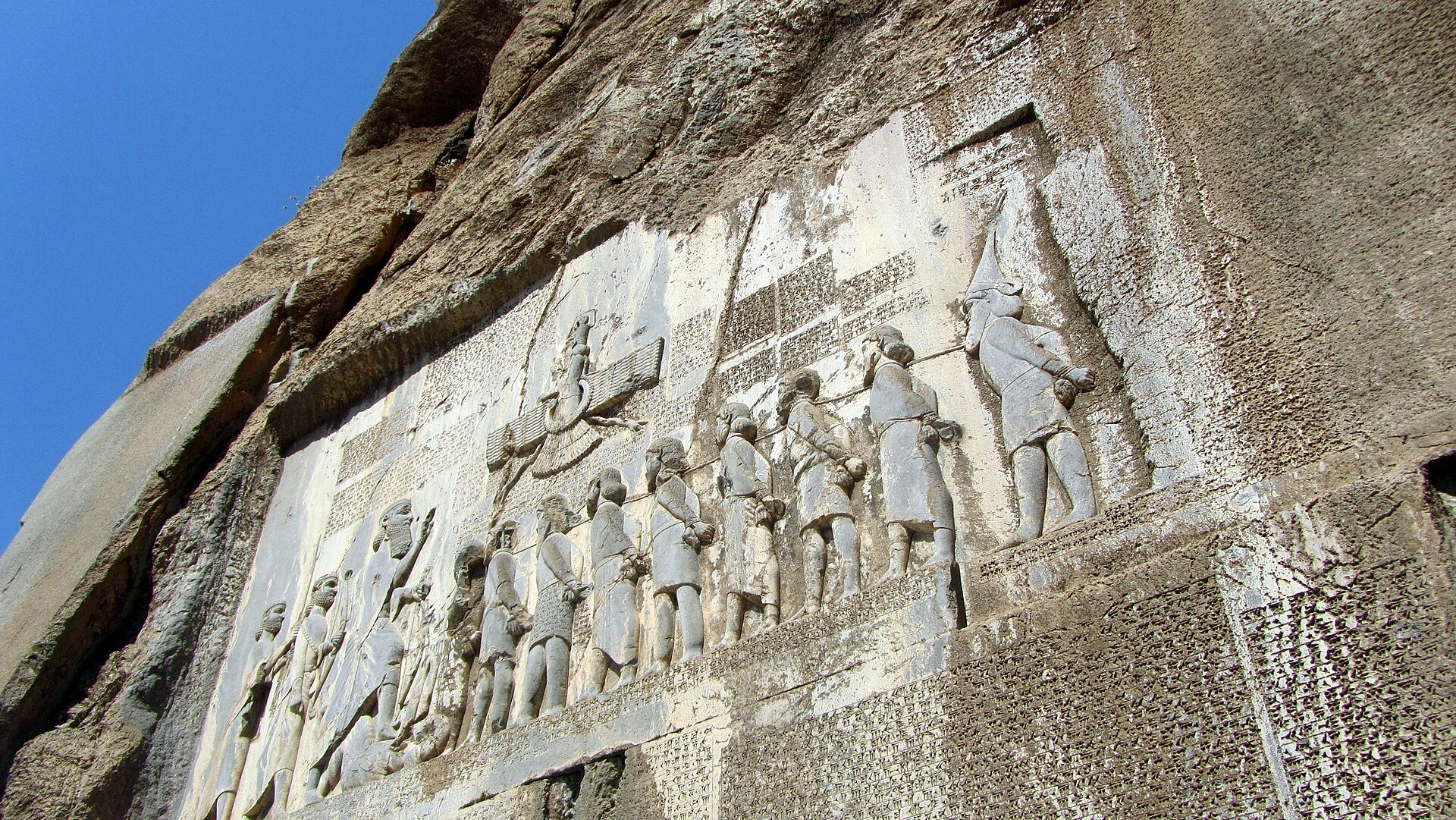
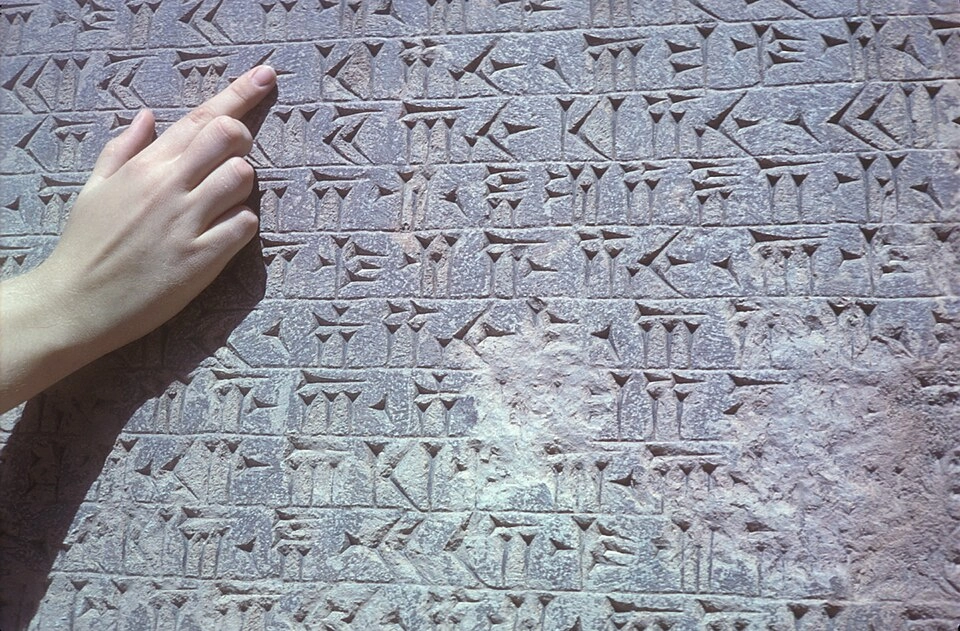
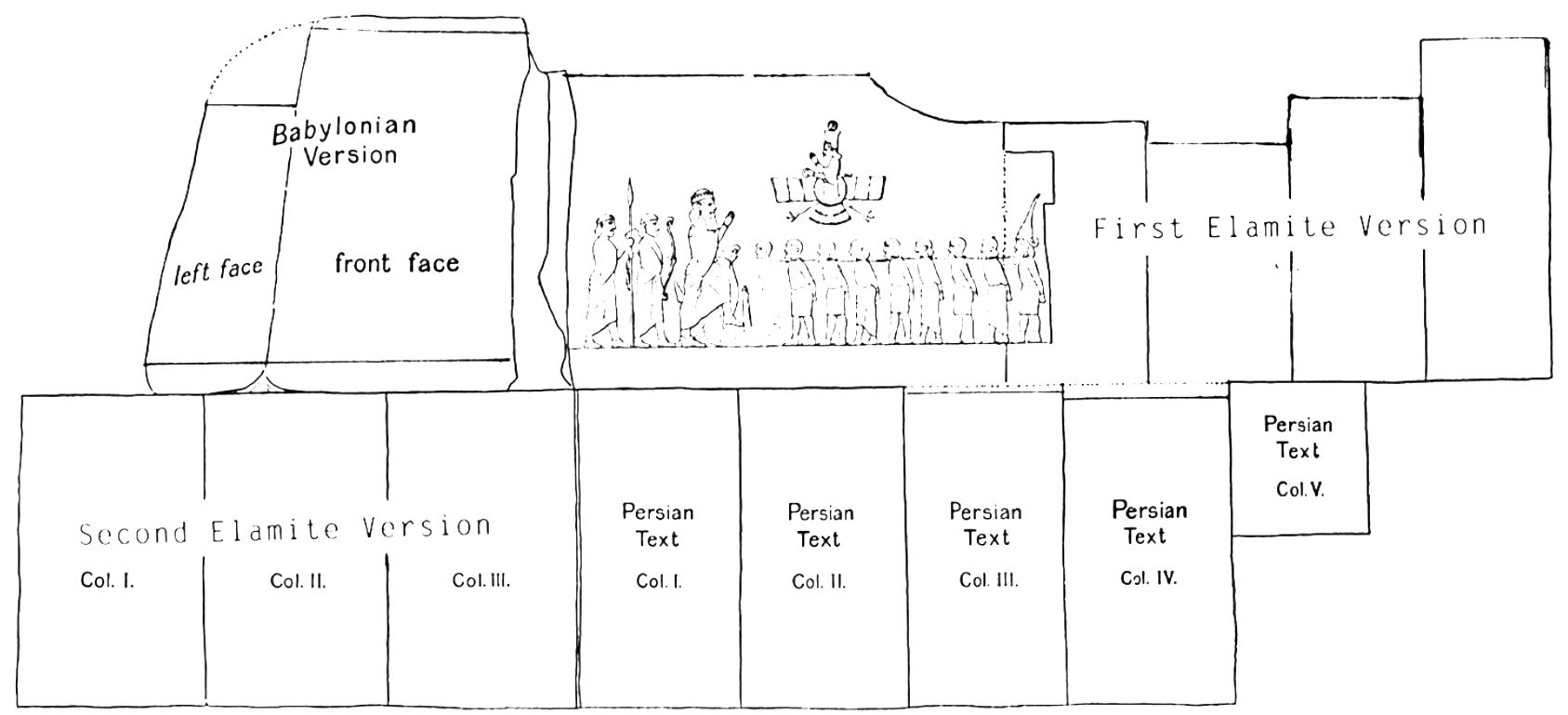
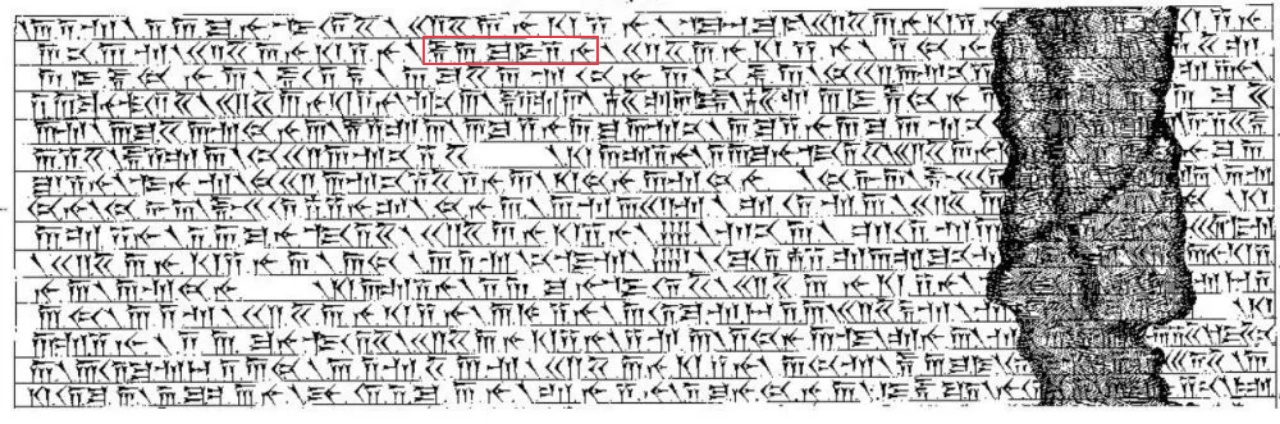
Not only that, but the Old Persian word for ‘Persian’ actually appears within the first sentence of that Behistun Inscription! You can see the word circumscribed in red in the image above. The following example is a transcription and gloss of that first portion of the Old Persian section of the Behistun Inscription.
If any of the abbreviations or notations in this article are unfamiliar to you, check out the “How to read linguistics” page.
But if all this looks too technical/boring, you can skip it without losing the plot.
-
Old Persian (Indo-European > Indo-Iranian)
𐏐𐎠𐎭𐎶𐏐𐎭𐎠𐎼𐎹𐎺𐎢𐏁𐏐𐎧𐏁𐎠𐎹𐎰𐎡𐎹𐏐𐎺𐏀𐎼𐎣𐏐𐎧𐏁𐎠𐎹𐎰𐎡[𐎹𐏐𐎧𐏁𐎠𐎹]𐎰𐎡𐎹𐎠𐎴𐎠𐎶𐏐𐎧𐏁𐎠𐎹𐎰𐎡𐎹𐏐𐎱𐎠𐎼𐎿𐎡𐎹
- 𐎠𐎭𐎶a-d-madamadam1sg;nomI
- 𐎭𐎠𐎼𐎹𐎺𐎢𐏁d-a-r-j-v-u-ʃdārayavaušdārayavahu‑šdarius‑nom;sgDarius
- 𐎧𐏁𐎠𐎹𐎰𐎡𐎹x-ʃ-a-j-θ-i-jxšāyathiyaxšāyathiyaking[nom;sg]king
- 𐎺𐏀𐎼𐎣v-z-r-kvazrakavazrakagreat[nom;sg]great
- 𐎧𐏁𐎠𐎹𐎰𐎡𐎹x-ʃ-a-j-θ-i-jxšāyathiyaxšāyathiyaking[nom;sg]king
- 𐎧𐏁𐎠𐎹𐎰𐎡𐎹𐎠𐎴𐎠𐎶x-ʃ-a-j-θ-i-j-a-n-a-mxšāyathiyānāmxšāyathiya‑ānāmking‑gen;plof kings
- 𐎧𐏁𐎠𐎹𐎰𐎡𐎹x-ʃ-a-j-θ-i-jxšāyathiyaxšāyathiyaking[nom;sg]king
- 𐎱𐎠𐎼𐎿𐎡𐎹p-a-r-s-i-jpārsiyapārsiyapersian[nom;m;sg]Persian
‘I (am) Darius, the great king, king of kings, the king of Persia, […]’
~ The Behistun Inscription, Old Persian Panel, Column I, Lines 1–2
[ ] in the transcription indicate portions of the inscription which were damaged but have been reconstructed from context. Parentheses ( ) in the transcription indicate partially obscured characters. We can be reasonably certain what the obscured/damaged sections say because a) they contain frequently-used formulaic constructions common in royal titularies, and b) the other languages in the inscription contain parallel translations.The pronunciation of 𐏂 is uncertain, but was perhaps a sibilant or affricate. By convention it is typically transcribed as ⟨ç⟩.
For more details about Old Persian cuneiform signs and their pronunciation, see Wikipedia.
My presentation of this example is based in part on the transcriptions and analyses in Schmitt 1991, and that of the Cuneiform Digital Library Initiative and Livius.org.
The kingdom of Parsis even receives mention in the later parts of the Bible, namely the books of Daniel, Esther, Ezra, and Nehemiah, where it is called פָּרַס Pārās in Biblical Hebrew.
Moving on: Old Persian is itself the direct ancestor of the Modern Persian language spoken in Iran, Afghanistan, and Tajikistan. Yet surprisingly, that’s not why the country is sometimes called Persia—at least not directly. The ancient Iranians preferred to refer to themselves using a historical version of the word Iranian, whose etymology we’ll return to in a bit. Persia referred merely to the specific subgroup of Iranians located in Persis, albeit a prominent subgroup. In the Behistun Inscription, Darius the Great lists Persia as one of the twenty-three countries subject to his rule.
How did the name of this one provincial kingdom rise to such prominence? It happened because Cyrus II—commonly known as Cyrus the Great, conqueror of the Median Empire and founder of the Achaemenid Empire—was himself descended from the rulers of Parsis. Prior to his rise to power, the Greeks had referred to the region of the Iranian plateau as Μηδία Mēdía, after the kingdom that preceded the Achaemenid Empire. This changed in the 6th century BCE when Cyrus II conquered the region, at which point the Greeks began to use terms such as Πέρσης Pérsēs, Περσική Persikḗ, Περσίς Persís to refer to his empire. Latin in turn borrowed the name from the Greeks and called the whole empire Persia, the adjective form of which is Persiānus ‘Persian’.
Darius I (Darius the Great), the third King of Kings of the Achaemenid Empire, even claimed ancestry from that original Persian lineage in order to legitimize his rule, despite there being no historical evidence for the claim. For Darius, leaning into the label “Persian” was a politically savvy move, and so the term became associated with the Achaemenid Empire, which was at its greatest extent under his rule. Darius’ son Xerxes I (of 300 film fame) likewise co-opted the name “Persian” to political effect. It so happened that in Greek mythology there was a figure named Perseus, who was the paramount Greek hero and slayer of monsters before Heracles / Hercules. The Greeks noticed the similarity between the words Περσεύς Perseús ‘Perseus’ and Πέρσης Pérsēs ‘Persian’, and assumed a linguistic connection—a folk etymology. Greek historians even contrived a mythical son of Perseus who was said to be the ancestor of the Persians. Xerxes was apparently aware of this myth, and tried to exploit this putative connection between the Persians and the Greeks to secure neutrality from the Argives during his invasion of Greece.
Farsi
In any case, it is because of the prominence of the Persian royal line that the West has generally referred to the Iranian plateau region using some form of the word Persia up until today. Multiple empires throughout history have thus been named the “Persian Empire”: first the Achaemenid Empire, then (after a brief interruption by Alexander the Great) the Parthian Empire, and lastly the Sasanian Empire. The Sasanian Empire in particular was a conscious revival of the Persian label. But between 633 and 651 CE, the Sasanian Empire fell to the Muslim conquests, which introduced a strong Arabic influence to the region. Since Arabic lacks a /p/ phoneme, Arabic speakers used the closest sound available—/f/—to pronounce the name of the region and language instead. Thus the name became فارسی Fārsi in Persian. The Anglosphere didn’t start using this word as the name of the language, Farsi, until the late 1960s or early 1970s (Spooner 1994: 176). However, the Academy of Persian Language & Literature as well as scholars in general prefer the term Persian to refer to the language in English. Thus Persian is the preferred exonym (the name of the language used by outsiders, i.e. the West) and Farsi is the preferred autonym/endonym (the name of the language within the language itself).
Iran
The endonym for the people and country of Iran, however, has always been some form of the word Iran (Modern Persian ایران Īrān). The original Proto-Indo-Iranian root was *Áryas, whose meaning is uncertain. Proposals include connections to words meaning ‘fitting, proper’, ‘united’, ‘born, nurturing’, and ‘companionable’ (Wiktionary: Reconstruction: Áryas). Regardless of its original meaning, in short order the word came to serve as the autonym for the Indo-Iranian peoples and later the Iranian peoples more specifically. In fact, it too pops up in the Behistun Inscription!
-
Old Persian (Indo-European > Indo-Iranian)
𐏐𐎺𐏁𐎴𐎠𐏐𐎠𐎢𐎼𐎶𐏀𐎭𐎠𐏃𐏐𐎡𐎶𐏐𐎮𐎡𐎱𐎡(𐎨)𐎡(𐏂𐎶𐏐)𐎫𐎹𐏐𐎠𐎭𐎶𐏐𐎠𐎤𐎢𐎴𐎺𐎶𐏐𐎱𐎫𐎡𐏁𐎶𐏐𐎠𐎼𐎡𐎹𐎠𐏐
- 𐎺𐏁𐎴𐎠v-ʃ-n-avašnāvašnā‑āwill‑instr;sgby the will
- 𐎠𐎢𐎼𐎶𐏀𐎭𐎠𐏃a-u-r-m-z-d-a-hauramazdāhaauramazdā‑haahuramazda‑gen;sgof Ahuramazda
- 𐎡𐎶i-mimaimathis[nom;n;sg]this
- 𐎮𐎡𐎱𐎡𐎨𐎡𐏂𐎶di-i-p-i-c-i-ç-mdipiçamdipi=ça‑minscription=add‑acc;sginscription also
- 𐎫𐎹t-ytayatayarel[nom;n;sg]which
- 𐎠𐎭𐎶a-d-madamadam1sg;nomI
- 𐎠𐎤𐎢𐎴𐎺𐎶a-ku-u-n-v-makunavama‑kunava‑mpast‑make‑1sg;actI made
- 𐎱𐎫𐎡𐏁𐎶p-t-i-ʃ-mpatišampati=šamfurther=disc.addmoreover
- 𐎠𐎼𐎡𐎹𐎠a-r-i-y-aariyāariya‑iyāaryan‑loc;sgin Aryan
‘By the grace of Ahuramazda this is the inscription which I have made, moreover, in Aryan.’
~ The Behistun Inscription, Old Persian Panel, Column IV, Lines 88–92
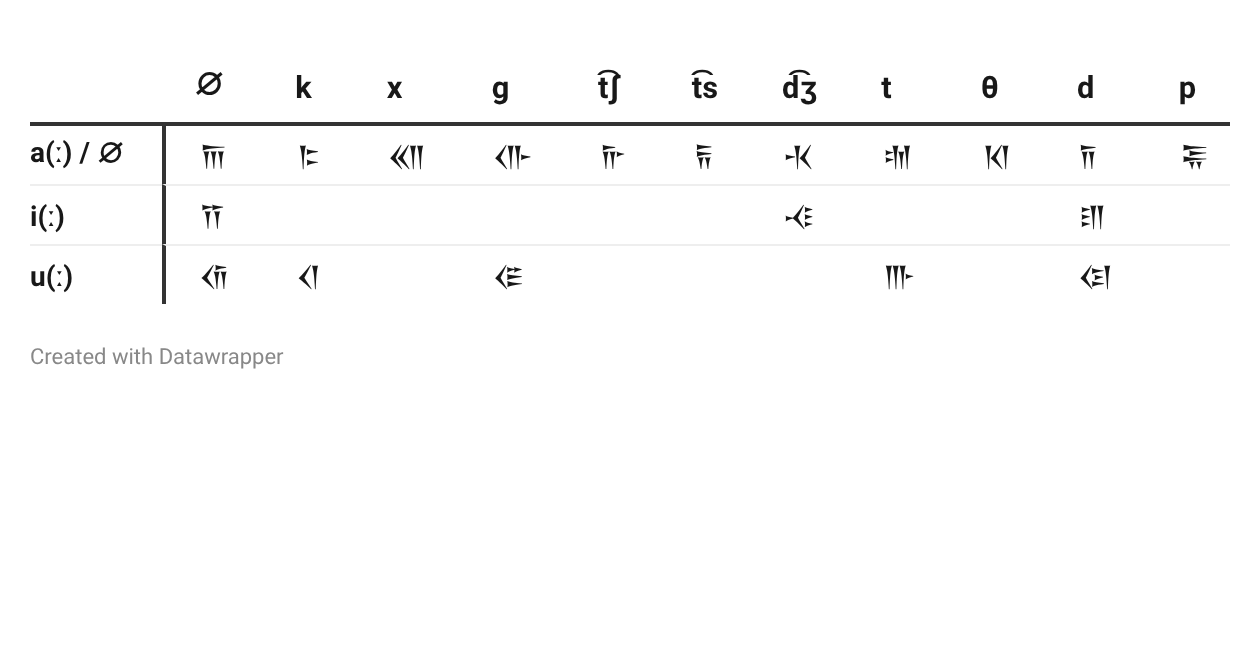
One especially neat feature of this example is that Darius goes out of his way to state that he wrote this inscription in the Aryan (i.e. Iranian) language. This was worth mentioning to him because all evidence suggests that Darius invented Old Persian cuneiform specifically for the Behistun Inscription! Even though cuneiform itself had been around for centuries, remember that Old Persian at the time was merely a regional language, not a dominant language of empire. If the government needed to write to its citizens, it typically did so in Aramaic. This is likely why the Old Persian script is unique among cuneiform scripts in how it works. It has only a small set of signs: 3 vowel signs, 33 syllable signs (which can also be used as standalone consonants), 8 ideograms/logograms, numerals, and a word separator 𐏐.
| ∅ | k | x | g | t͡ʃ | t͡s | d͡ʒ | t | θ | d | p | f | b | n | m | j | v | r | l | s | z | ʃ | h | |
|---|---|---|---|---|---|---|---|---|---|---|---|---|---|---|---|---|---|---|---|---|---|---|---|
| a(ː) / ∅ | 𐎠 | 𐎣 | 𐎧 | 𐎥 | 𐎨 | 𐏂 | 𐎩 | 𐎫 | 𐎰 | 𐎭 | 𐎱 | 𐎳 | 𐎲 | 𐎴 | 𐎶 | 𐎹 | 𐎺 | 𐎼 | 𐎾 | 𐎿 | 𐏀 | 𐏁 | 𐏃 |
| i(ː) | 𐎡 | 𐎪 | 𐎮 | 𐎷 | 𐎻 | ||||||||||||||||||
| u(ː) | 𐎢 | 𐎤 | 𐎦 | 𐎬 | 𐎯 | 𐎵 | 𐎸 | 𐎽 |
(Here’s a cleaner version of this table ⬇️)

Akkadian (Afroasiatic > Semitic) cuneiform, by contrast, had over 1,000 signs, some of them representing sounds, but many of them representing words or grammatical affixes. It thus seems likely that Darius adapted cuneiform to Old Persian, which up until that point didn’t have an established set of writing conventions. (Windfuhr 2009: 46–47).
Want to learn more about the invention of cuneiform and how languages can borrow writing systems from each other? Check out this issue of the newsletter:
 Daniel W. Hieber, Ph.D.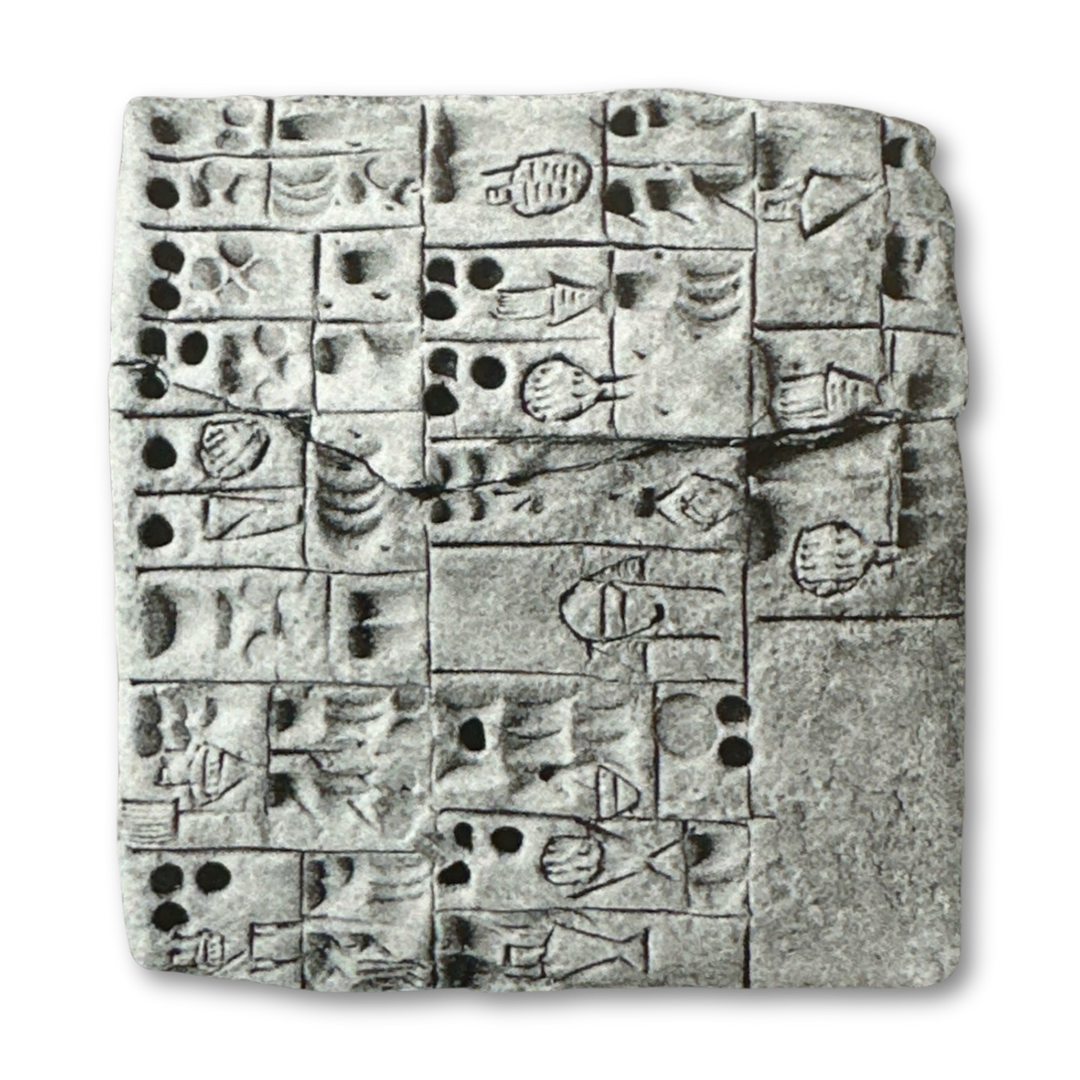
Aryan
You probably also noticed in the above example that the word ariyā is glossed as ‘Aryan’ rather than ‘Iranian’. That’s because Aryan is the Anglicized version of the word the early Iranians used to describe themselves, ariya. By the time of Middle Persian (c. 4th century BCE – 7th century CE), the pronunciation of the word had shifted to 𐭠𐭩𐭥𐭠𐭭 ʾērān ‘of the Iranians’ (consisting of the stem *ēr‑* ‘Iranian’ + the oblique plural suffix ‑ān ‘of, pertaining to’). In Classical Persian (c. 10th – 12th centuries) it became ایران Ērān ‘(land) of the Iranians’, and in Modern Persian it became ایران Īrān, which is where English gets the name of the country today, Iran. Thus, Iran and Aryan are etymologically related.
How then did the term Aryan come to be associated with the vile scientific racism of Nazi Germany? In the mid-1850s, linguists believed that Sanskrit was the oldest Indo-European language. And because Sanskrit, like Old Persian, also had a version of the word Aryan (आर्य ā́rya), linguists at the time quite reasonably surmised that the original Indo-Europeans probably referred to themselves with the self-designation Aryan. So it became common to refer to the original Indo-Europeans as the “Aryans”. German philologist Max Müller (1823–1900) even formally proposed that the term Aryan be used as the scientific name for the common ancestor of Latin, Sanskrit, Greek, Germanic, and Celtic—what we today call Proto-Indo-European. It was around the same time that French diplomat and writer Arthur de Gobineau alleged that the “Aryan race” (i.e. the Indo-Europeans) were a superior kind of human, laying the foundation for the Nazi racial theories of the 1920s.
Today we know that Sanskrit is not in fact the oldest Indo-European language. Moreover, there’s no strong evidence that Proto-Indo-European even had a word corresponding to Proto-Indo-Iranian *Áryas. That word can only be reconstructed as far back as the Indo-Iranian branch. And while the branch of Indo-European containing the languages of India is still called Indo-Aryan (because those people did in fact refer to themselves using a form of the word Aryan, as we have seen), sometimes it is simply called Indic. Overall, the term Aryan has understandably fallen out of general use in academia due to its strong association with the Nazi party.
What should you call Iran?
In keeping with a tradition extending back to the Ancient Greeks and their wars with the Achaemenid Empire, the West has long referred to the country of Iran using some form of the word Persia. That all changed in 1935 when Reza Shah Pahlavi officially requested that other countries begin using the endonym Iran to refer to the country. Western countries did so obligingly, reserving the use of the word Persia for historical contexts. But this decision was reversed in 1959 by the last Iranian Shah, Mohammed Reza Pahlavi. However, the decision stated that it was appropriate to use either Persia or Iran, so most of the world simply continued to refer to the country as they had been doing for the previous quarter century—Iran—and that’s where the situation still stands today. The modern country is typically called Iran, but in historical contexts you’ll often see it referred to as Persia. I hope, however, that this article has given you some historical and linguistic context for precisely why both names exist and how they are used today. If I succeeded in that goal, do consider sharing this article with others so that they can learn too! Just click the share button at the top of this page. Thanks for reading!
📚 Recommended Reading
📑 References
- Palmér, Axel I. 2025. The archaeology and genetics of Indo-Iranian prehistory. In Indo-slavic lexical isoglosses and the prehistoric dispersal of Indo-Iranian (Leiden Studies in Indo-European 26). Brill. https://brill.com/view/title/72253. (30 May, 2026).
- Schmitt, Rüdiger. 1991. The Bisitun Inscriptions of Darius the Great: Old Persian Text (Corpus Inscriptionum Iranicarum, Part I: Inscriptions of Ancient Iran, Vol. 1: The Old Persian Inscriptions: Texts I). Vol. 1. London: School of Oriental & African Studies.
- Spooner, Brian. 1994. Are we teaching Persian? Or Farsi? Or Dari? Or Tojiki? In Mehdi Marashi (ed.), Persian studies in North America: Studies in honor of Mohammad Ali Jazayery. Iran Books.
- Windfuhr, Gernot. 2009. Dialectology and topics. In Gernot Windfuhr (ed.), The Iranian languages (Routledge Language Family Series). Routledge.
If you’d like to support Linguistic Discovery, purchasing through these links is a great way to do so! I greatly appreciate your support!
Check out my Amazon storefront here.
Check out my Bookshop storefront here.