Baby talk in the languages of the world
How parents talk to their children around the globe

Across all languages, child-directed speech is simplified in both obvious and nonobvious ways—whether through overt simplification of words or covert avoidance of complex clauses—even when it sometimes appears that children are being presented with the full complexity of adult speech.
All cultures use baby talk, as we saw in the previous issue in this series, but not all baby talk is the same! In this issue, you’ll see what baby talk (or, more formally, child-directed speech) looks like in the languages of the world!
🔢 Articles in This Series
- Part 1: Why you should be talking to your infant
- Part 2: What’s the point of baby talk?
- Part 3: Is baby talk good for your child?
- Part 4: Do all cultures use baby talk?
- Part 5: Baby talk in the languages of the world [this post]
- Part 6: How much should you talk to your child?
- Part 7: What really matters when talking to your child [forthcoming]
A lot of people think that baby talk is something only done by American families, a myth we debunked in the previous issue in this series. But baby talk produced by American caregivers does seem to be unique in one respect: American English-speaking parents showed the most extreme changes to their prosody when compared to French, Italian, German, Japanese, and British English (Fernald et al. 1989: 1989). This probably explains why many people think baby talk is a uniquely American phenomenon—because American English speakers do it in an especially pronounced, attention-grabbing way (which is also probably grating to some people). Much of the idea that baby talk is a strange Americanism probably stems from this misperception.
Danish (Indo-European > Germanic) speakers have also been documented using exaggerated intonation in baby talk, but unlike American English, they don’t hyperarticulate the vowels (Cox et al. 2023). Other cultures don’t rely on exaggerated intonation at all. In Quiché Maya (Mayan), for example, baby talk does not use heightened pitch because high pitch is reserved for people of higher social status (Ratner & Pye 1984). The Mi’kmaq and East Cree languages (both in the Algonquian family) are also reported to not use special pitch modifications in child-directed speech (Chee & Henke 2023: 750). And in Cantonese (Sino-Tibetan) baby talk, it is not the intonation that is exaggerated but rather the tones (Xu Rattanasone, Burnham & Reilly 2013).
🌠 Aside: Tones vs. Intonation
That last statement merits some additional explication:
Both intonation and tone involve changes in pitch, but with different functions.
Intonation refers to the pitch contour of an entire utterance, and signals the emotional state or attitude of the speaker (e.g. excitement, sarcasm) or the function of the utterance (e.g. question vs. statement).
Tone refers to the pitch contours of individual words; for example, the first syllable of the word might be pronounced with a High pitch/tone, and the second syllable with a Low pitch/tone. In tonal languages, changing the pitch contour of a word (say, from High-Low to Low-High) changes the meaning of that word. Here are some examples from a Bantu language called Fuliiru (Atlantic–Congo > Bantu; Van Otterloo 2011: 128), where an acute accent (◌́) indicates a High tone, and no accent indicates a Low tone.
Minimal Tone Pairs in Fuliiru (Atlantic–Congo > Bantu)
| Kifuliiru | English | vs. | Kifuliiru | English |
|---|---|---|---|---|
| íkyóóba | mushroom | íkyooba | fear | |
| ínyuungu | squash seed | ínyúungu | cooking pot | |
| ííndá | pregnancy | íinda | louse | |
| úúbúlá | intestine | úúbúla | length | |
| úkúyálíka | to cloister | úkúyalíka | to heat water for ugali [corn meal dish] |
You can see how the meaning of a word changes based on its tone pattern. Intonation, however, changes the meaning of entire utterances, not individual words. The word house still means house regardless of whether you say it as a statement (falling intonation) or a question (rising intonation).
In tonal languages, tone and intonation interact, so that the tones on a word will be pronounced relatively higher or lower depending on the intonation of the overall utterance.
Returning to Cantonese baby talk: When I say that, “In Cantonese baby talk, it is not the intonation that is exaggerated but rather the tones”, this means that Cantonese parents are exaggerating the pitch contours of individual syllables, but not of the overall utterance.
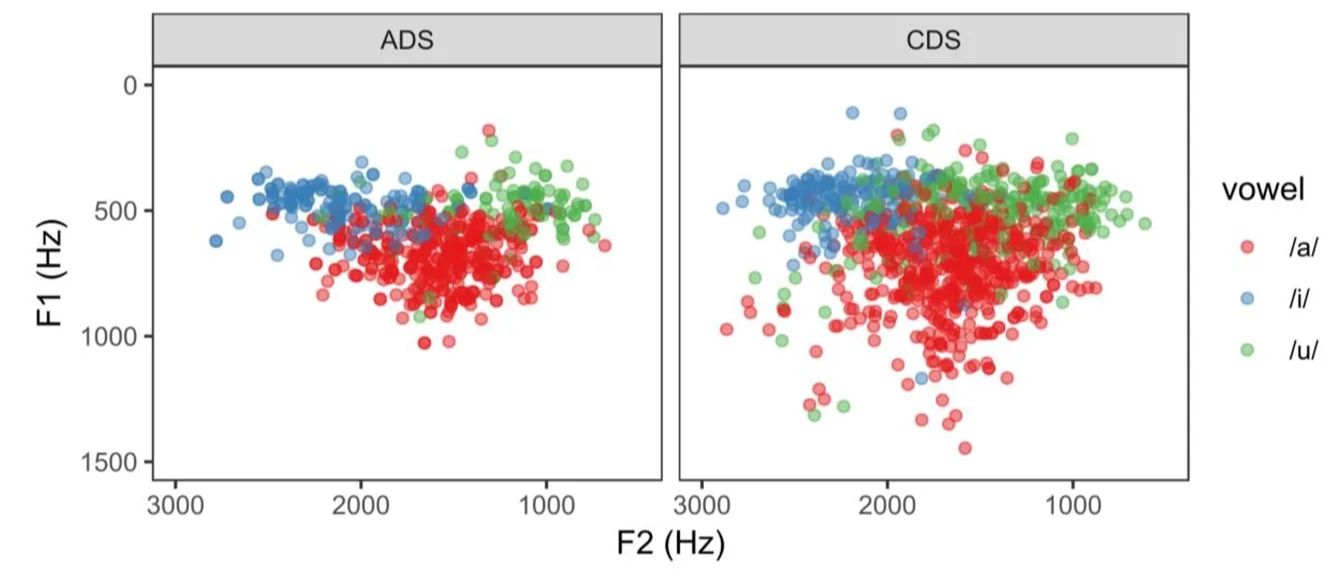
In the Australian Aboriginal language Warlpiri (Pama–Nyungan), speakers change the pronunciation of vowels (their quality, in technical terms) during baby talk to match the vowels that children themselves are saying (Bundgaard-Nielsen et al. 2023). Some vowels are pronounced further forward in the mouth, while others are pronounced lower in the mouth.
In Japanese baby talk there is no vowel exaggeration, but speakers do emphasize the rhythm of Japanese (Tajima et al. 2013), in which each mora (individual unit of timing) has approximately the same length.
Compare Japanese with languages like French, Italian, and Spanish, which give approximately the same amount of time for each syllable, or languages like English, which gives approximately the same amount of time between stressed syllables. These are called mora-timed, syllable-timed, and stress-timed languages respectively.
In addition to changes in prosody and intonation, many languages adjust the pronunciation of individual words in child-directed speech as well. Baby talk in the Cocopah language (Yuman-Cochimí) spoken in Arizona and Mexico has a complex set of conventions where consonants at the beginnings of syllables are replaced in different ways depending on the place and manner of articulation of the consonant in the adult form, and where the stress is. Here are some examples (Crawford 1970: 10):
| Adult-Directed Speech | Child-Directed Speech | English |
|---|---|---|
| xuˈčaq | xunˈvak | she’s bad |
| kaˈyus | kanˈvus | she somehow |
| xuˈčalm | xunˈvalm | when she’s pitiful |
| nʸmˈkur | nmnˈvul | her head |
| xaˈsanʸ | vaˈniː ~ ˈvanˈvan | girl before puberty |
| nʸiːˈyu | ninˈvu | her eyes |
| nʸiːˈya | ninˈva | her mouth |
| ṣuˈʔul | sunˈvul | she washes |
| nʸiːˈšaːɬʸ | ninˈvaːɬ | her hand |
| ˈrapm | inˈlapm | when it hurts (her) |
| nʸiːˈway | ninˈvay | her heart |
| awˈʂay | awnˈvay | she laughs |
| lʸuˈčaš | lunˈvas | she’s little |
| xaˈsanʸ kiˈyiːk | ˈvanˈvan kinˈviːk | little girl, come here |
| kʷaˈnʸuk | kanˈvuk | baby |
| luˈʔuy puˈwač | lunˈvay punvaʈ | she sits here and plays |
| uˈmič waːˈyaːč | unˈviṭ anˈyaːʈ | she cries continually |
| mišˈkʷiɬ ˈnʸaːm | kinˈviɬ naːm | you are very noisy |
| awˈnʸur uˈsaːw | awnˈvul unˈvaːw | she goes to school |
| nʸaˈwiː awˈnʸur puːˈwač | nanˈviː awnˈvul punˈvaʈ | the pencil is here |
| nʸaˈwiː uːˈnʸur puːˈwač | nanˈviː unˈvul panˈvaʈ | the cover is here |
| nʸaˈwiː uˈʂič puːˈwaya | nanˈviː unˈviʈ punˈvay(a) | she’s drinking again |
| nʸaˈwiː ˈʂič puˈwaya | nanˈviː inˈviʈ punˈvay(a) | I’m drinking again |
| nʸaˈwiː miˈʂič pmˈwaya | nanˈviː minˈviʈ pmnˈvaya | you’re drinking again |
| maˈpuč mišuˈšiːl | manˈpuṭ misunˈviːl | you don’t know |
| mišuˈray waːˈyaw ˈnʸaːm | sunˈvay anvˈyaw ˈnaːm | she’s very angry |
| aˈʂuː ˈikm | anˈvuː ˈvikm | a little later |
| kiˈyiː kxmˈnʸaw ˈkxir | ˈviː ˈnaw ˈvil | come tie my shoe |
| ˈšuki kiˈyiː nʸaˈwiː ˈknʸaːpm kiːˈʔiːp | ˈšuki ˈviː ˈviː ˈnaːp ˈviːp | Janice, come here, I want to tell you something |
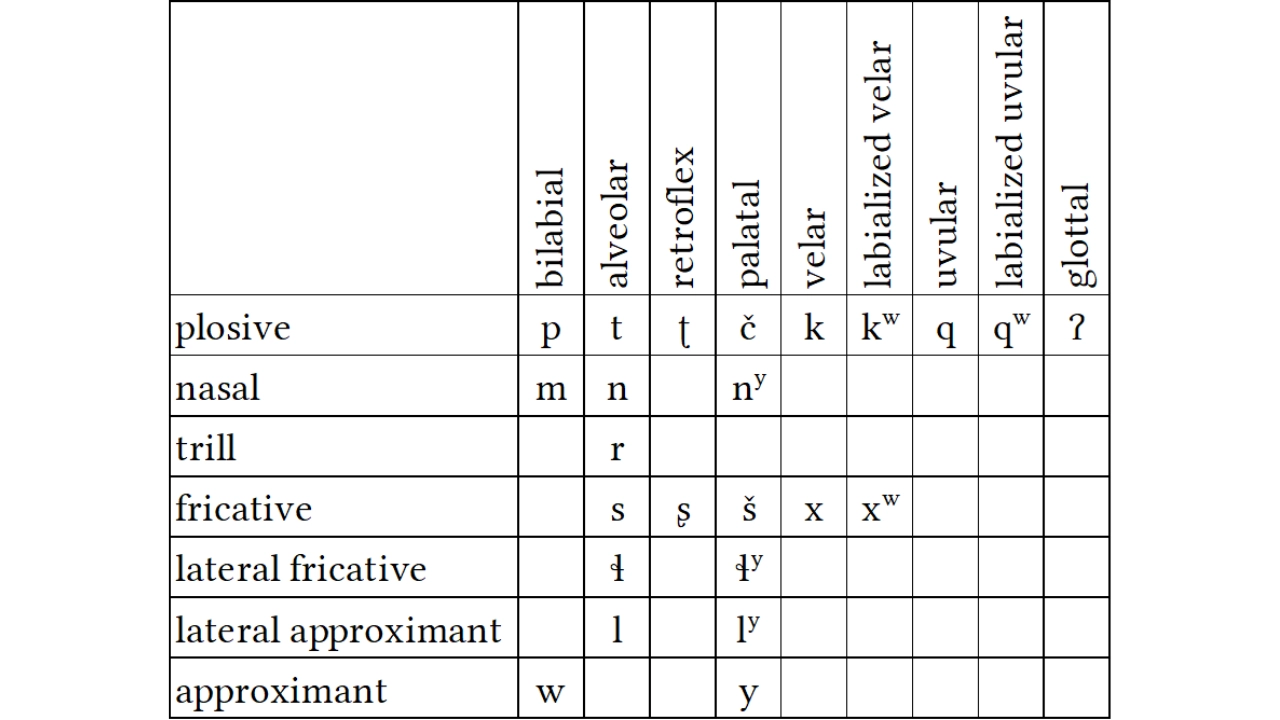
In fact, the entire consonant inventory of the language is simplified, so that only a subset of the language’s sounds appear in child-directed speech. This is what the consonant inventory of adult-directed speech looks like (Crawford 1970: 11):
And this is what the consonant inventory of child-directed speech looks like (Crawford 1970: 11):
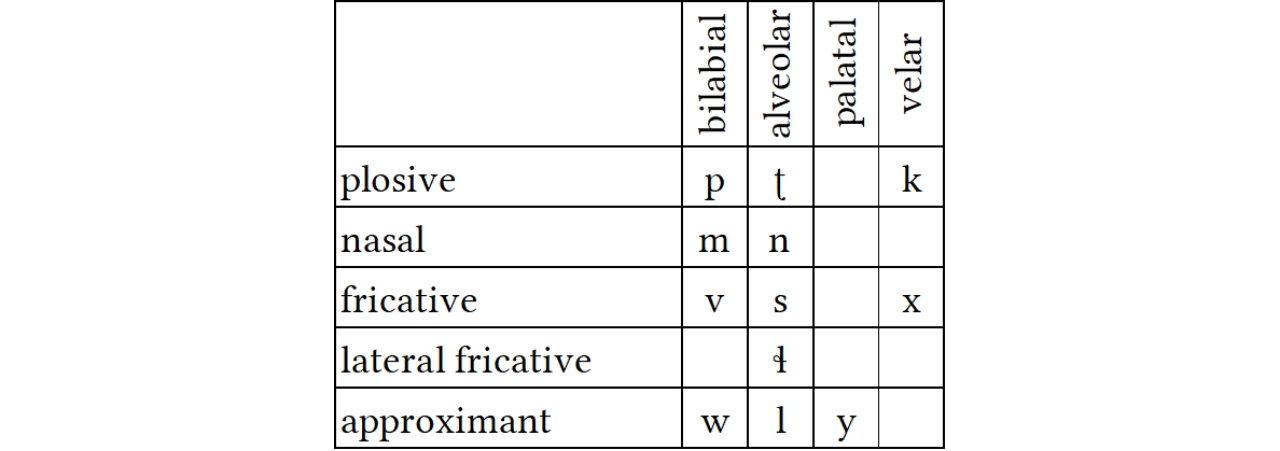
You can see that there are far fewer consonants used in child-directed speech than adult-directed speech.
Similarly, the specialized child-directed vocabulary in Nuuchahnulth (Wakashan) has a reduced consonant inventory compared to adult-directed speech. Here is the inventory for adult-directed speech:
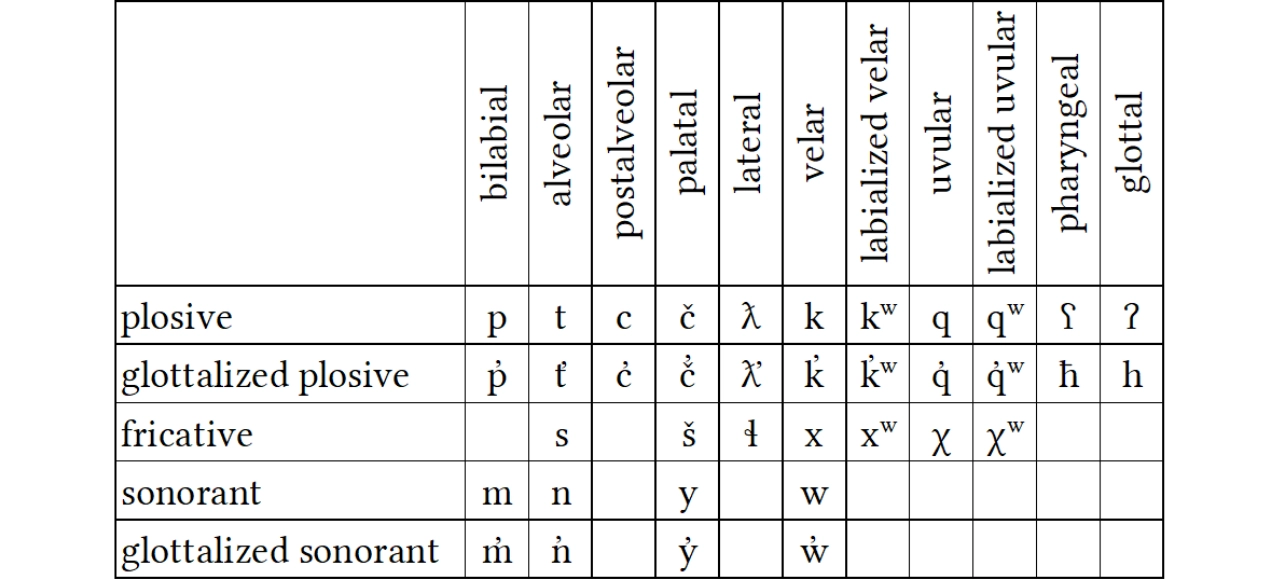
And here is the inventory for child-directed speech:
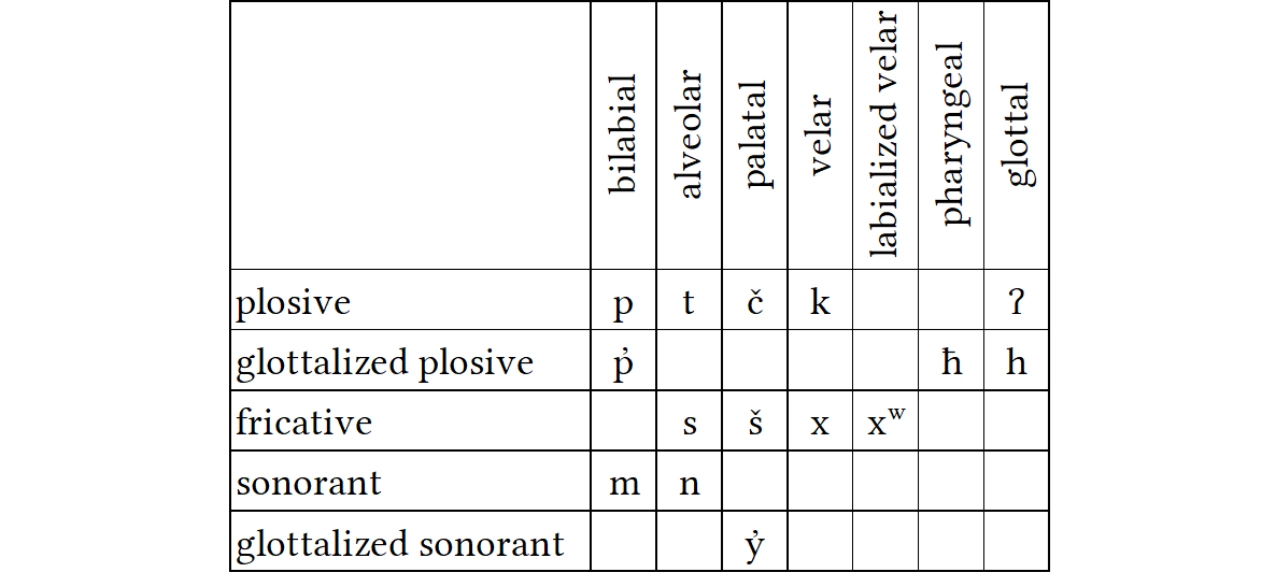
Reduplication (repetition of sounds, syllables, or entire words) is also a common feature of child-directed speech across languages, such as nana for banana or num‑num for food). Here are examples of reduplication in child-directed speech (CDS) in Inuktitut (Inuit–Yupik–Unangan), compared with their counterparts in adult-directed speech (ADS) (Crago & Allen 1997: 96–97):
| ADS Form | CDS Form | Translation |
|---|---|---|
| ipiq | aaqqaaq | ‘dirt’ |
| niqi | apaapa | ‘food’ |
| qimmiq | lulu | ‘dog’ |
| umajuq | uquuqu | ‘animal’ |
| nunakkuujuuq | vuvu | ‘vehicle’ |
What about grammatical differences? Does child-directed speech work differently in languages with elaborate morphology (like polysynthetic languages), which have vastly different grammatical structures than English? Just as an example, here’s a word from the polysynthetic language Yupik (Inuit–Yupik–Unangan):
If any of the abbreviations or notations in this article are unfamiliar to you, check out the “How to read linguistics” page.
-
Yupik (Inuit–Yupik–Unangan)
tuntussuqatarniksaitengqiggtuq
- tuntu‑ssur‑qatar‑ni‑ksaite‑ngqiggte‑uqreindeer‑hunt‑fut‑say‑neg‑again‑3sg.ind
‘He had not yet said again that he was going to hunt reindeer.’
Do parents perhaps simplify complex grammatical structures like these for their children in the first year or two? After all, children themselves tend to strip words of their inflection when speaking in the polysynthetic languages Severn Ojibwe (a.k.a. Oji-Cree; Algonquian), Inuktitut (Inuit–Yupik–Unangan), and Navajo (Na-Dené) (Chee & Henke 2023: 756), so it would make sense that parents did so too, as another method of accommodating their speech to match the stage of language development of their child.
This isn’t an easy question to answer, precisely because very little research on first language acquisition has been conducted with non–Indo-European languages (Chee & Henke 2023: 742–743). Nonetheless, there is some evidence to suggest that, while caregivers don’t strip otherwise-obligatory affixes from words, they do choose to use simpler (but still grammatical) words. Severn Ojibwe, for example, is about as morphologically complex as it gets, yet child-directed speech in the language tends to use repetition and short constructions, as this example shows:
Ohowe kiniin na.
‘Look at this!’
Awanen aha.
‘Who’s that, eh?’
Awanen aha.
‘Who is that?’
Aacic?
‘Baby?’
You would never know from this example that Severn Ojibwe is a highly morphologically complex language.
 Daniel W. Hieber, Ph.D.
🌠 Aside: Ergative-absolutive marking in child-directed speech
Here’s an especially fascinating aspect of child-directed speech in Inuktitut (Inuit–Yupik–Unangan) which unfortunately requires some robust background in linguistic typology to understand. So if this aside is too technical, just skip it.
Inuktitut doesn’t indicate subjects vs. objects in quite the same way English does. Instead it has something called ergative-absolutive marking: if a clause has two participants (i.e. the verb is transitive), the agent—the doer of the action—gets marked in a special way. This helps listeners determine who is doing what to whom in the clause. That marker of the agent of a transitive clause is called the ergative. If the clause only has one participant (i.e. the verb is intransitive), no special marking is needed, or the participant gets the “default” marking. That non-marking or “default” marking is called the absolutive.
Here’s the cool bit for baby talk: When Inuktitut caregivers use child-directed speech, they almost exclusively use the absolutive (Allen & Crago 1996; Allen 2013: 89). This means that they only use intransitive clauses when talking to children! Since adults nevertheless need to talk about events with two participants, accomplishing this involves a bit of syntactic gymnastics. Adults will use passive verbs or other constructions called antipassives and noun incorporation to express roughly the same event using an intransitive verb. As a result of this, children themselves begin using intransitive clauses before transitive ones, and use intransitives significantly more frequently than transitives overall (Chee & Henke 2023: 757). This same intransitive bias in child speech has also been documented in Navajo, East Cree, and Mohawk; in Navajo, fully 77% of verbs in child speech were intransitive (Chee & Henke 2023: 757).
This is such a fantastic example of how caregivers accommodate their child’s language learning in subtle and subconscious ways. No Inuktitut adult is explicitly thinking, “ergatives are hard, I should only use the absolutive for now”, yet they unwittingly provide an easier entry point into the complexities of Inuktitut grammar by doing so.
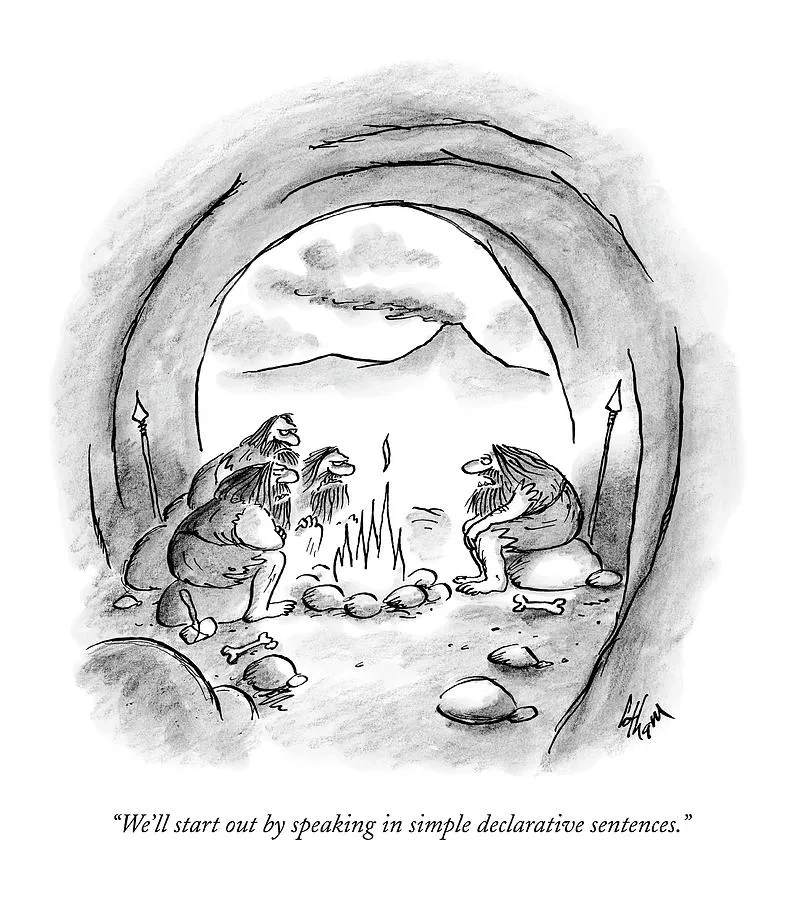
Despite the complexity of Native American languages, child-directed speech in these languages isn’t always simplified. Children are often presented with extensively inflected words just like in adult-directed speech. For instance, nouns in East Cree require multiple affixes, and these appear even in child-directed speech, as this example shows:
-
East Cree (Algonquian)
Mâuhî mîn chispituniniuh.
- mâu‑hîdem‑inan.pl
- mînagain
- chi‑spitun‑iniu‑h2‑arm‑1pl.incl‑inan.pl
‘And here are our arms.’
(Henke 2020: 225)
In Inuktitut, even “baby words” (vocabulary specific to child-directed speech) can still have the full range of complex inflection! Here are examples of the baby words aataaq‑ ‘get hurt’ and aaqqaaq‑ ‘dirt’ in use in child‑directed speech in Inuktitut:
-
Inuktitut (Inuit–Yupik—Unangan)
Aataartaulangasijualunga.
- aataaq‑jaulu‑runa‑si‑juq‑aluk‑unahurt‑pass‑fut‑pres‑ptcp.3sg.subj‑emph‑this.one
‘That guy is going to get hurt.’
(Crago, Allen, & Pesco 1998: 40)
-
Inuktitut (Inuit–Yupik–Unangan)
Iihiiruluk aaqqaaraaluturumasuuraaluummat.
- iihiiq‑gulukyucky‑bad.little
- aaqqaaq‑aluk‑tuq‑guma‑suuq‑aluk‑u‑mmatdirt‑emph‑consume‑want‑hab‑emph‑be‑sub.3sg.subj
‘Because the little bugs bit the dirty ones.’
(Crago, Allen, & Pesco 1998: 40)
The result is a somewhat ironic contrast between the “baby word”, which parents presumably use because they find it easier for the child to process, and the full complexity of Inuktitut grammar, which is notably less easy to process!
Lastly, one feature of child-directed speech that has been noted in Native American languages is how fluidly a word can be used as either a noun, verb, or adjective. The Acoma Keres (isolate) word ʔák’aʔák’a can mean ‘drink’, ‘you drink!’, ‘did you drink?’, ‘I want a drink’, ‘I had a drink’, and more (Miller 1965: 112). The Inuktitut root aahaaq‑ can mean ‘to hurt’, ‘thing that causes hurt’, ‘thing that hurts’, and ‘ouch’ (Crago & Allen 1997: 93). This is especially interesting because many Native American languages are known for blurring the distinctions between parts of speech entirely! (Incidentally, this flexibility in parts of speech was actually the focus of my dissertation; Hieber 2021.) So it would seem that this tendency starts early with children. I suspect, however, that Native American languages have been overly-exoticized in this regard, and that if scholars looked at child-directed speech in English they’d find this same flexibility. (Again, this was actually one of the findings from my dissertation: English displays a great deal of part-of-speech flexibility too; this isn’t a phenomenon limited to non–Indo-European languages.)
In sum, then, baby talk can look dramatically different in the world’s languages. Some languages rely heavily on prosodic changes like exaggerated intonation, others on phonological changes like swapping out consonant sounds, and others on entirely distinct sets of “baby words”. Across all languages, child-directed speech is simplified in both obvious and nonobvious ways—whether through overt simplification of words or covert avoidance of complex clauses—even when it sometimes appears that children are being presented with the full complexity of adult speech. Caregivers the world over do a great deal of work—consciously or subconsciously—to accommodate their children’s language-learning process.
In the next issue of this series on the science of baby talk, we’ll look at one of the most controversial claims in child language acquisition research: the Word Gap, which claims that poor households hear up to 30 million fewer words by age 4 than more affluent households. In that issue, we’ll look at how much you really need to be talking to your child.
Be sure to sign up below to get notified when the next issue posts!
🔢 Articles in This Series
- Part 1: Why you should be talking to your infant
- Part 2: What’s the point of baby talk?
- Part 3: Is baby talk good for your child?
- Part 4: Do all cultures use baby talk?
- Part 5: Baby talk in the languages of the world [this post]
- Part 6: How much should you talk to your child?
- Part 7: What really matters when talking to your child [forthcoming]
📚 Recommended Reading
📑 References
- Allen, Shanley E. M. & Martha B. Crago. 1996. Early passive acquisition in Inuktitut. Journal of Child Language 23(1). 129–155. https://doi.org/10.1017/S0305000900010126.
- Allen, Shanley E.M. 2013. The acquisition of ergativity in Inuktitut. In Edith L. Bavin & Sabine Stoll (eds.), Trends in Language Acquisition Research, vol. 9, 71–106. Amsterdam: John Benjamins Publishing Company. https://doi.org/10.1075/tilar.9.04all.
- Bundgaard-Nielsen, Rikke L., Carmel O’Shannessy, Yizhou Wang, Alice Nelson, Jessie Bartlett & Vanessa Davis. 2023. Two-part vowel modifications in Child Directed Speech in Warlpiri may enhance child attention to speech and scaffold noun acquisition. Phonetica 80(1–2). 1–42. https://doi.org/10.1515/phon-2022-0039.
- Chee, Melvatha R. & Ryan E. Henke. 2023. Child and child-directed speech in North American languages. In Carmen Dagostino, Marianne Mithun & Keren Rice (eds.), The Languages and Linguistics of Indigenous North America (World of Linguistics 13.2), vol. 2, 741–766. De Gruyter. https://doi.org/10.1515/9783110712742-033.
- Cox, Christopher, Christina Dideriksen, Tamar Keren‐Portnoy, Andreas Roepstorff, Morten H. Christiansen & Riccardo Fusaroli. 2023. Infant‐directed speech does not always involve exaggerated vowel distinctions: Evidence from Danish. Child Development 94(6). 1672–1696. https://doi.org/10.1111/cdev.13950.
- Crago, Martha B. & Shanley E.M. Allen. 1997. Linguistic and cultural aspects of simplicity and complexity in Inuktitut child directed speech. In E. Hughes, M. Hughes & A. Greenhill (eds.), Proceedings of the 21st Annual Boston University Conference on Language Development, 91–102. Cascadilla Press.
- Crago, Martha B, Shanley EM Allen & Diane Pesco. 1998. Issues of complexity in Inuktitut and English child directed speech. In 29th Annual Stanford Child Language Research Forum, 37–46.
- Crawford, James M. 1970. Cocopa baby talk. International Journal of American Linguistics 36(1). 9–13. https://doi.org/10.1086/465083.
- Fernald, Anne, Traute Taeschner, Judy Dunn, Mechthild Papousek, Bénédicte De Boysson-Bardies & Ikuko Fukui. 1989. A cross-language study of prosodic modifications in mothers’ and fathers’ speech to preverbal infants. Journal of Child Language 16(3). 477–501. https://doi.org/10.1017/S0305000900010679.
- Henke, Ryan E. 2020. The first language acquisition of nominal inflection in Northern East Cree: Possessives and nouns. University of Hawaii at Manoa Ph.D. thesis.
- Hieber, Daniel W. 2021. Lexical polyfunctionality in discourse: A quantitative corpus-based approach. Santa Barbara, CA: University of California, Santa Barbara Ph.D. thesis. https://doi.org/10.13140/RG.2.2.11932.00640.
- Kess, Joseph Francis & Anita Copeland Kess. 1986. On Nootka baby talk. International Journal of American Linguistics 52(3). 201–211. https://doi.org/10.1086/466018.
- Miller, Wick R. 1965. Acoma grammar and texts (University of California Publications in Linguistics 40). University of California Press.
- Ratner, Nan Bernstein & Clifton Pye. 1984. Higher pitch in BT is not universal: Acoustic evidence from Quiche Mayan. Journal of Child Language 11(3). 515–522. https://doi.org/10.1017/S0305000900005924.
- Tajima, Keiichi, Kuniyoshi Tanaka, Andrew Martin & Reiko Mazuka. 2013. Is the mora rhythm of Japanese more strongly observed in infant-directed speech than in adult-directed speech? In PRoceedings of Meetings on Acoustics, vol. 19. Montreal, Canada. https://doi.org/10.1121/1.4800508.
- Van Otterloo, Karen. 2011. The Kifuliiru language, Vol. 1: Phonology, tone, and morphological derivation (Publications in Linguistics 146). SIL International.
- Xu Rattanasone, Nan, Denis Burnham & Ronan G. Reilly. 2013. Tone and vowel enhancement in Cantonese infant-directed speech at 3, 6, 9, and 12 months of age. Journal of Phonetics 41(5). 332–343. https://doi.org/10.1016/j.wocn.2013.06.001.
If you’d like to support Linguistic Discovery, purchasing through these links is a great way to do so! I greatly appreciate your support!
Check out my Amazon storefront here.
Check out my Bookshop storefront here.